
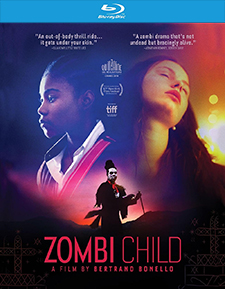
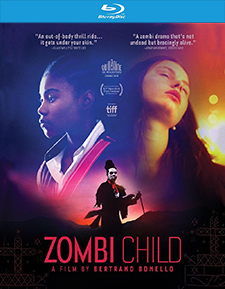
Zombi Child (Blu-ray Review)
- Review Date: Aug 12, 2025
- Format: Blu-ray Disc
-


Director
Bertrand BonelloRelease Date(s)
2019 (December 6, 2024)Studio(s)
My New Pictures/Les Films du Bal/Ad Vitam (Film Movement/Vinegar Syndrome)- Film/Program Grade: C+
- Video Grade: B+
- Audio Grade: A
- Extras Grade: B

Review
Ever since George A. Romero changed the concept of the zombie for all time with Night of the Living Dead, the creatures have been portrayed as slow-moving, living-dead cannibals in scores of subsequent movies and TV shows. Zombi Child, in contrast, returns to the roots of zombie lore and relates it to contemporary times.
A prologue set in Haiti in 1962 shows men being fed a special powder that renders them “dead,” then reanimated to work as slaves in the sugarcane fields. The formula for creating a zombie is illustrated. Puffer fish liver, which contains the poison tetrodotoxin, is mixed with a secret blend of ingredients and administered by a voodoo priest known as a bokor to produce an unconscious state that resembles death. Afterwards, a hallucinogenic substance called “zombie powder” is fed to the victims to put them in a suggestible catatonic state known as zombiism.
From 1960s Haiti, the setting shifts to the present day at an exclusive girls’ school in Paris. A Haitian girl, Melissa (Wislanda Louimat), was admitted into the school following her mother’s death in the 2010 earthquake in Haiti. Melissa is the only black girl at school. Fellow student Fanny (Louise Labecque) befriends Melissa. Both girls share an affection for Stephen King’s books.
To Fanny, Melissa confides the story of her uncle Clairvius (Mackenson Bijou), who died in Haiti in 1962 and was reanimated as a zombie. Melissa displays a combination of discomfort and respect regarding her family history, but Fanny is eager to explore zombie culture.
At this point, the film alternates between scenes detailing the zombification of Clairvius half a century ago and contemporary sequences at the Parisian school. Fanny invites Melissa to apply to her privileged group’s “literary society,” a late-night pretext for drinking, sharing secrets, and holding makeshift rituals by candlelight. To enter this club, Melissa must share something personal and crucial.
Director Bertrand Bonello combines drama, documentary, and horror in an unsettling film showing frightening rituals that include wild gyrations, bizarre guttural sounds, and creepy make-up. The tropes of the typical cinematic zombie are nowhere to be seen. Instead, we get a look at the roots of zombiism in Haitian culture and its impact through generations. More than legend, it’s a belief that has been carried into modern times.
The scenes set at the prestigious school show classes being conducted by professors, the girls attentive in their crisp school uniforms. As the camera pans across the class, it becomes clear that Melissa is the only person of color in the group. Her outsider status is further compounded by her association with the semi-secretive world of zombies.
Back in 1943, Val Lewton provided an almost poetically atmospheric look at zombie culture in I Walked With a Zombie. It, too, focused on Haiti and the traditional concept of the zombie, building suspense from an increasing feeling of unease. Zombi Child never achieves that level of intensity and often gets bogged down in lengthy scenes that slow the pace. With such a fascinating subject, however, the film keeps us involved, doling out information as the story unfolds. At times, it almost seems like part of a college course on zombie culture. Those expecting blood, gore, and grotesque-looking monsters chomping on fellow humans won’t find that here.
Zombi Child was captured digitally by director of photography Yves Cape with RED Monster cameras and Leitz SUMMILUX-C lenses and presented in the widescreen aspect ratio of 1.85:1. Picture quality of the Blu-ray is improved over the DVD version released in 2020, though it varies. Scenes in the French school are bright and beautifully detailed. Those involving zombie rituals are darker and deeply shadowed, likely to create an uneasy air of mystery. Often, however, the picture is so dark that only outlines of the characters and incidental details can be seen. Complexions are well rendered, particularly those of the French schoolgirls. During the final part of the film, featuring ceremonies, the color palette broadens with reds and muted primary hues dominating. Scenes in the sugarcane fields are lit by natural sunlight filtering through the tall plants.
There are two soundtrack options, French 2.0 Stereo and French 5.1 Surround Stereo. English subtitles appear at the bottom of the screen. There’s a lot of dialogue and it’s mostly clear and distinct. Guttural sounds emanating from one of the schoolgirls provides a creepy vibe. During the zombie ceremonies, seemingly uncontrollable shouts and cries emanate from the gyrating bokor. The school chorus sings a Christmas carol, and the song You’ll Never Walk Alone is heard at points during the film and over the closing credits. The score is composed of electronic music written by the director, Bertrand Bonello, and some contemporary songs.
Bonus materials on the unrated, Region-Free Blu-ray release from Film Movement include the following:
- Audio Commentary by Bertrand Bonello
- Child of the Sky Short Film (15:50)
- Trailer (1:49)
- Coma Trailer (1:34)
Commentary – Director Bertrand Bonello wanted to make the film differently from his previous films. The Haitian scenes were shot in Haiti. Many on the production team advised the director to look for other locations, but he wanted authenticity that could be achieved only with genuine Haitian locations. The script is based on a true story. Bonello explains the properties of “zombie powder” and its effects. He read books about Haiti and discovered that voodoo and zombies are inherent in the culture. A person is declared dead and is buried. During the night, the person is dug up and enslaved. The zombie is given powder each day that keeps him in a state between life and death. Bonello shot day-for-night to create a palpable atmosphere. As a white Frenchman, he was concerned about being accepted in Haiti, and had to convince locals that he didn’t intend to make the country look bad. Finding the perfect point of view was key. Bonello wanted to trace the zombie back to its origins, as explored by teenagers. A “hybrid” of several genres, Zombi Child is told in different time frames and different locations. Bonello used electronic sounds along with contemporary music for the soundtrack. He explains the significance of the lyrics to You’ll Never Walk Alone to the film’s theme. Production design drew upon elements that reflected Haitian history. An editing “equilibrium” had to be achieved, creating a challenge in post-production.
Child of the Sky – From choreographer Donna Thomsen and filmmaker Phillip Montgomery, this short film is the haunting, atmospheric story of a young woman who wakes up in a desert, lost, cold, and naked. A powerful force summons her to a strange woman who takes her in, offering her kindness and refuge. But sanctuary soon devolves into a weird ritual with others joining in and gyrating as a bizarre dance ensues.
Zombi Child undermines its subject matter with a sluggish pace and an unnecessary sub-plot of Fanny breaking up with her boyfriend that further slows the momentum of the main story. The performances are generally good, with some effective scenes of the zombies weakly wielding machetes as they labor in the sugarcane fields. Many key scenes are underlit, making it difficult to discern details. Director Bonello doesn’t seem to understand the importance of building suspense as a way to hold onto an audience. He lays the groundwork well enough but fails to make the story adequately compelling. Zombi Child offers a reserved look at a creature that popular entertainment has transformed into a blood-thirsty cannibal.
- Dennis Seuling