
Sneakers (4K UHD Review)
- Review Date: Sep 04, 2025
- Format: 4K Ultra HD
-


Director
Phil Alden RobinsonRelease Date(s)
1992 (April 22, 2025)Studio(s)
Universal Pictures (Kino Lorber Studio Classics)- Film/Program Grade: B+
- Video Grade: A-
- Audio Grade: B+
- Extras Grade: B+

Review
When Phil Alden Robinson’s Sneakers was released in 1992, it became a sleeper hit despite the fact that it was something of an anachronism: a comedy paranoia thriller starring two aging lead actors whose most popular work already lay behind them. While Robert Redford had become something of a poster child for paranoia thrillers during the Seventies thanks to his unforgettable roles in Three Days of the Condor and All the President’s Men, he hadn’t really done anything with the genre since then—and worse, he was fresh off the box office failure of Sidney Pollack’s expensive historical drama Havana. Sidney Poitier, on the other hand, had recently starred in two very different kinds of thrillers, neither of which managed to make much of a splash at the box office either: Shoot To Kill and Little Nikita. Neither Redford nor Poitier had the kind of marquee value that they once did, and paranoia thrillers weren’t exactly lighting up the box office at that point anyway.
Meanwhile, the presence of Phil Alden Robinson behind the camera may have also seemed somewhat anachronistic in 1992. As a writer, he had specialized in light comedies like Rhinestone and All of Me, and his overlooked directorial debut In the Mood was no different. Yet he had just found major success with Field of Dreams, which managed to blend his penchant for comedy with warmhearted nostalgic drama. Still, it was hardly a paranoia thriller. But Robinson had an ace up his sleeve: his friendship with writer/producers Lawrence Lasker and Walter Parkes, both of whom had written the screenplay for Wargames over a decade earlier. Their research for that film had inadvertently led them into the rarefied world of people who are hired to break into security systems in order to discover vulnerabilities (basically, early versions of white hat hackers). Together with Robinson, they spent the next ten years developing a script on the subject, until Robinson’s newfound box office cred from Field of Dreams helped to get the suits at Universal to back the project.
Sneakers is about a group of security experts who specialize in uncovering security vulnerabilities, led by Martin Bishop (Redford). His team includes Donald Crease (Poitier), a former CIA operative; “Whistler” Emery (David Strathairn), a blind telecommunications specialist; Carl Arbogast (River Phoenix), a young hacker; and “Mother” Roskow (Dan Aykroyd), a security technician and true believer in every single conspiracy theory known to man. Every one of them has hidden secrets in their pasts, but they’re all good at what they do, so they’re approached by NSA agents Dick Gordon (Timothy Busfield) and Buddy Wallace (Eddie Jones) to stage a real heist in order to recover a codebreaking black box from mathematician Dr. Gunter Janek (Donal Logue). Bishop wants nothing to do with the job, but the NSA knows all about his own secrets, so the team reluctantly agrees to help. Given the subject matter involved, Bishop ropes in his even more reluctant ex-girlfriend Liz Ogilvy (Mary McDonnell), and before they’re done, they’ll find out the secret behind what happened to Bishop and his former partner Cosmo (Ben Kingsley) back during the late Sixties.
It’s all classic paranoia thriller stuff, but the real twist this time is that the thriller elements in Sneakers are mostly played for laughs—the suspense is as lighthearted as the comedy. Finding the right balance when blending genres like this can be tricky, but that’s where Robinson had another ace up his sleeve: himself. He had already found the perfect blend between comedy and heartfelt drama in Field of Dreams, and for the most part, he succeeded in blending comedy and thrills in Sneakers. The only false note is the cringeworthy scene where Liz has to get Werner Brandes (Stephen Tobolowky) to say specific words so that they can beat a voiceprint identification system—McDonnell does her best, but it’s still a painfully unfunny experience. Still, it’s a minor misstep in a film that otherwise nails the perfect tone throughout.
That tone is aided by a whimsical score from the great musical thief James Horner, who channels both David Shire and Michael Small here (that is, when he’s not stealing from everyone else). If you want to evoke the classic paranoia thrillers of the Seventies, there’s no better composers to mimic. There are knowing elements like that all throughout Sneakers, with Robinson openly acknowledging that Redford is an artifact from another era by having him drive a battered old 1967 Volkswagen Karmann Ghia convertible. (He also coached Gary Hershberger to give an impressive performance in a flashback as the college-age Bishop, mimicking Redford’s classic speech cadences perfectly). Yet for all of the deliberately anachronistic elements and dated technology on display in the film, Robinson, Lasker, and Parkes were still prescient enough to see where the world was heading, and from that perspective, Sneakers remains as relevant as ever:
“There’s a war out there, old friend. A world war. And it’s not about who’s got the most bullets. It’s about who controls the information. What we see and hear, how we work, what we think... it’s all about the information!”
Cinematographer John Lindley shot Sneakers on 35mm film using Panavision cameras with spherical lenses, framed at 1.85:1 for its theatrical release. This new 4K master was provided by Universal, based on a 4K scan of the original camera negative, cleaned up and graded for High Dynamic Range in both Dolby Vision and HDR10. There are some faint background speckles during the opening credits, possibly an artifact from the original optical printing process, but everything after that looks as pristine as possible. Any opticals like that credit sequence were derived from dupe elements and do look softer than the surrounding material, but everything else is sharp, clear, and far more detailed than Universal’s old 1080p master (which suffered from excessive digital tinkering). Thanks to the HDR grading, there’s more detail in the contrast range as well, with deep blacks that don’t crush any picture information that should be visible. The warm color balance looks spot on as well, but it’s arguable that the biggest improvements here come from the contrast and black levels. There’s just the faintest whiff of a silvery bleach bypass look to the image, and while I wasn’t able to find any information about what processes that Lindley may have originally used back in 1992, it’s an appealing look that really makes Sneakers sing in 4K.
Audio is offered in English 2.0 and 5.1 DTS-HD Master Audio, with optional English subtitles. Sneakers was released theatrically in Dolby Stereo, and the 5.1 track sounds like a straightforward discrete presentation of the original four matrix-encoded channels. Practically speaking, there’s little difference between the two since it’s a front-focused mix regardless of format and the surrounds are limited to light ambience with little directionality. Either way, the dialogue and the music are the primary focus, and regardless of who James Horner may have stolen from this time, his wry score still supports the tone of the film perfectly.
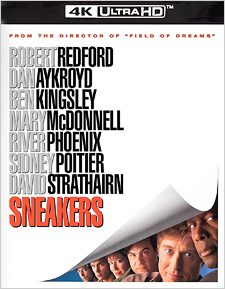
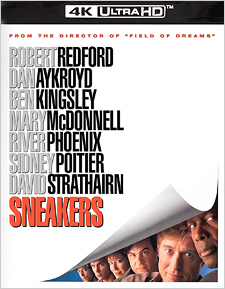
The Kino Lorber 4K Ultra HD release of Sneakers is a two-disc set that includes a Blu-ray with a 1080p copy of the film. There’s also a slipcover that duplicates the theatrical poster artwork on the insert. The following extras are included:
DISC ONE: UHD
- Audio Commentary by Phil Alden Robinson with Lawrence Lasker and Walter F. Parkes
- Audio Commentary by Phil Alden Robinson and John Lindley
DISC TWO: BD
- Audio Commentary by Phil Alden Robinson with Lawrence Lasker and Walter F. Parkes
- Audio Commentary by Phil Alden Robinson and John Lindley
- The Making of Sneakers (SD – 40:04)
- Trailer (HD – 2:54)
- 3 Days of the Condor Trailer (HD – 3:05)
- Havana Trailer (SD – 3:06)
- Indecent Proposal Trailer (HD – 2:15)
- The Last Castle Trailer (SD – 2:24)
The commentary with Robinson, Lasker, and Parkes was originally recorded for Universal’s 2003 Collector’s Edition DVD release of Sneakers, but it was replaced by the one with Robinson and Lindley for their 2007 HD-DVD version. Continuing the saga of right hand vs. left hand, Universal’s initial 2013 Blu-ray was bare-bones, while their 2015 version restored the commentary with Robinson and Lindley but continued to omit the original 2003 track. Fortunately, Kino Lorber has righted the ship by including both. In the broadest strokes, the director/writer commentary focuses naturally on story elements and the development of the script, while the director/cinematographer commentary leans toward technical information. In practice, however, both of them offer a little of each. On the whole, the original track is preferable since it’s more balanced and less prone to stretches of silence, but they both have something to offer.
The Making of Sneakers was originally produced for the 2003 DVD, and it’s an old-school making-of documentary of the type that are rarely included on major studio releases anymore (and precious few boutique releases, for that matter). Produced, written, and directed by J.M Kenny, it features interviews with Robinson, Lasker, Parkes, Robert Redford, Mary McDonnell, David Strathairn, River Phoenix, Dan Aykroyd, Sydney Poitier, and Ben Kingsley. It also includes interviews with two of the technical advisors for the film: cryptography professor Len Adelman (who wrote some of Dr. Janek’s dialogue) and telephone system hacker John Draper, aka “Captain Crunch.” Robinson, Lasker, and Parkes are the primary guides to the world of Sneakers, stepping through their research into the world of cryptography and explaining how that influenced the development of the story and the characters (a process that took ten years). They close with some thoughts about the nature of privacy during those early days of the electronic information age, foreshadowing the genie that has been out of the bottle ever since.
I’ve said it before and I’ll keep saying it over and over again, but one good making-of documentary is worth its weight in talking-head interviews, so this is a satisfying extras package regardless of the fact that it’s not the most extensive one. And the 4K makeover offers a significant upgrade over the old Blu-ray. It may seem strange to call a film a sleeper when it stars Robert Redford, Sidney Poitier, Dan Aykroyd, and River Phoenix, but Sneakers has fallen off the radar a bit since 1992. It hasn’t had staying power in the popular consciousness the way that Field of Dreams has. So don’t fall asleep on it, because it’s never looked better on home video than it does in 4K. The technology in the film may have dated a bit, but the technology used to reproduce it on disc makes it seem as fresh and vital as ever.
-Stephen Bjork
(You can follow Stephen on social media at these links: Twitter, Facebook, BlueSky, and Letterboxd).