
Mask, The (4K UHD Review)
Director
Chuck RussellRelease Date(s)
1994 (November 11, 2025)Studio(s)
New Line Cinema (Arrow Video)- Film/Program Grade: A-
- Video Grade: A+
- Audio Grade: A+
- Extras Grade: A


Review
Few actors, comedic or otherwise, were as big as Jim Carrey in the 1990s. With the combined momentum of In Living Color, Ace Ventura: Pet Detective, The Mask, Dumb and Dumber, Batman Forever, and Ace Ventura: When Nature Calls, he was arguably the biggest comedic box office draw of the mid-1990s. Yet despite the popularity of those films, 1994’s The Mask seems to have had the farthest reach and the biggest impact, appreciated by comic book fans, film fans, and everyday moviegoers alike with fewer detractors. It was an enormous success that proved Jim Carrey could carry a mainstream film, playing leading dual roles as a sympathetic, straight man and a bombastic comic relief, the latter of which he was primarily known for.
The Mask was also one of the first adaptations out of the gate for Dark Horse Comics, aside from USA Network’s Duckman TV series and Peter Hyams’ adaptation of Timecop, the latter of which released later that same the year. Opinions differ on the genesis of the project, some saying that it was intended to be New Line Cinema’s next big horror franchise once Freddy Krueger’s run had come to an end. Even if it was, it definitely began more as a horror film, one that Chuck Russell, who had directed A Nightmare on Elm Street Part 3: Dream Warriors with great success, initially turned down as he saw it more as an upbeat comedy with musical elements. Once New Line had run the gamut on coming up with a satisfactory script and director, they went back to Russell who, along with screenwriter Mark Werb, shaped it more into an off-the-wall comedy with noir-ish qualities, and most importantly, a believable and likable central character.
Many changes were made from the original comics along the way. In them, Stanley Ipkiss was one of many people who wound up with the mask, nicknamed “Big Head.” He was a daydreamer in a troubled relationship with his girlfriend, but within his masked persona, he would go out and commit violent vengeful acts, quipping always the way. He’s subsequently killed by the police, and the mask passes on to others. In the film version, Stanley is a hopeless loner with a pet dog, “the nicest guy” as one of his potential dates puts forth to him, and once he has the mask, his revenge against those who are awful to him is more cartoonish than disturbing. It’s essentially The Nutty Professor by way of Tex Avery, with a dash of movie musical thrown in. “The Mask” can seemingly do anything, such as influencing a cadre of police officers to sing and dance with him to the Desi Arnaz favorite Cuban Pete. However, the one thing he seems to be unable to do is materialize money, which he needs to get into a club that Stanley Ipkiss couldn’t. It’s a logical flaw with a character that has seemingly unlimited supernatural powers, albeit only at night since the mask belonged to the Norse god of mischief Loki (awkwardly found by Stanley floating under a bridge), but you can forgive these minor nitpicks since the film does so much more right.
Jim Carrey is obviously outstanding as both Stanley Ipkiss and “The Mask,” the former of which you can see the forthcoming dramatic groundwork being laid for in 1998’s The Truman Show, but newcomer Cameron Diaz lights up the screen as the sexy, lounge-singing gun moll Tina Carlyle. Her chemistry with Carrey is undeniable, and it’s a shame that they didn’t appear in more films together, ala William Powell and Myrna Loy in The Thin Man series and beyond. One must also not overlook the star power of Max portraying Stanley’s clever and lovable Jack Russell Terrier Milo, who often steals the show (and is likely directly responsible for the rise in popularity of that particular breed). Unappreciated altogether is Peter Greene as the low level gangster Dorian Tyrell, who is genuinely chilling at times, making for a worthy and serious opponent in an otherwise exaggerated world that doesn’t seem to be set in any specific time period.
Basically, The Mask takes place in its own Earthly universe, long before computers, cell phones, electric cars, and extreme political discourse became prevalent. Edge City is more of an industrial place wherein pollution is omnipresent. Look no further than the scene between Stanley and Tina in the park wherein they appreciate the various “pinks and greens” in the night sky, which has more far more alternate connotations to it than even I realized at the time. It’s also a Batman-esque society wherein crime is a part of everyday life, though not so much corruption. Not dissimilar from Batman, the police are rather ineffective in this world. Hard-nosed Lieutenant Kellaway (Peter Riegert) and his bumbling assistant Detective Doyle (Jim Doughan) seem to be the leading authority figures, and both The Mask and Dorian Tyrell have very little problems in outwitting them. Stanley’s ineffectual and so-called “best friend” Charlie (Richard Jeni) is also a weak link, often giving Stanley terrible advice and leaving him holding the bag in most situations. His presence may be to illustrate that even Stanley’s closest friend is also not all that great to him, but I would by no means call him my “best friend.” A bright spot is Amy Yasbeck as Peggy, a beat reporter following up on what’s going on with The Mask who helps to convince Stanley that he’s more than he thinks he is... despite what we learn about her character later in the film.
Above all, the comedy of The Mask, specifically the one-liners, the pratfalls, and the groundbreaking visual effects-driven gags, all of which hold up surprisingly well due to their cartoonish nature, is what gives the film its long legs. Not unlike Looney Tunes and Merrie Melodies, the pastiche of absurdist humor set against the relatively simple story of a nobody rising up to be a somebody still works beautifully. There are minor chinks in the armor here and there, but The Mask remains a highly entertaining and hilarious superhero-adjacent romp.
Cinematographer John R. Leonetti shot The Mask on 35mm film with Panavision Panaflex cameras with Zeiss lenses, the results of which were finished photochemically, and presented theatrically in the aspect ratio of 1.85:1. Arrow Video debuts the film on Ultra HD for the first time with a new 4K 16-bit scan and restoration from the original camera negative, which has been approved by director Chuck Russell, graded for High Dynamic Range in HDR10 and Dolby Vision, and encoded to a triple-layered BD-100 disc. Leonetti’s beautifully-stylized palette, made up of many colors and textures, is rendered expertly here. Detail is abundantly tighter and grain is beautifully resolved, even in the visual effects shots, blending splendidly with the surround material. Bitrates sit in the 80 and 100Mbps range, often far exceeding that, with only very minor speckling. The HDR passes maintain the gorgeous saturation of the film, evening it out in spots that were previously a bit too overcast in shades of blue, which hid some of the other hues. Reds, blues, greens, and purples pop off the screen, with lovely combinations of blues and golds (long before teal and orange was a dreaded combination), as well as the aforementioned pinks and greens. Blacks are super deep with perfect contrast, and the image is stable throughout. It’s a perfect presentation.
Audio options include English 5.1 DTS-HD Master Audio, 2.0 LPCM, and Dolby Atmos, with optional subtitles in English SDH. New and exclusive to this release is the Atmos option, which frankly puts the other tracks to shame. Neither the 5.1 or the 2.0, both likely stemming from the DTS and Dolby Stereo theatrical soundtracks, are poor options by any means. However, the new Atmos track elevates the film’s soundtrack, giving particular attention to Randy Edelman’s fine score, as well as the musical sequences. The thumping swing number Hey Pachuco by Royal Crown Revue and the literally show-stopping run-through of Cuban Pete sung by Jim Carrey wrap around the soundfield with amazingly clarity. Dialogue is perfectly attuned and sound effects have enormous impact, especially the more explosive moments that reach deep into the lower registers. Because of The Mask’s chaotic nature, there’s plenty of effective panning and placement, as well. There’s no room for complaint here as this is a solid set of audio options.
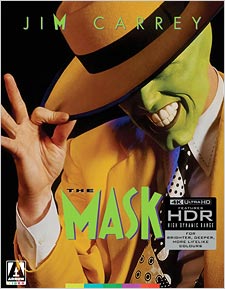
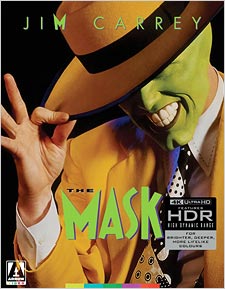
Arrow Video’s 4K Ultra HD release of The Mask sits in a black Amaray case with six postcard-sized art cards and a double-sided insert, which features the original theatrical poster artwork on one side and the theatrical “How do you measure up to...” vinyl banner artwork on the reverse. Also included is a double sided-poster with the same artwork options and a 40-page booklet re-creating the “Edge City Tribune” front page on the cover, featuring cast and crew information, the essay Masks of Dreams, Masks of Nightmares by Alexandra Heller-Nicolas, the film’s original production notes, presentation information, production credits, and special thanks. Everything is housed in a rigid slipcase that features the theatrical teaser poster artwork with a slipcover featuring the theatrical poster artwork. The following extras are included on the disc:
- Audio Commentaries:
- Audio Commentary with Chuck Russell
- Audio Commentary with Chuck Russell, Robert Shaye, Mike Werb, Mike Richardson, Bob Engelman, Scott Squires, Tom Bertino, and John R. Leonetti
- The Man Behind The Mask: A Talk With Director Chuck Russell (HD – 20:27)
- From Strip to Screen: Adapting the Comic Into a Blockbuster (HD – 18:33)
- Green Faces Blue Screens: The Visual Effects of The Mask (HD – 14:16)
- Sssssssplicin’!: Editing The Mask (HD – 6:51)
- Ask Peggy: Amy Yasbeck Tells All! (HD – 12:37)
- Toeing the Conga Line: Making The Mask Move (HD and Upscaled SD – 10:09)
- Terriermania: The Mask and America’s Obsession With the Jack Russell Terrier (HD – 10:18)
- Archival Features:
- Return to Edge City (SD – 27:18)
- The Making Of (SD – 3:11)
- Interview Bites (SD – 4:38)
- Introducing Cameron Diaz (SD – 13:19)
- Cartoon Logic (SD – 13:44)
- What Makes Fido Run? (SD – 10:52)
- Deleted Scenes:
- Viking Scene (SD – 1:50)
- Viking Scene with Commentary by Chuck Russell (SD – 1:50)
- Death of Peggy (SD – 2:05)
- Death of Peggy with Commentary by Chuck Russell (SD – 2:05)
- B-Roll (SD – 5:24)
- Theatrical Trailer (SD – 1:59)
- Image Galleries:
- On-Set Production Photos (HD – 410 in all)
- Stills Gallery (HD – 15 in all)
First up are a pair of vintage audio commentaries. Director Chuck Russell expertly flies solo for his track, delving mightily into various aspects of the film, though dropping out here and there. Next is a classic New Line Home Video track wherein the contributors were recorded separately and stitched together later, creating a curated, documentary-like experience. It features producer Bob Engelman, New Line Cinema co-chairman Robert Shaye, executive producer Mike Richardson, Chuck Russell, screenwriter Mike Werb, animation supervisor Tom Bertino, visual effects supervisor Scott Squires, and cinematographer John R. Leonetti. Both are outstanding tracks.
In The Man Behind The Mask, director Chuck Russell talks about getting into the film business and producing Back to School, making A Nightmare on Elm Street Part 3: Dream Warriors at New Line Cinema, looking into acquiring the rights to The Mask, reworking the darker version of the original script, relating to Stanley Ipkiss’ character, being influenced by Jerry Lewis, using tension and release in his films, casting and working with Peter Greene, incorporating musical numbers, Jim Carrey being sick but committed on the set, utilizing Carrey’s physical assets and talents mixed with special effects, working in the new world of CGI, shooting on smaller budgets, feeling the pressure at the Cannes Film Festival, and the innocence and appeal of the film today. From Strip to Screen speaks to creator of The Mask and executive producer Mike Richardson, as well as screenwriters Mike Werb and Mark Verheiden. They speak about collaborating at Dark Horse Comics on The Mask in the first issue of Dark Horse Presents, making the screenplay more humorous and less violent than the original comics, putting the Cuban Pete song in the film, what Mike Werb brought to the script when he became involved later, the casting Cameron Diaz elevating her underwritten character, getting Jim Carrey involved, adding Max as Milo, making the source of the mask be the Norse god of mischief, tightening up the film during test screenings, reshooting the ending, reactions to the film, and the lasting appeal of the film.
Green Faces Blue Screens speaks to visual effects supervisor Scott Squires about his early days in photography and later getting his first job on Close Encounters of the Third Kind, various other films and commercials he worked on later, receiving the script for The Mask and figuring out the visual effects, his duties on the film, studying Tex Avery and having a sense of comedic timing, getting lighting and color references, Jim Carrey’s work in the film, working long hours, moving on to other projects, being nominated for Academy Awards, the film’s longevity, and the overuse of CGI in other films that came afterwards. In Sssssssplicin’!, editor Arthur Coburn briefly talks about his early work, being hired by Chuck Russell, being on the set, how in sync he was with Russell when showing him his first cut, editing different takes of Jim Carrey, Max’s contributions, the musical numbers, and enjoying himself while cutting the film.
In Ask Peggy, actress Amy Yasbeck discusses having a good year professionally in 1994, reading and auditioning for The Mask, getting the part and meeting with Jim Carrey about it, looking at her scripts with her husband John Ritter, working with Peter Riegert, her early days with Jim Carrey and how comfortable she was with him on the set, being a double-crossing character, working with Peter Greene, her deleted death scene, going to the premiere, and her reflections on the character. Toeing the Conga Line features never-before-seen rehearsal footage as well as an interview with choreographer Jerry Evans, who talks about getting the job on the film, receiving an unheard of opening title credit, working with Jim Carrey and Cameron Diaz, keeping the producers in the dark about the musical numbers, shooting doubles and extra dancers, the work ethic of Jim Carrey, working with Anne Fletcher (Step Up), and being prepared and well-rehearsed. Terriermania is a video essay by film critic Elizabeth Purchell who explores pets in movies and TV shows, and the popularity of Jack Russell Terriers because of The Mask.
Next are a set of Archival Features by Jeffrey Schwarz at Automat Pictures. Return to Edge City is a retrospective overview of the making of the film, The Making Of is an extremely brief promotional featurette, Interview Bites features various promotional on-set interviews with the cast and the director, Introducing Cameron Diaz talks about discovering and casting her in the film, Cartoon Logic talks about Tex Avery’s influence on the film’s humor and special effects, and What Makes Fido Run? talks about what goes into the training of animals, specifically Max. Collectively, there are vintage interviews with Chuck Russell, Robert Shaye, Bob Engelman, Mike Richardson, Mike Werb, Jim Carrey, Cameron Diaz, Peter Greene, Richard Jeni, Peter Riegert, Max, John R. Leonetti, Tom Bertino, Scott Squires, casting associate Mark Paladini, casting director Fern Champion, animation historian John Canemaker, and animal trainers Steve Berens, Nicole Zuehl, and Brandon McMillian.
The Deleted Scenes, both of which contain optional commentary by Chuck Russell, feature the film’s original prologue, as well as a scene in which Peggy’s character is killed. Last is a set of on-set B-Roll footage, the main theatrical trailer, and a massive Image Galleries archive containing 410 production photos and 15 promotional stills.
Some minor things that haven’t been included are the DVD-ROM materials from the original DVD release, which included storyboards. Also missing are the film’s marketing materials, particularly TV spots, additional teasers and trailers, and the music video tie-in for Who’s That Man by Xscape, a song that closes the film. Otherwise, this is a very complete package.
Revisiting The Mask, having not seen it in multiple decades, was an eye-opening experience. It’s amazing how well the film stands up, and how odd and different it was for the time. Unfortunately, other projects like Dark City, which is similarly different from everything else coming out that time, didn’t fare as well comparatively, which is a shame. However, The Mask continues on as the perfect marriage of actor, director, and source material. Arrow’s 4K Ultra HD release is top of the line, with a perfect presentation and fantastic extras. It’s a highly recommended release.
- Tim Salmons
(You can follow Tim on social media at these links: Twitter, Facebook, BlueSky, and Letterboxd. And be sure to subscribe to his YouTube channel here.)