
Man in a Cocked Hat (Blu-ray Review)

Director
Jeffrey Dell and Roy BoultingRelease Date(s)
1959 (January 20, 2026)Studio(s)
Charter Film Productions/British Lion Films (Kino Lorber Studio Classics)- Film/Program Grade: B-
- Video Grade: A
- Audio Grade: A
- Extras Grade: B-

Review
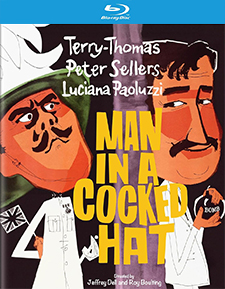
First, let’s get this business with the title out of the way. This is a British comedy from the Boulting Bros., released there as Carlton-Browne of the F.O. (1959) but in the United States as Man in a Cocked Hat, possibly cut from its original 89 minutes. Kino’s release opts for the latter title on the spine and cover of this Blu-ray release, though this is the complete version of the film and its title card onscreen identifies it as Carlton-Browne of the F.O., no matter what the Blu-ray case claims. Given that Anchor Bay released the film on DVD way back in 2003 under the original British title, why Kino would revert to its less-remembered U.S. moniker when the title card contradicts it is anyone’s guess.
Regardless, the film, like many British comedies of the 1950s, is often misidentified as an Ealing Comedy, which it is not; that studio stopped making new movies in 1957. Nevertheless, the classic “Ealing Comedy” style continued elsewhere, such as the similar run of films made by the Boulting brothers: John (primarily a producer, but sometimes director or co-director) and Roy (primarily a writer and director or co-director, as here). Where the Ealing comedies were typically gentle satires of British cultural and government institutions, the Boulting brothers’ films tended to be both broader and at times more bitingly critical (if less subtle), targeting everything, from the highest echelons of the British government to working-class charwomen, though Ealing also did this, earlier, in films like The Man in the White Suit (1951).
Such films were quite popular in Britain and to a lesser extent in the U.S. The Ealing comedies helped make Alec Guinness an international star, while the Boulting brothers films established former Goon Show player Peter Sellers, as well as Terry-Thomas. (Terry-Thomas, in fact, replaced Sellers for the film It’s a Mad, Mad, Mad, Mad World when Sellers became too expensive to hire.)
Compared to the crude slapstick that dominated American film comedy of the 1950s, these smaller-scale British films, not large-budgeted but usually more intelligent, wittier, polished and featuring excellent ensemble casts, somehow seemed better and funnier than Hollywood’s program comedies of the period. I found most of these pictures hilarious when I first saw them as a teenager and in my 20s but, watching them today, most of them, even the classic ones like the Boulting Bros.’s I’m All Right Jack (also 1959), not anywhere as funny as I had remembered them, though they all still have scattered amusing moments and occasionally funny dialogue. They’re still fun to watch for their casts—the Boulting brothers films use recognizable names and faces, even for tiny roles—but movies like Carlton-Browne of the F.O. especially seem unusually labored and unfunny when viewed today.
With a plot similar to that same year’s The Mouse That Roared, also starring Sellers and made in Britain but predominantly an American production shot there, Carlton-Browne of the F.O. revolves around a (fictitious) island nation called Gaillardia, a former British colony granted self-rule in 1916, though Britain’s Foreign Office (the F.O. of the title) failed to notify its representative, Davidson (Miles Malleson), still stationed there more than 40 years later. No one at the Foreign Office has ever heard of Gaillardia, and after the assassination of its President it’s decided to send the bumbling head of “Miscellaneous Territories,” Cadogan De Vere Carlton-Browne (Terry-Thomas), to investigate, accompanied by military representative Col. Bellingham (Thorley Walters). Also traveling to Gaillardia, incognito, are Mr. Jones (Ian Bannen), the Oxford-educated heir to the throne, and Gaillardian citizen Iiyena (Luciana Paluzzi), actually a princess herself, daughter of the dead President’s main rival, the Grand Duke (John Le Mesurier). Upon arrival they’re greeted by hopelessly corrupt Prime Minister Amphilbulos (Peter Sellers), who seems aware of the country’s rich and untapped cobalt deposits, which soon attract not only British, but also U.S. and Soviet representatives, all wanting a piece of the action.
In the movie, Gaillardia, located somewhere on the 33rd parallel, is a mishmash of French, Italian, and Spanish influences, tropical but not explicitly north or south. The deliberate vagueness of the island’s location is somewhat amusing, but the film has the same problem virtually all comedies and dramas have when creating imaginary countries, like the nonexistent communist states seen in myriad Cold War-era Hollywood films and TV shows. That is, it’s much harder to generate biting satire about nation that doesn’t exist as opposed to one that does; this kind of thing only works when the true target of the satire is obvious, as in The Great Dictator. The more forthright the filmmakers are in their satire, Kubrick’s Dr. Strangelove, for instance, the more comic weight it can carry. Carlton-Browne is trifling and forgettable.
Peter Sellers was on the cusp of stardom when the film was released, explaining his undeserved co-starring billing, second after Terry-Thomas when, in fact, Sellers isn’t in the film all that much, and both Ian Bannen and Thorley Walters have much larger parts. Like the rest of the cast of Gaillardians, Sellers performs with a jumble of Italian, Spanish, and French, but it’s not remotely a standout performance. Terry-Thomas, emblematic British cad and toff, is somewhat cast against type, here a clueless if low-key bungler, but the aimless script generates little empathy and less interest for the character. The Ian Bannen and Luciana Paluzzi parts, feeling rather shoehorned into the plot, fare somewhat better; Paluzzi (billed here as Paoluzzi) is undeniably beautiful and only in her early 20s.
The good news is that Kino’s new Blu-ray sources a new 4K scan of the original camera negative, the result being that this black-and-white, 1.66:1 widescreen film looks positively gorgeous. The DTS-HD Master Audio (2.0 mono) is also excellent, supported by optional English subtitles. The disc is Region “A” encoded.
There but a single extra feature: a new audio commentary by film journalist Laurence Lerman that’s both well-researched and well-organized.
Movies like Carlton-Browne of the F.O. seem better remembered than they actually are. Not unpleasant and certainly not shoddy, it’s compactly but expertly produced, and its cast of familiar British character actors in every scene is a plus; it’s just not nearly as funny as one remembers.
- Stuart Galbraith IV