
Law and Order (Blu-ray Review)
- Review Date: Aug 01, 2025
- Format: Blu-ray Disc
-


Director
Edward L. CahnRelease Date(s)
1932 (June 17, 2025)Studio(s)
Universal Pictures (Kino Lorber Studio Classics)- Film/Program Grade: B+
- Video Grade: A
- Audio Grade: A
- Extras Grade: B+

Review
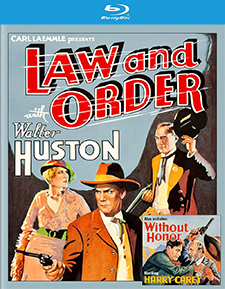
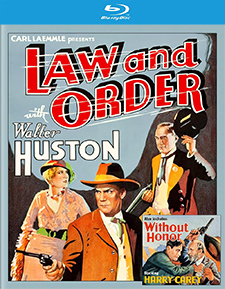
A most welcome release, Kino’s Blu-ray of Law and Order (1932) not only includes a magnificent restoration of that extremely good early talkie Western, but also a bonus Western starring Harry Carey (Sr.), Without Honor, also from 1932, it preserved by the Library of Congress.
Law & Order is, reportedly, the first movie to dramatize the Gunfight at the O.K. Corral, though co-writer John Huston’s screenplay fictionalizes the characters, with even the climatic gun battle changed to the “O.K. Barn,” as if that fooled anybody. The movie is imaginatively directed by Edward L. Cahn, remembered today for his cheap sci-fi and horror films of the 1950s (Creature with the Atom Brain, It! The Terror from Beyond Space, Invisible Invaders, etc.), movies which, even when their scripts were interesting, were undercut by Cahn’s bland direction. But Law and Order is another matter. His direction and editing are imaginative and even kinetic, quite unlike most early talkies, with a frequently roving camera and almost modern-style quick cutting during the action scenes.
The film is based on the novel Saint Johnson by W.R. Burnett, who wrote or co-wrote the screenplays for Little Caesar, Scarface, and The Great Escape, and who collaborated later with John Huston on High Sierra and The Asphalt Jungle. Huston’s father, Walter Huston, plays the fictionalized Wyatt Earp, here called Frame Johnson, while Harry Carey plays a hybrid character that’s part Doc Holliday, part Morgan Earp.
Tired of being a lawman, Frame Johnson, Ed Brandt (Carey), Frame’s brother Luther (Russell Hopton), and Deadwood (Raymond Hatton) mosey over to lawless Tombstone, Arizona, where the Clanton family equivalents are Poe (Ralph Ince), Walt (Harry Woods), and burly Kurt Northrup (Richard Alexander, Prince Barin from the Flash Gordon serials). When, coaxed into a deputy marshal job by Judge R.W. Williams (Russell Simpson) and others, and Frame shocks all by outlawing firearms in Tombstone, this sets up a showdown between Frame and his friends and the Northrups.
Though most of the kinks transitioning from silent to talkies had been worked out by 1932, Law and Order is still a little clunky here and there. Like most Westerns until about 1937-38, there’s no musical underscoring except at the beginning and end, and some of the performances are a little theatrical, including, at times, Walter Huston.
In other respects, though, the film is way ahead of its time, particularly with the fast cutting of the action scenes, particularly the first scenes in Tombstone and later the Gunfight itself, edited in a style far closer to a modern film than one nearly a century old. Indeed, the film gives evidence that those behind the magnificent George Cosmatos-Kurt Russell Tombstone (1993) looked to Law and Order (and probably all the other Gunfight at the O.K. Corral movies) for inspiration. Some specific moments in this film are more or less replicated in Tombstone.
And while the characters lack the historically-correct mustaches and dusters found in the later film, like most silent Westerns and many early talkie ones, there’s a verisimilitude in the costuming, props, and production design that by the end of the decade would transform into a more standardized, “Hollywood Western” look. But in 1932, the end of the old west was only as remote as 1995 is today. Throughout Law and Order are little touches that feel more authentic than Westerns made just a few years later.
Walter Huston is generally very good as Frame while Harry Carey, “bright star of the early western sky,” as John Ford described him, is wonderfully naturalistic, even if both men are a little old for their parts, and Carey’s Bronx accent occasionally bubble to the surface. In an early role before he got fat, Andy Devine appears in a fascinating vignette as an outlaw threatened with lynching until Frame saves him, if only for the hangman’s noose. Upset by this, Frame cheers him up by noting he’ll be a celebrity, the first man legally hanged in Tombstone, which leads to a deeply, darkly comic hanging scene that’s still unsettling today.
Kino’s Blu-ray of Law and Order is derived from “4K scans of from the 35mm composite fine-grain and 35mm composite dupe negative,” with some obvious digital tweaking as well. For a 1932 release, the image is splendid, at times resembling Warner Archive’s Blu-rays of their black-and-white TV Westerns made 25 years later.
The bonus feature, Without Honor—that’s the title onscreen, though posters called it “Without Honors”—is much more the typical ‘30s B-Western. For one thing it’s obviously a lot cheaper, probably in the $20,000 range versus Law and Order, which probably cost around $80,000-$90,000. Most B-Westerns have rudimentary plots, but Without Honor is curiously prolix and confused, its story involving smuggling, multiple bank robberies, horse thievery, Texas Rangers, forged deeds, a young girl raised in secret, and a dog wearing fake fur. I never could entirely follow its Byzantine plot.
Regardless, the film is mainly of interest for its cast rather than its busy plotting. Like many ‘30s B-Westerns, it’s comprised of former silent era stars down on their luck. Carey had been a major Western star of the silent era who slummed in early talkie B-Westerns before reestablishing himself as a prominent character actor, most famously as the President of the Senate in Frank Capra’s Mr. Smith Goes to Washington. One of the main villains, Mike Donovan, is played by burly, wild-eyed and English-born Gibson Gowland, whose career stretched back to D.W. Griffith’s The Birth of a Nation and Intolerance but who’s best remembered as the lead in Erich von Stroheim’s masterpiece, Greed. He worked steadily if in increasingly smaller, eventually uncredited parts until the 1940s—he has a bit in The Wolf Man, for instance—but his thick, County Durham accent limited his parts. Also appearing in the film is, as Jackie Gleason called her, “the ever-popular Mae Busch,” who in the 1920s had a prominent career playing vamps. At the time of Without Honor she had already begun appearing in Hal Roach comedies, immortalized as the frequent wife of Oliver Hardy in such Laurel & Hardy films as Chickens Come Home and Sons of the Desert. It’s interesting to watch her here, greatly underplaying her saloon-girl-with-a-secret part relative to her extravagantly shrewish Mrs. Hardys.
Also, unlike Law and Order, Without Honor seems set in that strange universe where the Old West exists in tandem with present-day environs. In Mexico, Carey’s gambler mentions a Depression across the border, and Mae Busch’s costumes and hairstyles are emphatically early-1930s, not late 19th century. In one scene what looks like a gasoline station can be glimpsed around a corner, yet everyone rides horses and carries six-guns. This peculiar fantasy setting was taken for granted in many B-Westerns, even the majority, at least into the late-1940s.
Without Honor was produced and distributed by Weiss Brothers, a very minor but apparently prolific production company churning out cheap B-pictures of all kinds, including many starring Carey. The Library of Congress’s preservation video master appears to source 35mm composite elements, which are scratched up and missing frames occasionally, but the image is otherwise sharp and impressive for what it is. Given how most public domain masters of early B-Westerns look, this is a pleasure to watch.
Both films are presented in decent DTS-HD Master Audio 2.0 mono with optional English subtitles, and the disc containing both pictures is Region “A” encoded.
Supplements consist of audio commentaries on Law and Order by writer Max Allan Collins (seen recently on VCI’s Dick Tracy set) and film historian Heath Holland; and Without Honor by Toby Roan. The real surprise is a 37:24 appreciation of Law and Order by French filmmaker and historian Bertrand Tavernier. It’s a little disconcerting watching him wax nostalgically over Republic’s lowbrow Three Mesquiteers series and the like, but fascinating. He knows his stuff and is much-missed.
Great fun, Law and Order and Without Honor are Highly Recommended.
- Stuart Galbraith IV