
Jazz Boat (Blu-ray Review)
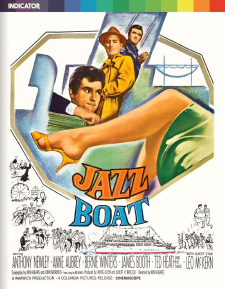
Director
Ken HughesRelease Date(s)
1960 (February 16, 2026)Studio(s)
Warwick Films/Columbia Pictures (Indicator/Powerhouse Films)- Film/Program Grade: B-
- Video Grade: A
- Audio Grade: A
- Extras Grade: A-
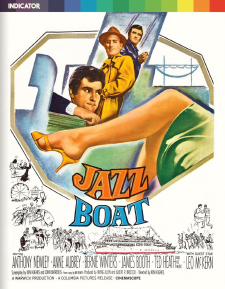

Review
[Editor’s Note: This is a Region B-locked British Blu-ray import.]
This is an odd one, a British crime film/comedy/quasi-musical, perhaps inspired by the West End success of West Side Story. I guess I was expecting something along the lines of It’s Trad, Dad! (1962), the aimless but agreeable musical directed by Richard Lester, featuring some great “Trad Jazz” performances by The Temperance Seven and others. Jazz Boat (1960) has little in the way of jazz in the usual sense; it’s a bizarre mess of a movie.
Mild-mannered electrician Bert Harris (Anthony Newley) boasts to dim pal Jinx (comedian Bernie Winters) that he’s the notorious “Cat,” an elusive jewel thief but apparently not Cary Grant. He’s pulling Jinx’s leg, but the dumb lug believes him, reporting this supposed revelation to Spider Kelly (James Booth), the only marginally brighter leader of a gang of petty thieves (cigarette cartons, parking meter coins) that consists of his girlfriend, Doll (Anne Aubrey, a bad actress but also the girlfriend of co-producer Irving Allen); Holy Mike (David Lodge, unrecognizable in beard and spectacles); and Dancer (Al Mulock, later an iconic, ultimately tragic presence in Sergio Leone Westerns).
Churlish police Sgt. Thompson (Lionel Jeffries) wants to bust the obnoxious gang, but his “bad cop” tactics only earn him the ire of his more forgiving boss (guest star Leo McKern, curiously subdued), who thinks these “kids” deserve understanding, not threats. Bert, meanwhile, is fixing the alarm system at a local jewelry store, but the careless clerk (John Wood) foolishly allows Bert to see him open the safe along with other egregious security lapses. When Spider and his gang insist on meeting Bert, the electrician digs himself into a progressively deeper hole trying to impress them with his first-hand knowledge of the jewelry store’s security system, prompting the gang to rob it that very evening, with Bert reluctantly in tow.
Most of Jazz Boat is your basic crime caper, with Newley functioning as the nebbish swept up in the otherwise serious (and, toward the end, rather violent) story, in the tradition of a 1940s Bob Hope comedy. Inexplicably, there are a couple of out-of-nowhere musical numbers, most notably Take It Easy, with Spider and his gang suddenly breaking into song and dancing through the streets, while Newley gets a very un-Newley-like solo number, Someone to Love, both possibly influenced by the London run of West Side Story, a huge hit running some 1,039 performances from 1958 to 1961. Except for Oui Oui Oui Oui, a digressive French number sung by Eurovision contestant Jean Philippe (in his only film role), all the songs have music and lyrics by Joe Henderson, apparently the American Jazz saxophonist who, as a songwriter, was neither a Leonard Bernstein nor a Stephen Sondheim.
One can only guess that Lionel Jeffries’s singularly humorless cop might also have been inspired by West Side’s similarly churlish Officer Krupke. There’s no reason to make him so persistently cranky. The big musical guest, playing himself, is bandleader Ted Heath, whose postwar big band was so popular it continued more than 30 years after Heath’s death. But Heath’s band was more in the style of American swing like Glenn Miller than any emerging British musical trends, or even the retro “Trad Jazz” one, and probably seemed pretty unhip to 1960s British teenagers.
The cast further underscores this strange disconnect. McKern (his hair dyed gray) and Jeffries (already bald) weren’t much older than the story’s “wayward youths.” At the time of filming, McKern was 39, Jeffries was just 33, yet Booth, Winters, Lodge, and Mulock were, respectively, 31, 29, 38, and 33. Also relatively young was the film’s camera operator, Nicholas Roeg, working under DP Ted Moore. If nothing else, the black-and-white, CinemaScope photography is attractive.
Ultimately, as one critic put it, Jazz Boat is essentially “purposeless,” with moderately entertaining performances, songs, a few laughs, and some very mild suspense, but mostly this jazz boat is a little like the RMS Queen Mary, cemented to its Long Beach dock, and not going anywhere, either.
Once again, The Digital Bits was sent only a check disc, with no booklet, no Blu-ray case, no nuthin’. The Region “B” encoded disc, a worldwide premiere, presents the film in its original 2.35:1 widescreen CinemaScope aspect ratio. Detail is strong as are blacks, and the presentation is strong. The LPCM mono audio is fine, and supported by optional English subtitles.
The bountiful supplements consist of a new audio commentary by historians Will Fowler and Vic Pratt; Cusp of an Era, an 11-minute appreciation by composer Neil Brand; Now and Then: Anthony Newley, a 32-minute interview with the actor/songwriter from 1968 by Bernard Braden, previously unreleased as it was intended to catch up with Newley years later a la the Up! series with the “Now” part of the interview never filmed; a trailer and image gallery. Apparently a 32-page booklet is included, but we didn’t receive that. This release is limited to 3,000 copies.
Certainly peculiar, Jazz Boat was co-financed by Columbia Pictures, strange considering that what appeal it has would seem almost entirely limited to British audiences, though for those interested in this particular time and place in British cinema, it’s moderately recommended.
- Stuart Galbraith IV