
Directed by David Lean: Volume II (Blu-ray Review)
Director
David LeanRelease Date(s)
1949-1955 (January 7, 2026)Studio(s)
Cineguild Productions/London Film Productions (Imprint Films/Via Vision Entertainment)- Film/Program Grade: See Below
- Video Grade: See Below
- Audio Grade: See Below
- Extras Grade: B+
- Overall Grade: A-

Review
[Editor’s Note: This is a Region-Free Australian Blu-ray import.]
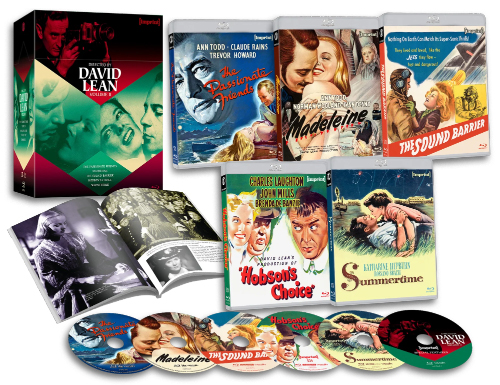
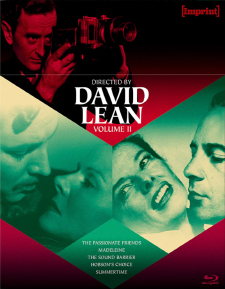
Australia’s label Imprint is back with Directed by David Lean: Volume II, the second part of an impressive collection of all of the director’s early films. Volume I included In Which We Serve (1942), This Happy Breed (1944), Blithe Spirit and Brief Encounter (1945), Great Expectations (1946), and Oliver Twist (1948), while this new set continues with The Passionate Friends (1949), Madeleine (1950), The Sound Barrier (1952), Hobson’s Choice (1954), and Summertime (1955). As with Volume I, Volume II is offered in a sturdy box, features excellent video transfers, and scads of older and brand-new extra features. The set is region-free and each film gets its own Blu-ray snap case.
The Passionate Friends (1948) starts out looking like it’s an upper-class reworking of Brief Encounter, complete with explorations of illicit romance and adultery, a complex flashback structure, narration, and even that same film’s co-star, Trevor Howard. Unlike the everywoman Celia Johnson in Lean’s earlier film, in The Passionate Friends, that role is played by austere Ann Todd, a capable but icy blonde actress this reviewer has never warmed to. The role of her husband is played by Claude Rains, who played an almost identical, if somewhat more sinister character, in 1950’s Where Danger Lives.
Mary Justin (Todd) is en route to a vacation in Switzerland, unaware that her pre-war former lover, university professor Steven Stratton (Howard) has coincidentally booked the room right next-door. She daydreams about their past romance, and how, ultimately, she married much older wealthy banker Howard Justin (Rains). They like and perhaps even love one another, but without the passion she still feels toward Steven. In flashbacks, she recalls the affair she had with Steven in 1939, after she had married Howard. When he discovers the affair and confronts them, the next morning she abruptly breaks it off and the Justins head to Washington, the romance over.
Now, nine years later, fate has brought them together again. Can their romance be rekindled?
This is one of those rare films that, initially, is obviously extremely well-crafted but seems pointless, a much-less appealing retooling of Brief Encounter, but which steadily gains interest because, as it turns out, it’s really about something very different. The camera sees what Mary sees, yet her interpretation of Steven’s and Howard’s feelings toward her misinterpret their real (and, in Howard’s case, deeper) emotions. Where Brief Encounter is partly about unselfishness, putting loyalty to one’s family ahead of personal desire, however exhilarating, The Passionate Friends is actually the inverse of that, the consequences of selfishness.
Ironically, both Lean and Todd opted in real life for the consequences of selfishness, they falling in love when each was already married. They divorced their partners and embarked on a largely unhappy marriage of their own, a relationship that damaged Lean’s career. Moreover, in the process Lean also hurt his professional relationship with filmmaking partner Ronald Neame, the former cameraman turned producer-writer on Lean’s early pictures. The Passionate Friends was originally to have been directed by Neame, but Lean shook Neame’s confidence by criticizing the script and urging it not be put into production until changes were made. Lean then replaced Neame several days into production. It was soon obvious to all Lean and Todd were having an affair and the film was a box-office failure.
But it wasn’t a train wreck. Trevor Howard is very good and Claude Rains is superb, something like Anthony Hopkins’s in Remains of the Day, where one penetrates the masks the character wears and the actor allows the audience to read the emotional torment. Lean’s direction and editing are also excellent, the film’s best scene superbly staged, when Mary rushes back to her upstairs hotel suite to wave goodbye to Steven, unaware that Howard is already in the room, seated near the door and watching her through sheer, willowy curtains. This is one of the very few Lean films I hadn’t seen before, but will want to revisit again, aware of the story’s outcome, to look at its first half in a new light.
Region-Free like the other discs in this set, The Passionate Friends looks very good on Blu-ray, the black-and-white, 1.37:1 standard frame perhaps a notch below other Lean ’40s films in high-def, but very good. The LPCM 2.0 mono is also fine, and accompanied by optional English subtitles.
Supplements consist of an audio commentary by Alain Silver and Jim Ursini, authors of David Lean and His Films; The Passionate Friends: An Appreciation featuring Melanie Williams, author of David Lean; The Passionate Sounds: Jim Pople Remembers The Passionate Friends,; and a still gallery.
THE PASSIONATE FRIENDS (FILM/VIDEO/AUDIO/EXTRAS): A-/A-/A/B
I had steered clear of Madeleine (1950) for decades; not only were reviews mixed-to-negative, Lean himself considered it his worst film. I assumed it to be polished with excellent direction, editing, and production design, but dull with a poor script, something, I imagined, like The Paradine Case (1947), one of Hitchcock’s rare duds. Imagine my surprise, then, when the picture turned out to be quite engrossing as well as superbly made.
Based on a true story, the picture opens in 1850s Glasgow, where marriageable-age Madeleine Smith (Ann Todd again) lives in a stately, recently-purchased home with her family, ruled in the strictest Victorian traditions by her overbearing father, James Smith (Leslie Banks, in his final film role). Madeleine chooses to live in a basement bedroom to gain access to the servants’ entrance, and thus be able to rendezvous with her secret lover, Frenchman Émile L’Angelier (Ivan Desny), with only the maid, Christina Hackett (Elizabeth Sellars, in an early role), aware of any impropriety. Though secretly engaged, Madeleine is loath to reveal the relationship to her father, knowing he’d be outraged once he learned of their clandestine meet-ups and forbid any future contact with L’Angelier.
Indeed, all along the father has been pressuring Madeleine to accept the attentions of a “proper” gentleman, William Minnoch (Norman Wooland) who, for his part, isn’t remotely stuffy but warm and caring. When one of these two suitors wind up dead, Madeleine is charged with murder.
Banks’s domineering father is like an alternate universe version of David Tomlinson’s Edwardian father in Mary Poppins. “I run my home precisely on schedule, at 6:01, I march through my door; my slippers, sherry, and pipe on view, at 6:02, consistent is the life I live!” With his partly paralyzed face, Banks even looks like a Mr. Hyde to Tomlinson’s Dr. Jekyll. He controls every movement of every family member, and every action in the household: with whom his daughters interact socially, what they read to the family after supper, what time everyone goes to bed. Any deviance or objection is at one’s own peril. Though upper-class, Madeleine’s daily life isn’t much different from a prison, with better food.
Lean’s film expertly expresses this oppressiveness superbly via the production design, not far removed from his Dickens films, and the same brooding black-and-white cinematography which, as before, captures its era with impressive authenticity.
Ann Todd, having played the historical character on the stage, gives what may be her best film performance. No matter that Lean hated Madeleine; she maintained great affection for the film. Though twice as old as the real Madeleine, who was 22 at the time of the murder, her performance and the way Lean shoots her allows the audience to suspend disbelief and accept her as the shirking violet she presents herself as.
The film was somewhat controversial and criticized for its ambiguity: Madeleine’s guilt or innocence is left up to the viewer. This extends to the trial scenes, where both the prosecutor and barrister for the defense each make compelling summations, climactically looking more or less into the camera, making the movie audience a member of the jury, so to speak. This may have damaged the film’s commercial chances, but it doesn’t particularly damage the film.
Licensed from ITV Studios, the video transfer of this 1.37:1 standard-frame, black-and-white film is better than The Passionate Friends, with inky blacks and a sharp image. Like all the titles in this set, the LPCM 2.0 mono is excellent, and supported by optional English subtitles.
Extras consist of an audio commentary by Silver and Ursini again; another appreciation by Williams; and another interview with Pople, along with a still gallery.
MADELEINE (FILM/VIDEO/AUDIO/EXTRAS): A-/A/A/B
In lesser hands, The Sound Barrier (1952) might have been trite melodrama, a dated picture about civilian aircraft designers and test pilots pushing postwar technology toward unknowable limits now commonplace. But David Lean was no ordinary filmmaker, and dramatist Terrence Rattigan’s script no ordinary screenplay. It works, and still holds up marvelously well today, because it moves in unexpected directions, with unanticipated emphases. Though it contains elements clearly influential on other later films, including Philip Kaufman’s stupendous The Right Stuff (1983), the focus of The Sound Barrier is as much a nebulous barrier of another kind, the relationship between an adult daughter and her emotionally aloof father.
The story begins near the end of the Second World War, when self-made millionaire aircraft magnate (and early pilot) John Ridgefield (Ralph Richardson) oversees his company’s development of game-changing jet engines and aircraft. Into this environment daughter Susan (Ann Todd) returns home newly-married to fighter pilot Tony Garthwaite (Nigel Patrick). Impressed by his flying credentials, Ridgefield not only welcomes Tony into the family but offers him a job as a test pilot once the war is over.
However, this puts additional pressure on Ridgefield’s son, Christopher (Denholm Elliott), who feels enormous pressure to follow in his esteemed father’s footsteps and fly himself. Though aware he hasn’t got the knack, he undergoes training for his first solo flight, only to die in a fiery crash.
After the war, Garthwaite joins Ridgefield’s company, the Old Man eager to develop aircraft capable of exceeding the speed of sound. Susan, by this time pregnant, is increasingly distressed by her husband’s dangerous test flights, despite the comfort of friends Jess (Dinah Sheridan) and Philip Peel (John Justin), he another pilot and old friend of Tony’s.
Hollywood aviation films of the period like Strategic Air Command (1955) tended to dish out equal portions of gee-whiz technology with big dollops of Cold War propaganda. What impresses about The Sound Barrier is that for all its impressive hardware and aerial footage, the film is really quite an intimate, personal story about the strained relationship between a woman and her father, a reserved man she can’t understand, who seems so obsessed with breaking the sound barrier that even the lives of loved ones is a small price to pay.
Lean resisted using Richardson, an actor he always found dull onscreen, a position he reversed during the making of Sound Barrier. Adopting a thick Northern accent (apparently to emphasize his self-made man status), Richardson is mesmerizing, particularly late in the film when his true character is peeled away like an onion.
(Spoilers) Estranged from his daughter and grandson, he asks Susan to come see him, and as he monitors ground-to-air talk of a particularly dangerous test flight, Ridgefield drones on asking about her plans for his grandson’s schooling. Schooling? Why discuss it now? Like so much British drama, it’s all about reading between the lines. The father, who always seemed so cold-blooded and uncaring is terrified about the danger he’s putting his test pilot through, and can’t bear to suffer through that flight alone. Susan at first is bemused, finding her father’s questions oddly inappropriate, to the point where he finally has to blurt out that he doesn’t want to be left alone. Not now. Suddenly, she gets it. He’s not the uncaring father she’d for years assumed he was, but in fact had been suffering in silence and tremendous solitude all along. It’s a very moving scene, and hardly what one might have expected in what’s regarded as a “semi-documentary” about jet aircraft.
Much of the picture works a similar magic. Like The Right Stuff, the realism of the full-size aircraft and stunning aerial photography (no models) is integrated with more impressionistic material capturing the ethereal appeal of reaching for the stars. The final scenes, in the father’s observatory, with its big telescope and stars in the night sky recalls producer Alexander Korda’s Things to Come (1936) as much as a David Lean film.
Lean was disappointed that Nigel Patrick’s performance didn’t quite convey the aura of the test pilots he met, and while that’s true he’s excellent in all his scenes with Richardson, Patrick’s outsider character becoming a kind of surrogate for the audience. John Justin, best remembered as the star of The Thief of Bagdad (1940) captures the test pilot character better, especially in one unexpected moment near the end.
Though heavily fictionalized—British pilots weren’t, in fact, first to break the sound barrier, nor did their efforts lead to a domination of the commercial jet industry—the aircraft shown is fascinating from a historical perspective, and the screenplay and Lean’s direction always makes the technology and theoretical problems the characters face easy to follow at all times. Lean also shoots the flying scenes in interesting ways: suggesting their power through the rustling of fields blown by their exhaust, in some scenes sticking to audio from the pilot’s radio rather than ordinary shots of the jet in flight, etc. He varies what the audience sees of these repeated test flights so that they’re never dull.
Presented in 1080p 1.37:1 standard frame and in black-and-white, The Sound Barrier is derived from a 2018 BFI restoration of the original British version, not the shortened American release, Breaking the Sound Barrier. Except for a single shot the film shows no perceptible signs of damage or age-related wear; blacks are inky and contrast is excellent, as is the impressively sharp resolution. The LPCM 2.0 mono also excellent, with optional English subtitles provided.
Silver and Ursini are back with an audio commentary track, Williams, too, with her Appreciation. Also included are Painting the Sky: Peter Mullins Remembers The Sound Barrier (2025); a 1959 interview with David Lean; an interview with Geoffrey Wansell; and a still gallery.
THE SOUND BARRIER (FILM/VIDEO/AUDIO/EXTRAS): A-/A/A/B
Hobson’s Choice (1954) is a delight from beginning to end. Its core conflict, alcoholic boot and clog merchant Charles Laughton versus his three marriageable-age daughters, is lighthearted, not the moral/religious crisis of milkman Tevye’s in Fiddler on the Roof. From Harold Brighouse’s early 20th century play, its story is unexpectedly progressive, feminist even in 1950s terms. Expectedly, Laughton is wonderful, but the real surprise is John Mills, nearly unrecognizable in his early scenes.
Miserly widower Henry Hobson (Laughton) runs his upmarket Salford boot shop with his three adult daughters. Old maid Maggie (Brenda de Banzie), all of thirty, does almost all the work, running the shop with a keen business sense while younger daughters Alice (Daphne Anderson) and Vicky (Prunella Scales, in her second film) mostly keep house. Hobson himself does precious little work, spending most of his days and nights at the pub down the street. Not only does Hobson not pay his daughter wages, he refuses to pay any dowry to the families of his daughters’ suitors: Alice’s boyfriend, Albert Prosser (Richard Wattis), a young solicitor, or Vicky’s intended, Freddy Beenstock (Derek Blomfield), son of the local corn merchant. Maggie, Hobson fully intends to hold onto, never dreaming she would ever marry.
Maggie rebels. She recognizes the shop’s bootmaker, Will Mossop (John Mills), who works out of the cellar, as a grossly-unappreciated, underpaid master craftsman. Though homely and otherwise uneducated, Maggie announces her intentions to marry him and start their own, rival business. For Mossop, this comes as a surprise.
The role of Will Mossop had been intended for Robert Donat (of Goodbye, Mr. Chips), but he had to withdraw due to illness, with Mills, an unlikely choice, replacing him. With his alarming haircut, bushy black eyebrows, and covered in dirt, the actor is barely recognizable. His character’s arc, from subservient, unambitious and meek, to assertive and confident (and almost handsome by the end) is a joy to watch.
The story, however, revolves around Maggie’s take-charge actions rather than the Hobson and Mossop characters. They say behind every great man stands a woman, and in Hobson’s Choice, Maggie drives virtually every single plot point, through her experience, confidence, and sheer force of will. Lean reportedly was dissatisfied by Brenda de Banzie’s performance—she’s perfectly fine, though at 45, she hardly passes for 30. Watching the film again, it did occur to me that Kay Walsh, who was married to Lean throughout the 1940s (Lean left her for Ann Todd) and co-starred in a number of his early films, might have been even better, but she and the director were, apparently, not on the best of terms in 1954.
Adapted by Lean, Norman Spencer, and Wynyard Browne, its screenplay is as tight as a drum, never stagey but highly cinematic yet compact. And so, so delightful.
Imprint’s Blu-ray, derived from an earlier StudioCanal restoration, looks great, the black-and-white, 1.37:1 image sharp as a tack, with rich blacks, while its LPCM 2.0 audio is excellent as well, with optional SDH subtitles like the other films.
Extras include another Appreciation with Melanie Williams, an interview with Prunella Scales (originally filmed for, I believe, the first Blu-ray release in Britain, an interview with Norman Spencer, and a still gallery.
HOBSON’S CHOICE (FILM/VIDEO/AUDIO/EXTRAS): A/A/A/A-
The ultimately joyous Summertime (1955) was Lean’s last small-scale production; only big epics followed, and some would argue that he lost something in the process. Surprisingly, Lean himself regarded Summertime—not Lawrence of Arabia, not Bridge on the River Kwai, not Great Expectations—as the personal favorite among his films. Modestly produced for just $1.1 million, it was a substantial hit, grossing as much as $5 million worldwide. Lean got along famously with star Katharine Hepburn, and he so fell in love with Venice, where the entire film was shot, that he made a second home there.
Very loosely adapted from Arthur Laurents’s 1952 Broadway play The Time of the Cuckoo, which starred Shirley Booth, Summertime opens with “fancy secretary” Jane Hudson (Hepburn), a middle-aged spinster (she was in her late forties but looks older), arriving in Venice, Italy, a dream holiday for which she had been saving for years. She becomes friendly with two American couples, retirees Lloyd and Edith McIlhenny (MacDoanld Parke and Jane Rose) and randy Eddie Yaeger (Darren McGavin) and his wife, Phyl (Mari Aldon). She also gets to know the hotel’s widowed owner, Signora Fiorini (Isa Miranda) and streetwise barefoot urchin Mauro (Gaetano Autiero), who acts as her guide.
Despite all these new friends, Jane is consumed with loneliness until she attempts to buy a red glass goblet she spots in a shop window, only to discover that the shop’s owner, Renato de Rossi (Rossano Brazzi), is the same man she saw watching her while she was seated at an outdoor café at the Piazza San Marco the afternoon before. Both attracted and repelled by the younger Renato’s obvious intentions, she returns to the shop with Mauro the next day only to find Renato not there, and is humiliated when she falls into the canal nearby.
But then Renato turns up at Jane’s hotel and, despite her persistent refusals, coaxes her into letting him take her out that evening...
Summertime elegantly conveys several different qualities simultaneously. For one, it gently satirizes both American tourists in Europe while also poking fun at the natives, in a manner similar to Jacques Tati’s later classic Playtime. The American tourists stand out like sore thumbs, mangling the language, sticking to absurdly busy itineraries, sometimes unthinkingly offending the Italians. (Lloyd complaining about the “wap” food.) Pre-over-tourism Venice is, on one hand, staggeringly beautiful, yet Lean makes amusing observations: Jane spots the beginnings of TV antennae on rooftops and is nearly pummeled by garbage dropped into the canal from a high window. Mauro is sweetly charming but also a little boy who won’t hesitate to bum a smoke.
But this very mature, adult film also contrasts the repressed mores, particularly repressed sexuality, of overly-suspicious and sanctimonious WASPish Americans with the more free-spirited, take-life-as-it-comes Venetians. Jane carries a 16mm movie camera everywhere to capture the sights, but it struck me watching Summertime this time how much she uses it less as a camera than as a kind of protective social barrier, and how it functions for Jane is identical to the secondary function cellphones serve today. At the café, for instance, she’s constantly fidgeting with it to avoid eye-contact and other social interactions, exactly like how many people pretend to be engaged with their cellphones to avoid talking to others on a bus or subway, at a restaurant, etc. More overtly, she wears dark sunglasses in much the same manner. Summertime, then, is partly about Jane’s struggle between wanting to experience Venice fully while also being deathly afraid to let too much in.
Summertime also captures the loneliness of solitary travel better than any film I can think of, while Hepburn gives one of her very best film performances portraying virtually the opposite of her usual screen persona (and how she presented herself); she exposes a vulnerability and lack of confidence she almost never allowed onscreen or in her private life. Her Jane is often foolish, even childlike, self-defeating. In stark contrast to her glamourous MGM years, her ruddy but blotchy and freckled features aren’t hidden from the camera lens.
The cinematography by Jack Hildyard, in full flower in this 4K restoration, is positively dreamy. Back in 1955, most Americans could only pine for exotic overseas travel, making Summertime, at the time of its release, a vicarious experience that must have made middle-aged American women swoon. Unlike her American retiree friends, who are travelling all over the continent, Jane’s adventure seems limited pretty much to Venice, one of the most romantic cities in the world. She might deny it, even to herself, but how could she not be hoping for a romantic interlude?
Imprint’s Summertime has one big advantage over Criterion’s Blu-ray release: while the Criterion is presented only in 1.37:1 standard frame, Imprint’s is offered in both that format and in 1.78:1 widescreen, approximating the original intended 1.85:1 theatrical release. The opening titles of that version are presented full-frame, but the rest of the picture is widescreen. Frankly, both versions, from the same 4K remastering, look stupendous. The image, filmed in Eastman Color and originally printed by Technicolor, are razor-sharp with brilliant color. The LPCM 2.0 mono is also impressive, and optional English subtitles are provided.
Two discs are included in this snap-case, the first primarily for the film but featuring the following extra features: a 2025 audio commentary by Alain Silver and James Ursini, authors of David Lean & His Films; an older commentary by film scholar Mark Nichols; Summertime: An Appreciation, an interview with Melanie Williams, and a trailer. The second disc includes Before the Epic: David Lean’s Little Gems (Part Two), the 2025 documentary by Simon Lewis; the documentary David Lean: A Self-Portrait; and two South Bank Shows—David Lean: A Life in Film (1985) and David Lean and Robert Bolt (1990).
SUMMERTIME (FILM/VIDEO/AUDIO/EXTRAS): A/A/A/A
Also included in this boxed set is a hardbound, full-color booklet, which consists of chapter excerpts covering the films included here from Alain Silver and James Ursini’s The Films of David Lean. These excerpts add significantly to the viewing experience.
Needless to add, Directed by David Lean: Volume II comes very highly recommended.
- Stuart Galbraith IV