
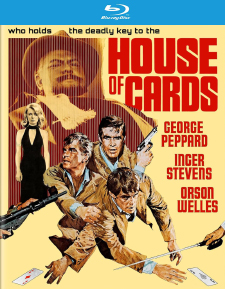
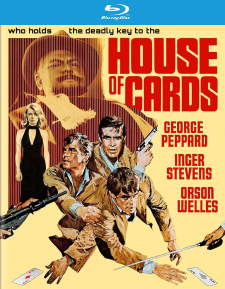
House of Cards (Blu-ray Review)
Director
John GuillerminRelease Date(s)
1968 (April 21, 2026)Studio(s)
Westward Films/Universal Pictures (Kino Lorber Studio Classics)- Film/Program Grade: B-
- Video Grade: A-
- Audio Grade: A
- Extras Grade: B-

Review
Not bad, House of Cards (1968) is an American thriller filmed entirely in France and Italy with an international cast and crew. It’s well made for what it is—director John Guillermin’s forte being this type of action-heavy film, the acting is generally good, the musical score by Francis Lai (A Man and a Woman, Love Story) is evocative, and the cinematography by Piero Portalupi (A Farewell to Arms) makes good use of the Techniscope format favored by Universal during the late ’60s and early ’70s. Yet, somehow, it doesn’t quite coalesce and is ultimately disposable and forgettable. The adaptation of Stanley Ellin’s same-named novel by James P. Bonner (actually Irving Ravetch and Harriet Frank, Jr., of The Reivers, Norma Rae and Murphy’s Romance) has more than its fair share of plot holes, and is never really credible.
Reno Davis (George Peppard) is an American boxer and aspiring writer living in Paris. Driving home from the last fight of his career, he and friend Louis (Raoul Delfosse) are shot at by what turns out to be an eight-year-old boy, Paul (Barnaby Shaw), fooling around with a Barretta, wandering the grounds of a large estate. Out of work, Reno accepts an offer from the boy’s widowed mother, Anne de Villemont (Inger Stevens) to tutor Paul. She also gives him a gun for protection, and the family doctor, Morillon (Keith Mitchell), claims Anne has become paranoid about the possibility of her son being kidnapped since her famous French general husband was killed in a terrorist attack during the Algerian Conflict. For his part, Reno is disturbed by the family’s snobbish, fascist attitudes.
The next afternoon, Reno is picnicking along the Seine with Paul, Louis, and his new girlfriend, Veronique (Geneviève Cluny), when an assassin begins shooting at them. When Reno rendezvous with the others at Louis’s flat, he finds his friend’s throat slashed, Paul apparently kidnapped, and Veronique claiming to police that Reno had murdered Louis. Reno escapes through a window, making his way back to the de Villimont villa only to find everyone gone and the mansion closed up, but does finds a regiment’s worth of arms hidden in its wine cellars, part of a fascist conspiracy to overthrow France and, eventually, all of Europe.
House of Cards has all the ingredients of a great thriller, so why is it so unsatisfying? Partly, maybe, because the fascist overthrow part of the story is too murkily-defined; the film plays like large portions of that part of the story are missing. A big plot twist is botched because it’s never clear (at least to me) whether Anne is aware of one character’s true identity or not (and whether that would have mattered anyway). On one hand, making Reno a boxer cleverly adds credibility to the notion that Reno—hardly trained as a spy—could fight his way out of a jam, even when outnumbered by various armed goons, but Peppard plays him a bit too flip and cocky to be believed.
There are plot holes galore: near the end of the story, we learn French Intelligence has been monitoring Reno’s movements all along, but why haven’t they stepped in earlier? Once captured, why do the story’s villains pretend to be making arrangements to whisk Reno off to Argentina when they intend to kill him anyway? Why don’t they just kill him on the spot, instead of letting him wander about, discovering clues? Nevertheless, House of Cards is not boring; Guillermin stages the action scenes with verve. the French and Italian locations are interesting; the movie looks more like a French-Italian production than an American one.
The performances are good: Peppard, who had been directed by Guillermin in The Blue Max and P.J., is relaxed and confident. Third-billed Orson Welles has a couple of good scenes as the ringleader of the fascist plot; he’s intelligent and genuinely menacing. Yet the film is not memorable and, unsurprisingly, was never released to videotape or DVD.
Kino’s Blu-ray of House of Cards mostly looks great. The 2.35:1 Techniscope format was, from the production standpoint, non-anamorphic and shot “flat” using two-perf-high frames instead of the usual four, thus requiring half as much negative stock, making it a favorite of tight-budgeted European features. It also meant that standard 35mm ’scope prints were, because of the smaller frame area, significantly grainier, as reflected in House of Cards’ video transfer, but otherwise the image impresses, with strong color and good resolution. The DTS-HD Master Audio (2.0 mono) is fine for what it is, and English subtitles are provided for this English-language production. Region “A” encoded.
Extras are limited to a terrible-looking trailer in 4:3 format and a new audio commentary by film historian and screenwriter Gary Gerani.
House of Cards could have been much better, but its plusses equal its minuses and, all told, it’s not a bad way to spend 105 minutes.
- Stuart Galbraith IV