
Devil’s Rain, The (4K UHD Review)
Director
Robert FuestRelease Date(s)
1975 (March 31, 2026)Studio(s)
Sandy Howard Productions/Estudios Churubusco (Severin Films)- Film/Program Grade: C-
- Video Grade: A-
- Audio Grade: B+
- Extras Grade: A

Review
It’s difficult to imagine a film like The Devil’s Rain being made at any other time than in the mid-1970s. It’s almost universally acknowledged as not being a very good film, but it’s a fascinating one based upon the treatment of its subject matter and its amazing cast. The original marketing campaign built around it by Bryanston Distributing (Flesh for Frankenstein and The Texas Chain Saw Massacre) promised “Absolutely the most incredible ending of any motion picture ever!” Nothing could truly live up to that kind of hype, but the film still managed to be a mild success, mostly with horror fans in the aftermath who appreciated it for its extensively gooey make-up effects, as well as fans of unintentionally hilarious bad movies.
The Prestons are a peaceful family concerned for their safety when they come under threat from Jonathan Corbis (Ernest Borgnine), the head priest of a Satanic cult. He requires a book that contains the signatures of members of his cult, and will do anything to get it. After Emma (Ida Lupino) is kidnapped and one of her sons shows up on the front porch missing his eyes and melting in the rain, one of her other sons, Mark (William Shatner), goes to Corbis and disappears. Meanwhile, the third son, Tom (Tom Skerritt), and his wife Julie (Joan Prather), come to help after Julie begins having psychic visions of Corbis. Receiving help from a psychic researcher, Dr. Richards (Eddie Albert), they set out to rescue their family from Corbis’ deadly clutches. Other members of the cast include Keenan Wynn, George Sawaya, and a fresh-faced John Travolta.
The Devil’s Rain is a treasure trove of eccentric, sometimes questionable performances, mostly from Ernest Borgnine and William Shatner, mixed with highly memorable prosthetic and make-up effects. There was even a technical advisor present for the Satanic ritual sequences in the form of the then-high priest of the Church of Satan, Anton LaVey, as well as his partner and church co-founder, Diane. If not for some of the more extreme moments, The Devil’s Rain could almost be mistaken for a TV movie. Its script lacks proper motivation for Corbis to want the aforementioned book and the need to capture the souls of the Prestons, outside of purely being recklessly evil, which is a problem since many moments in the film are overly long. Even its director, Robert Fuest (And Soon the Darkness, The Final Programme, and the Dr. Phibes films), thought so, feeling that the extended melting scenes could have been trimmed down. It’s certainly a part of the equation, but the real issue is that there just isn’t enough narrative meat on the bone, and the film tends to sag for great lengths of time before getting to something that’s interesting.
On the other hand, some very good cinematography from Álex Phillips Jr. (Bring Me the Head of Alfredo Garcia) is put to use and there’s plenty of creepy imagery on display, but it’s the (as advertised) over-the-top downer of an ending that the film is mostly remembered for, even to this day. It was originally released in June and July of 1975, sometimes double-billed with The Cat o’ Nine Tails, Asylum, and Crimson Cult, but later re-released in 1978 on an official double-bill with Ray Austin’s The Virgin Witch. It survives today as a strange genre artifact, one that has it fans, some for its unintended humor, and others for seeing such a highly-regarded cast put themselves through it and coming out on the other end somewhat embarrassed by it.
Cinematographer Álex Phillips Jr. shot The Devil’s Rain anamorphically on 35mm film using the Todd-AO process, the results of which were finished photochemically, and presented theatrically in the aspect ratio of 2.35:1. Severin Films debuts the film on Ultra HD with a new 4K scan of the original camera negative, which has been graded for High Dynamic Range in HDR10 only, and encoded to a dual-layered BD-66 disc. Since most of the screen is devoted to negative space above and below the frame for an 86-minute film and few extras, a dual-layered disc is entirely appropriate. The opening credits are the roughest section of the film by far, with obvious scratches and instability, but things improve dramatically after that. This is the sharpest and most detail-oriented presentation of the film to date. Heavy grain is rendered fairly well with bitrates that sit almost exclusively in the 80 to 95Mbps range, which aren’t always perfect, but detail never really suffers for it. Some mild scratches and speckling can be seen throughout with improved contrast, as well as some streaking, primarily in the latter half of the film. The HDR deepens blacks, as well as the red of Corbis’ Satanic robes. Its showcase is during the infamous melting scene at the end of the film when multiple hues flow out of each victim. Flesh tones can be a tad uneven, but they generally appear very natural. It’s a largely stable image that’s very pleasing, and definitely the best the film has ever looked on home video. (It’s worth noting that the black frame seen at 82:32 is still present on this release as it was on the previous Blu-ray, which appears to be a part of the fabric of the film, for whatever reason.)
The audio is presented in English and Spanish 2.0 mono DTS-HD Master Audio with subtitles in English SDH for the English track and English for the Spanish track. Being mono-sourced, the main English option is predictably flat without much in the way of dynamics, although sporadic fidelity is present in some of the sound effects. Dialogue is clear and discernible, but the rest of the track can tend to be a little muddled due to the sound and musical elements being at war with each other, chiefly during the ending. Otherwise, it’s a clean track with no other issues.
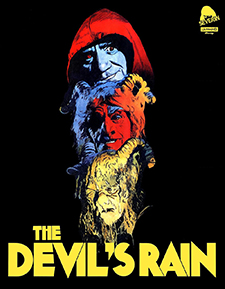
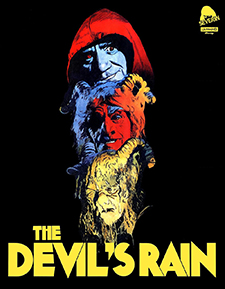
The Severin Films 2-Disc 4K Ultra HD release of The Devil’s Rain sits in a black Amaray case alongside a 1080p Blu-ray disc with an insert featuring artwork from the film’s UK theatrical release. Also included is a slipcover showcasing a combination of the Italian theatrical artwork on the front and a reworking of artwork featuring Jonathan Corbis melting used on one of the US and Thai theatrical posters. The following extras are included on each disc:
DISC ONE: UHD
- Audio Commentary with Robert Fuest and Marcus Hearn
- Audio Commentary with Stephen R. Bissette
- Theatrical Trailer (HD – 2:47)
DISC TWO: BD
- Audio Commentary with Robert Fuest and Marcus Hearn
- Audio Commentary with Stephen R. Bissette
- Confessions of Tom (HD – 10:59)
- The Devil’s Make-Up (HD – 4:43)
- Archival 1975 Interview with William Shatner (Upscaled SD – 3:47)
- First Stop Durango (HD – 14:47)
- Consulting With the Devil (HD – 10:17)
- Hail Satan! (HD – 8:02)
- Filmmaker/Horror Collector Daniel Roebuck on The Devil’s Rain (HD – 1);33)
- On Set Polaroids of Script Supervisor Ana Maria Quintana, Accompanied by Radio Spots (HD – 127 in all – 7:57)
- “Images from Hell” (HD – 151 in all – 7:48)
- Theatrical Trailer (HD – 2:47)
- TV Spots (HD – 4 in all – 2:05)
The audio commentary with director Robert Fuest and moderator Marcus Hearn has been carried over from the Dark Sky Films’ 2006 DVD release. It’s an excellent track as he and Hearn discuss the film, with Fuest speaking about his misgivings with the script, his dealings with the cast and crew, working on location in Durango, the logistics of working with a Spanish-speaking crew, working on The Avengers and the Phibes films, dealing with the effects on The Devil’s Rain, and becoming a teacher later in life. New to this release is an audio commentary with film historian and all-around fan of The Devil’s Rain, Stephen R. Bissette. He offers a very enthusiastic and informative chat about the film, covering the careers of the cast and crew pretty extensively, various aspects of its production, and other types of “melting” movies.
Confessions of Tom features an interview with Tom Skerritt who talks about becoming an actor to learn filmmaking early on in his career, mentoring under Hal Ashby, various films he appeared in, working with Robert Fuest and Ernest Borgnine, disagreeing with the producers about the tone of The Devil’s Rain, having to do reshoots, dealing with conflicts on the film sets, playing golf with Ernest Borgnine, and being appreciative for the kind of career that he’s had. The Devil’s Make-Up speaks to special effects artist Tom Burman about the difficulties in making people appear to melt on camera, his brother Ellis sculpting a piece for Ernest Borgnine and him having to apply it, the producers being rough on the production, various stories about the actors, and his thoughts on the final film. In the Archival 1975 Interview with William Shatner, he speaks to an interviewer about the possibility of a Star Trek film, various other things that he’s working on, details about The Devil’s Rain, and the popularity of Star Trek after the show was canceled.
First Stop Durango talks to script supervisor Ana Marie Quintana about reading Variety to keep up with new projects, becoming a script supervisor overnight, being on the set of The Devil’s Rain in Durango, forgetting her script on her first day, working with Álex Phillips Jr., her trials as the new kid on the block, being impressed by the cast and crew, pressures on the set, falling in love with Mexico, and working for Steven Spielberg. Consulting With the Devil features interviews with Peggy Nadramia and Peter H. Gilmore, the high priestess and high priest of the Church of Satan. They speak on Anton LaVey and his involvement with The Devil’s Rain, detailing his influence on the film’s script and production design, its accuracy, and his dealings with the cast and crew. In truth, they could have done an audio commentary on the film based upon their apparent deep knowledge of it.
Hail Satan! speaks to former Church of Satan high priestess Blanche Barton, Anton LaVey biographer and author of The Secret Life of a Satanist, about becoming a Satanist at a young age, giving a rundown of what Satanism actually is, Anton LaVey’s work with Robert Fuest, his various memories of the cast and crew, and his appreciation of the ending. In the interview with Daniel Roebuck, actor and avid horror collector, he tells a humorous story about seeing the film when he was young, gives his appreciation of the film and working with some of its actors throughout his career, and shows off his collection of memorabilia.
Next is a gallery of Polaroids shot by script supervisor Ana Marie Quintana on the set, which are accompanied by 6 radio spots, some of which are paired with The Virgin Witch. “Images from Hell” is an animated still gallery featuring images of posters, lobby cards, promotional items, pressbooks, book and soundtrack covers, newspaper clippings, home video release covers, behind-the-scenes photos, and memorabilia. Last is the film’s theatrical trailer and 3 TV spots. The only thing missing from the Dark Sky Films DVD release is a brief newsreel showcasing Anton LaVey.
Severin Films has given The Devil’s Rain a very nice 4K package with a quality presentation and an extensive extras package. It certainly puts the film in its proper context and gives its makers, as well as its fans, a chance to defend and appreciate it. If you’re a fan of the film, then this release is definitely worthy of your time.
- Tim Salmons
(You can follow Tim on social media at these links: Twitter, Facebook, BlueSky, and Letterboxd. And be sure to subscribe to his YouTube channel here.)