
Citadel, The (Blu-ray Review)
- Review Date: Jul 17, 2025
- Format: Blu-ray Disc
-


Director
King VidorRelease Date(s)
1938 (June 24, 2025)Studio(s)
Metro-Goldwyn-Mayer (Warner Archive Collection)- Film/Program Grade: B
- Video Grade: A
- Audio Grade: A
- Extras Grade: B-

Review
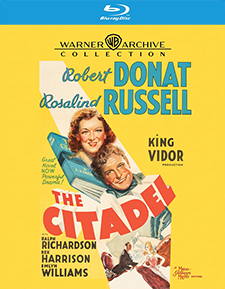
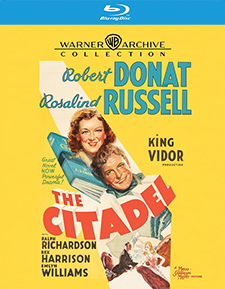
MGM initiated a series of British productions in 1938 with A Yank at Oxford and followed it with The Citadel. Based on A.J. Cronin’s semi-autobiographical novel about idealism, disillusionment, and ethics in the medical profession, it stars Robert Donat, (Goodbye, Mr. Chips) as young, idealistic doctor Andrew Manson, who travels to a small Welsh mining town to treat mostly poor coal miners.
The compassionate doctor is more concerned with improving the health and lives of his patients than with getting rich. The town’s medical resources are limited and he gets no cooperation from the town’s stubborn bureaucrats, but he perseveres. He insists, in vain, that a child with the measles be sent home from school to avoid spreading the disease. He delivers a baby who appears to be stillborn, but doesn’t give up and miraculously resuscitates the child. On discovering that the source of a typhoid outbreak is a leaky sewer system, he joins his new friend, Dr. Philip Denny (Ralph Richardson, Things to Come), in a plot to force the bureaucracy to act. Word spreads, and he wins the admiration and respect of the townspeople.
Manson falls for the local school teacher, Christine Barlow (Rosalind Russell, His Girl Friday) and the two soon marry. With a wedding present from Dr. Denny of a state-of-the-science microscope, Manson sets up a lab in his home to try to figure out why so many miners have respiratory problems, and discovers their lungs have been compromised by a build-up of coal dust. But Manson is hampered by the egos of his superiors and the ignorance of the populace, who think of coal dust as just an unavoidable part of miners’ working conditions.
When prejudices prevent Manson from doing his research, he and Christine leave for London. There, he joins a privileged group of doctors who put personal enrichment above ethics. Most of the exorbitant fees they charge their wealthy, pampered patients are to treat manufactured “illnesses” and the doctors enjoy a lavish lifestyle, with their patients’ interests secondary. Mason falls into this way of life but Christine is upset at the change in her husband. When Manson’s friend Denny dies because of the incompetence of one of the profiteering doctors, Manson reassesses his priorities and declares, “It’s high time we start putting our own house in order.”
As the conflicted doctor who faces ignorance, recalcitrance, and an ethical crisis, Donat conveys self-assurance, humility, despair, and anger. His dignified bearing easily commands the screen. His art is never forcing a moment. He recognizes the strength of a scene and never overplays.
Russell doesn’t have much to do except be the loving, supportive wife and eventually her husband’s conscience. Russell’s screen roles usually reflected a stronger personality. She would later establish herself as an apt comedienne in such films as The Women and Auntie Mame. In The Citadel, she turns in a sympathetic portrayal of the young wife struggling by her husband’s side and steering him back to his ideals, but her screen time is so limited that her character is underdeveloped.
The film has a lush look in keeping with the MGM style of the 1930s. Director King Vidor assembled a fine supporting cast, with Emlyn Williams, Rex Harrison, Francis L. Sullivan, and Cecil Parker. This is the kind of picture at which MGM excelled—dramatic, large cast, impressive production design, lush photography, engaging characters. The Citadel earned four Academy Award nominations, including Best Picture, Best Actor for Donat, and Best Director (King Vidor). It also won the New York Film Critics Circle and National Board of Review honors for Best Picture.
The Citadel was shot by director of photography Harry Stradling, Jr. on 35mm black & white film with spherical lenses and presented in the aspect ratio of 1.37:1. For a film nearly 90 years old, The Citadel looks great. The picture on the Blu-ray from the Warner Archive Collection is sharp, details are prominent, and contrast is quite good. Blacks are rich and velvety, and grayscale is pleasing. The depiction of the Welsh mining town is especially impressive, with its narrow streets. There’s a marked contrast between Manson’s life in the small town and his affluent life in London, where the costumes boast fine fabrics and tailoring and the set design is resplendent.
The soundtrack is English 2.0 mono DTS-HD Master Audio. English SDH subtitles are an available option. Dialogue is clear and distinct. Donat speaks with a light Scottish brogue but the Welsh miners have no Welsh accents, probably so they can be easily understood. The score by Louis Levy and Charles Williams is serviceable and never dominates the narrative. It lacks the grandeur of a Max Steiner score but it’s appropriate for an intimate rather than epic story.
Bonus materials on the Blu-ray release from Warner Archive include the following:
- The Ship That Died (10:09)
- Strange Glory (10:37)
- The Daffy Doc (7:02)
- Theatrical Trailer (4:36)
The Ship That Died – In this 1938 entry in John Nesbitt’s Passing Parade series, the mystery of the May Celeste is examined. The ship sailed from New York in early November, 1872 with a full crew, including the captain’s wife, which caused uneasiness among the superstitious sailors. Two weeks later, the ship was found with sails set but not a sign of life. There was no indication of a mutiny or struggle, the cargo was intact, and one longboat was still lashed to the deck. A maritime court offered several theories but none could be confirmed. Many decades later, the mystery of the “doomed vessel” Mary Celeste remains unsolved.
Strange Glory – Billed as “An Historical Mystery,” this 1938 short film concerns Anna Ella Carroll, a propagandist and military strategist for the North during the Civil War who helped formulate the “Tennessee Plan,” which turned the tide of the war in favor of the Union troops. In a dramatic re-creation, Carroll asks for recognition as the author of the plan that succeeded in dividing the Confederacy.
The Daffy Doc – In this 1938 Vitaphone black & white cartoon, Daffy Duck assists in an operating room. He makes a mess of surgical implements, is kicked out of the OR, and gets his head stuck in an iron lung. When he extricates himself, various parts of his body, in turn, blow up like balloons. He decides to get a patient of his own—Porky Pig—with a giant hammer but succeeds only in clobbering himself, after which he has a consultation with multiple images of himself. They agree to operate, Daffy chases Porky, and they both get stuck in the iron lung.
The Citadel tells a fascinating story about professionalism in the medical field and the lure of materialism. The screenplay by Ian Dalrymple, Frank Wead and Elizabeth Hill illustrates how ignorance, tradition and fear can undermine medical research and effective treatment. There are places where editing would have helped to streamline the narrative. Dr. Manson’s idealism gives way to disillusion and the attractions of the upper-class lifestyle of big-city doctors who coddle rich hypochondriacs. This makes him relatable, especially after his toils in a backward community that offered only resistance and the barest sustenance. The film deals with dedication, competence, authority, and ethics, themes that extend beyond the medical profession.
- Dennis Seuling