
Them! (4K UHD Review)
Director
Gordon DouglasRelease Date(s)
1954 (June 16, 2026)Studio(s)
Warner Bros. (Shout! Studios/Scream Factory)- Film/Program Grade: B+
- Video Grade: A-
- Audio Grade: B+
- Extras Grade: C-

Review
Monster movies are a dime a dozen, but when it comes to making a truly great one, there a few key elements at play. Obviously, having a great monster is important, but as Steven Spielberg and Ridley Scott so ably demonstrated, if your mechanical shark or man in a rubber suit isn’t working as designed, you can always just cut around it instead. But that leads to the single most critical factor that doesn’t always receive enough consideration: pacing. Having the greatest monster in the world can only help so much when the narrative flow can’t hold the audience’s attention in between the set pieces.
In that regard, the 1933 version of King Kong remains the ne plus ultra of monster movie pacing, a paradigm that far too few of its imitators have followed (and none of its remakes, unfortunately). The story is openly lifted from the 1925 adaptation of Arthur Conan Doyle’s The Lost World, but thanks to the efforts of producer/directors Merian C. Cooper & Ernest Schoedsack, screenwriter Ruth Rose, and the most underrated contributor of all, editor Ted Cheesman, King Kong is the Eight Wonder of Modern Monster Movie pacing. The film is riveting from its first frame to its last, using little more than atmosphere to maintain constant tension throughout the establishing sequences, and once Kong finally makes his unforgettable appearance, it never lets up.
Still, there’s more than one way to skin the metaphorical cat when it comes to pacing, and it all comes down to the kind of story that’s being told. When Warner Bros. assigned house director Gordon Douglas to direct Them! in 1954, something about the structure of the script caught his eye, and it influenced the way that he approached the pacing of the film. The project had been in development for a while, starting with a story treatment by George Worthing Yates, but when Yates’ actual script was rejected, producer Ted Sherdman took it to writer Russell Hughes instead. But by the time that Them! went into production, Hughes had passed away before the script was completed and Sherdman was out as producer (he was replaced by David Weisbart), but Sherdman still ended up writing the final screenplay himself. And it provided the perfect hook for Douglas to craft one of the best-paced monster movies of the Fifties.
Structurally, the first act of Them! is a murder mystery, if not an outright police procedural. It opens with New Mexico State Police officer Ben Petereson (James Whitmore) and his partner Ed Blackburn (Chris Drake) encountering a young girl (the unforgettable Sandy Descher) wandering the desert in a catatonic state. That leads to the discovery of her family’s trailer, which hasn’t just been destroyed, but rather pulled apart from the outside. Worse, a nearby general store has been similarly torn asunder, with its owner lying dead in the basement. As the mystery deepens, FBI agent Robert Graham (James Arness) is brought in to aid the investigation. What they discover together leads to the involvement of Dr. Harold Medford (Edmund Gwenn) and his daughter Dr. Pat Medford (Joan Weldon), both of whom are entomologists working for the Department of Agriculture—and not just entomologists, either, but rather myrmecologists, which gives the audience an obscure clue regarding what’s really going on (spoiler alert for a 70-year-old movie: it’s ants).
Them! runs a lean, mean 92 minutes, and the titular monsters responsible for all of the death and destruction aren’t revealed until 28 minutes into the film, nearly a third of its running time. But thanks to Douglas intuiting the fact that the first act is essentially a murder mystery, even those first 28 minutes are all crackerjack stuff. Douglas keeps everything moody and atmospheric, not exactly in the mode of film noir, but more akin to an actual police procedural. The clues are doled out carefully and methodically, giving the audience new information piece by piece as the investigation unfolds step by step, never letting the pacing flag until the source of the mysterious whining sound in the desert is finally revealed. And then, once these giant mutated ants do make their first appearance, Them! never lets up until the last of them (no pun intended) lies dead, along with at least one of the protagonists.
Yet while that’s undeniably true, it’s also a little deceptive since it doesn’t do full justice to how well that that Douglas maintains tension in Them! from beginning to end. Once Kong finally appears in King Kong, the film moves breathlessly from one set piece to the next with only the smallest of breaks in between. Them!, on the other hand, only features two significant set pieces: the underground infiltration of the nest in the desert, and the finale in the Los Angeles sewer system. To be fair, they’re genuinely spectacular set pieces that have proven profoundly influential on filmmakers like James Cameron (okay, let’s not mince words here: he openly ripped them off in Aliens). But Douglas keeps the tension high even between those memorable sequences, never quite letting go of the procedural element as the police, scientists, and members of the military try to uncover where the ants have gone (a search that leads to an iconic appearance by Fess Parker, as well as uncredited ones by Leonard Nimoy and Dub Taylor).
Yet however important that one particular element of a film may be, it’s still an organic whole that’s the sum of its constituent parts. While the pacing of Them! is nearly perfect, it’s still a monster movie, and it wouldn’t be quite as entertaining if it didn’t offer memorable monsters. In that regard, the somewhat chaotic production history of Them! worked in its favor. It was originally planned to be shot in 3-D and in full color, but Jack Warner had no faith in the project, so it was downgraded to standard black-and-white at the last minute. But since visual effects like stop motion animation were difficult to pull off in 3-D, the decision was made to only use full-sized animatronic ants instead. That ended up aiding the verisimilitude of the film as a whole, since stop motion has a reality all of its own. However fantastical that the story may be, Them! always feels real, and yes, that includes the giant ants. Douglas and editor Thomas Reilly kept them visible just long enough to whet the audience’s appetite, but never so long that it spoils the illusion.
Put all of that together, and Them! provides a masterclass of monster movie staging, editing, and yes, pacing (let’s not forget scoring, either, since Bronisław Kaper’s bombastic yet effective music is yet another key element that makes the film work as well as it does). There’s a good reason why it’s widely considered to be one of the best science fiction films of the Fifties. But the lessons that it teaches extend to this very day, although few other filmmakers have followed them to the same degree that Gordon Douglas and all of his collaborators did. Visual effects technology may have improved (although that’s debatable sometimes), but no one has figured out an improved way to pace a monster movie. As a result, like the original King Kong, Them! can be equaled, but never bettered.
Cinematographer Sid Hickox shot Them! on 35mm film using spherical lenses, framed at—well, it’s complicated. Them! was produced during the transition from the Academy aperture to widescreen, and it would have been exhibited in different ways on different screens, either full-frame or matted, with Hickox protecting for a variety of different ratios. Theatres may have projected it at 1.37:1, 1.66:1, 1.75:1, or (possibly) 1.85:1—although in the latter case, according to a September 25, 1953 inter-office memo from Steve Trilling at Warner Bros., it was to be shot to allow for up to 1.75:1. (H/T to 3D Film Archive’s Bob Furmanek for posting a copy of that memo). Different sources from the era do list a variety of different aspect ratios, including 1.85:1, but according to the April 14, 1954 issue of Variety, it was 1.66:1, and that’s the ratio at which it’s presented in this 4K version, which is based on a 4K scan of the original camera negative, digitally remastered and graded for High Dynamic Range in Dolby Vision and HDR10.
Them! has been released on home video anywhere from 1.33:1 to 1.85:1, but 1.66:1 seems like a good compromise ratio, and all of the framing works fine here, neither revealing too much nor looking too cramped—1.85:1 probably was a bridge too far. While Them! was originally planned for full color and 3-D, Warner Bros. put the kibosh on that at the last minute (Trilling’s memo affirms that the film was going to be shot flat in black-and-white). But this version does preserve the red/blue colored Them! title at the beginning of the film that was used on some prints—although that’s a long story of its own that we won’t get into here.
Opticals like the opening titles and the many dissolves throughout the film were derived from dupe elements instead, and they’re much softer than the surrounding material. Unfortunately, Them! wasn’t printed A/B roll, and the dissolves weren’t cut into the shots, either, so that softness ends up affecting the entire leading and trailing shots. But that’s the nature of the original production, so it is what it is. Fortunately, the rest of the material scanned from the negative looks wonderful: spotless, sharp, and beautifully detailed (it’s easy to get lost in the textures of the fabrics on the various suit coats worn by some of the male characters). Grayscale, contrast, black levels, grain—everything looks as it should.
The sole remaining anomaly is most of the underground footage—all of the visit to the desert nest, and most of the sewer scene up until the army rolls in after the death of [redacted]. It’s even softer than the various dissolves throughout the film, and that may have been intentional. It doesn’t look like simple fog filters or other on-set diffusion, either, but rather that it was printed that way in post. Regardless, it’s always looked that way, at least on home video, so it’s another inevitable artifact of the original production. But don’t let any of these minor caveats dissuade you: this is still a great 4K upgrade for Them! It may not be the Thing from another World, but it’s still a Thing of Beauty.
Audio is offered in English 2.0 mono DTS-HD Master Audio, with optional English SDH subtitles. Everything sounds clear and well-balanced, from the dialogue to the effects and Bronisław Kaper’s standout score. There’s little noise or distortion to mar the experience, either. While it certainly lacks the dynamics of modern digital mixes, there’s still more dynamic range here than I’ve heard on any other home video version—turn it up loud, settle back, and prepare to feel the presence of every gunshot, flamethrower blast, and screeching ant.
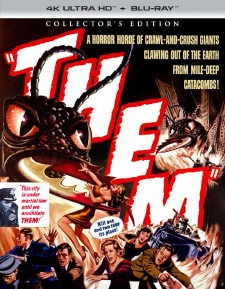
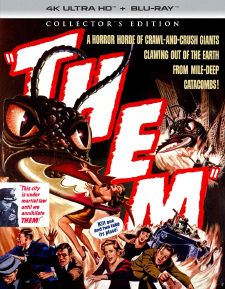
The Shout! Studios 4K Ultra HD release ofThem!is a two-disc set that includes a Blu-ray with a 1080p copy of the film. It also includes a slipcover that duplicates the theatrical poster artwork on the insert. The following archival extras are included on the Blu-ray only:
- Them! Memories (HD – 4:57)
- A Nameless Terror (HD – 17:23)
- Entering the Atomic Age (HD – 9:40)
- Behind-the-Scenes Footage (Upscaled SD – 2:51)
Shout! has added three new extras for this release. Them! Memories is an interview with Richard Bellis (aka “Dickie” Bellis), who acknowledges that while he was an 8-year-old child actor at the time, he wasn’t as much of an actor as Sandy Descher was. He struggled with being able to generate the tears that Gordon Douglas wanted during the finale, but Douglas played a bit of a trick on him (and on his mother) in order to get him to cry. (To Douglas’ credit, he made up for it afterward, and Bellis says that he wasn’t scarred by the experience.)
Speaking of Douglas, A Nameless Terror is a featurette honoring the director, hosted by author/screenwriter C. Courtney Joyner. He provides an overview of the state of Warner Bros. at the time, and expands the field to include writer Ted Sherdman and producer David Weisbart, both of whom had worked with Douglas previously. Joyner says that Douglas admitted that he did some good films and some lousy ones, but he recognized that the script for Them! was a bit different. That’s part of what made him insist on not using rear projection or other visual effects for the ants, since he wanted them grounded in reality. (The fact that the film was originally intended to be in 3-D was of course another factor.) Joyner also briefly addresses the career of Douglas post-Them!.
Entering the Atomic Age is a look at James Arness, with Western film historian Rob Ward discussing the films that Arness made with John Wayne and his move into the science fiction genre with The Thing from Another World and Them!. He also briefly addresses James Whitmore and Fess Parker’s performances.
Finally, there’s an archival collection of Behind-the-Scenes Footage that was included on both the Blu-ray and DVD versions of Them!. It’s actually a collection of slated outtakes that show off how the ant puppets worked (and didn’t work), proving that editor Thomas Reilly deserves a fair share of the credit for how well that they work in the final film.
While it’s nice to have some new extras, as an extras package goes, this is still rather slim pickings. But Them! stands on its own with or without any extras, and it’s never looked better on home video than it does here. Shout’s 4K Ultra HD release is highly, highly recommended for monster movie aficionados, and for pretty much everyone else as well. Them! belongs on the shelf of every self-respecting movie fan, regardless of genre preferences.
-Stephen Bjork
(You can follow Stephen on social media at these links: Twitter, Facebook, BlueSky, and Letterboxd).