
Stunt Man, The: Limited Edition (4K UHD Review)
Director
Richard RushRelease Date(s)
1980 (February 23, 2026)Studio(s)
Melvin Simon Productions/20th Century Fox (Transmission/Radiance Films)- Film/Program Grade: A
- Video Grade: A
- Audio Grade: B+
- Extras Grade: A


Review
[Editor’s Note: This is a Region-Free 4K Ultra HD British import.]
It’s rare that an illusion vs. reality film gives away the entire game in the first few minutes, but Richard Rush’s The Stunt Man does just that before the opening credits have even finished. After a buzzard collides with a helicopter, the pilot shouts “That goddamned crazy bird, he tried to kill us!” His unseen passenger Eli Cross (Peter O’Toole) takes a bite out of an apple and replies:
“That’s your point of view. Shall we stop and ask the bird what his was?”
It’s a throwaway moment (quite literally so, since Eli immediately tosses the apple out the window), but it establishes the fact that the entire film is going to revolve around the intersection between perceptions and paranoia, where even attempted murder may not be what it appears to be. This moment also establishes the role of chance in driving the way that people connect with each other: the buzzard had been minding its own business until a pair of telephone linesmen threw a piece of food at it to scare it away, and after it bounces off the helicopter’s canopy while fleeing, the apple that Eli carelessly tosses out the window will end up landing on the roof of a police car. The officers inside of it are about to enter a diner in pursuit of an escaped fugitive named Cameron (Steve Railsback), and before long, both Eli and Cameron will become an important part of each other’s lives.
That’s because Eli Cross is a director on location in California in order to shoot his new anti-war film set during World War I. Cameron is a shellshocked Vietnam veteran who has been accused of attempted murder, and while fleeing the police, he inadvertently stumbles into a stunt gone awry. That draws the attention of Eli, who needs a new stuntperson as much as Cameron needs a place to hide. So, Cameron takes on a new identity as the stunt double for Raymond Bailey (Adam Roarke), which serves as a disguise to help avoid the attention of the local police chief Jake (Alex Rocco). Along the way, Cameron romances the film’s volatile leading lady Nina Franklin (Barbara Hershey), all while trying to learn the trade from stunt coordinator Chuck Barton (played by real-life stunt legend Chuck Bail). But Cameron doesn’t know the first thing about the film business, and he’s unable to distinguish between fantasy and reality even while working behind the scenes. Soon, he starts to suspect that Eli is planning an attempted murder of his own, with his new stuntperson serving as a sacrificial lamb on the alter of the director’s ego.
Perception is everything when it comes to The Stunt Man, or perhaps it would be more accurate to say misperception. Everything depends on one’s point of view, and while the helicopter pilot may have felt that the buzzard was trying to kill them, the bird almost certainly felt that they were the ones who were trying to kill it. Rush offers a window into both points of view during the opening moments of the film, but as soon as Cameron enters the picture, the film switches exclusively to the vet’s skewed perspective. It may be third-person camerawork, but it’s still a first-person point of view. As a result, The Stunt Man blatantly cheats the actual filmmaking process, but that’s because Cameron doesn’t understand the first thing about it. We see what he thinks that he sees, and since his perceptions can’t be trusted, neither can ours. Eli tries to explain the power of cinematic illusion to Cameron, but even that can’t be trusted:
“Did you not know, that King Kong the first was just three foot six inches tall? He only came up to Fay Wray’s belly button? If God could do the tricks that we can do, he’d be a happy man.”
In reality, the two stop-motion puppets for the 1933 King Kong were less than half that height; they wouldn’t have come up to the belly button of Eli’s mythical version of Kong, let alone to Fay Wray’s. This error was doubtless an intentional one on Rush’s part, because since Eli is actively playing games with Cameron, Rush is actively playing games with his audience. Eli does indeed have a god complex, and he’s more than willing to lie, cheat, and manipulate in order to get the results that he wants. He intentionally humiliates Nina in front of her parents as a way of getting a more authentic performance out of her, and that’s partly why Cameron believes that Eli is willing to murder his own stuntpeople in order to get the perfect shot. Our perceptions are limited by our biases, and since we’re not the ones suffering from PTSD, Rush limits our perceptions in The Stunt Man in order to manipulate us into feeling what Cameron feels.
We can’t trust what Rush is showing us any more than Cameron can trust what Eli is telling him. Earlier in the film, when Cameron asks “Why are you trying to save my ass?”, Eli responds: “Because you’re as crazy as the young man I’m making this film about. Besides, I’ve fallen madly in love with the dark side of your nature.” That’s true enough, since Eli hasn’t been able to capture what he calls the “authentic stench of madness” in his film, and he’s in desperate need of a little of Cameron’s darkness. He constantly pushes his longsuffering screenwriter Sam (Allen Goorwitz) for rewrites, complaining that “We’re shaking a finger at them Sam, and we shouldn’t. If we’ve anything to say, it’s best to slip it in while they’re all laughing, and crying, and jerking off at all the sex and violence.”
Neither Eli nor Sam have been able to capture the madness of war without spelling it out clumsily, but Cameron is able to provide a glimpse into the authentic kind of madness that they both needed to make a truly effective anti-war film. The open question in The Stunt Man, of course, is just how far that Eli is willing to push Cameron in order to get it. And the only person who can provide an answer is Richard Rush, but until the very final moments of the film, it’s also an open question just how far that he’s willing to push his own viewers to make them share in Cameron’s paranoia. In forcing us to share those perceptions (and misperceptions), our point of view becomes Cameron’s, and so Rush’s point of view becomes Eli’s. He’s manipulating us from his godly perch behind the camera just as blatantly as Eli manipulates his entire cast and crew—at least until the final moments of the film, anyway, but even that’s not the last word on the subject. After everything seems to resolve and the closing credit scrawl has concluded, Eli rudely breaks the fourth wall in a last-minute voiceover:
“Sam, rewrite the opening reel. Crush the little bastard in the first act!”
And then the image fades out, accompanied by his maniacal laughter, which could just as easily be Rush’s own. Rush set out to crush us in the first act of The Stunt Man, and he even warned us up front that he was going to do just that, but we’re all easily fooled by the illusions of cinema. King Kong the first may not have been three foot six inches tall, but God still would have been happy to perform such trickery, and Richard Rush was delighted to fool all of us in The Stunt Man.
Cinematographer Mario Tosi shot The Stunt Man on 35mm film using Panavision Panaflex cameras with spherical lenses, framed at 1.85:1 for its theatrical release. This version is based on a 4K scan of the original camera negative, digitally remastered by Heavenly Movie Corporation under the direction of Radiance Films, with HDR and SDR grading performed by Stephen C. Horne (both Dolby Vision and HDR10 are included). There’s some dirt on the opening opticals, especially during the animated titles, and the image is understandably soft with some frozen grain that’s also due to the optical work. Once they’re over, things tighten up dramatically (although there are a few optical zoom-ins throughout the rest of the film that still look coarse). There are a handful of prominent white scratches visible in shots like the one at 15:27, but for the most part, any other damage is of the single-frame variety and it’s not really noticeable in motion.
The image is generally as sharp and detailed as it can be, although it’s worth remembering that Tosi frequently employed diffusion and reflected light sources, both of which soften the image at times. That also flattens the contrast range a bit in those shots, but that’s just the nature of the cinematography. Otherwise, the contrast range is excellent, the colors look accurate, and densities appear solid throughout. (There’s just a bit of fluttering in Cameron’s final confrontation with Eli over pay, but that may simply be a visual artifact from the helicopter blades whirring overhead.) David Mackenzie at Fidelity in Motion handled the encoding onto a BD-100, so needless to say there isn’t a whiff of any issues in that regard, and the film’s variable grain structure is all handled with precision. It’s a fantastic visual upgrade for The Stunt Man.
Audio is offered in English 2.0 mono and 5.1 DTS-HD Master Audio, with optional English SDH subtitles. The Stunt Man was released theatrically in mono, but Anchor Bay produced a multichannel remix back in 2001, and presumably this is a lossless version of the same mix (that one was actually 5.1 EX with an encoded rear surround channel, but there’s no way of knowing if it’s still encoded that way here). For the most part, it sounds like a repurposing of the original dialogue, music, and effects stems without adding any new sound effects, so it’s entirely in character with the original mono mix—even the bit of bass rumble from the idling police car at the beginning of the film is nearly identical on both tracks. Yet if you believe that any kind of remixing is a bridge too far, the original mono is still an option here, and it’s been upgraded to lossless, too (both the Anchor Bay DVD and Severin’s Blu-ray only offered lossy Dolby Digital). Personally, I prefer giving Dominic Frontiere’s wondrously wry score as much breathing room as possible, so I lean toward the 5.1 track, but your own mileage may vary and it’s good to have options.
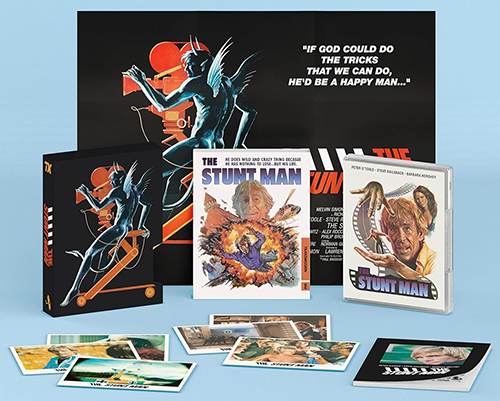
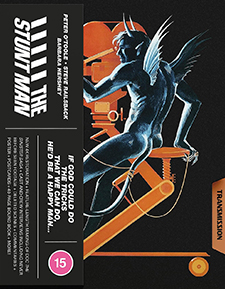
The Radiance Films Region-Free Limited Edition 4K Ultra HD release of The Stunt Man is #002 in their Transmission line. It’s a two-disc set that includes a Region-Free Blu-ray with a 1080p copy of the film. It also includes a slipcover, 6 art cards, a foldout poster featuring the classic “devil” artwork, and a 40-page booklet with essays by Adam Nayman and Brandon Streussnig, plus a 1990 interview with Richard Rush by Kenneth Turan. Everything comes housed inside a rigid hardbox with one of Radiance’s removable obi strips on the side. The slipcover and the insert on the case each offer different alternate poster designs while the hardbox uses the “devil” artwork, so you’re pretty much covered at every stage of the packaging. It’s limited to 5,000 units, but there are still copies available as of this writing. The following extras are included:
DISC ONE: UHD
- Introduction from Richard Rush (Upscaled SD – 4:24)
- Commentary by Richard Rush, Peter O’Toole, Steve Railsback, Barbara Hershey, Alex Rocco, Sharon Farrell, and Chuck Bail
- Commentary by Monica Castillo and Christina Newland
DISC TWO: BD
- Introduction from Richard Rush (Upscaled SD – 4:24)
- Commentary by Richard Rush, Peter O’Toole, Steve Railsback, Barbara Hershey, Alex Rocco, Sharon Farrell, and Chuck Bail
- Commentary by Monica Castillo and Christina Newland
- The Sinister Saga of Making The Stunt Man (Upscaled SD – 114:21)
- Chuck Bail (HD – 10:06)
- The Maverick Career of Richard Rush (HD & Upscaled SD – 34:18)
- Peter O’Toole on The Stunt Man (HD – 18:46)
- Devil’s Squadron: Steve Railsback and Alex Rocco (HD – 18:59)
- Barbara Hershey on Nina Franklin (HD – 14:23)
- New Beverly Q&A (HD – 17:18)
- Deleted Scenes (Upscaled SD – 5:55, 3 in all)
- Trailer (Upscaled SD – 2:05)
Radiance has added a new commentary track featuring critics Monica Castillo and Christina Newland. They explore the career of Richard Rush, the development of the script for The Stunt Man, its changes from the novel, and they also note the similarities between the eccentricities of Rush and those of Eli Cross—the latter of whom usually appears as a godlike figure descending from above. They discuss the history of stuntpeople and films about stuntpeople, before diving deep into The Stunt Man itself, including the importance of Dominic Frontiere’s score. Castillo and Newland consider The Stunt Man to be one of the great movies about movies, and it’s hard to argue with that.
There’s also a new interview with Chuck Bail, excerpted from Craig Railsback’s upcoming documentary Rush: The Director’s Cut. Bail describes the circuitous path that eventual led him to his career in film, first as an extra and eventually as a stuntperson. Bail has a long history with Richard Rush going all the way back to Hell’s Angels on Wheels in 1967, and he credits Rush with having influenced his career. But Bail had some influence in return, as he describes in a case where Rush used one of his ideas in The Stunt Man.
The rest of the extras are archival, starting with the group commentary that was originally recorded for Anchor Bay Entertainment’s 2001 DVD. It’s a curated track with the participants recorded separately (or at least in smaller groups) and then edited together. Richard Rush discusses the themes of The Stunt Man and his stylistic choices, all while telling some tales about the production. (He’s also prone to narrating what’s happening onscreen, unfortunately.) Steve Railsback, Barbara Hershey, Chuck Bail, Peter O’Toole, Alex Rocco, and Sharon Farrell focus on their own experiences making the film. But Rush is the dominant voice, so your mileage may vary depending on your tolerance for his quirks, but there’s still some good material here.
Speaking of tolerance for quirks, there’s The Sinister Saga of Making The Stunt Man, a feature-length home video documentary written and directed by Rush himself for Anchor Bay’s 2001 DVD. It opens with a montage of the lavish praise that Rush has received, which could charitably be described as tongue-in-cheek, but it seems pretty clear where the egomania of Eli Cross came from. The Sinister Saga also includes interviews with Railsback, Hershey, O’Toole, Bail, Farrell, and more, but Rush remains front and center (he even has conversations with himself via split-screen). Yet he does provide an invaluable overview of the complicated path that The Stunt Man took to reach the screen, as well as his own thoughts about the film’s themes. There’s also a deleted scene that’s not available elsewhere, which Rush says that he regrets cutting (and boy, was he ever wrong about that). Yet by the end of The Sinister Saga, when Rush details his painful battles with getting any distribution at all for The Stunt Man, his egotism becomes more understandable, if not necessarily sympathetic. It takes a village to make a film, but it took Richard Rush to get The Stunt Man across the finish line against all odds.
(Note that the Introduction from Richard Rush is just an excerpt the first few minutes of The Sinister Saga. It’s included here separately because that’s how Anchor Bay did it on their DVD.)
The other two Deleted Scenes included on the disc are equally dispensable: Sand Pile and Police Station. The former is a somewhat redundant conversation between Eli and Sam, while the latter is an over-the-top scene where Eli takes Nina to the police station in order to retrieve Raymond, who had been arrested for indecency. They’re interesting, but The Stunt Man is far better without them.
The rest of the extras were produced for the 2011 Blu-ray from Severin Films. The Maverick Career of Richard Rush is just that, an interview with Rush that covers his career from his Roger Corman days to films like Getting Straight, Freebie and the Bean, The Stunt Man, and The Color of Money, including his disappointing experience losing control of his original screenplay for Air America. Devil’s Squadron is an interview with Steve Railsback and Alex Rocco, who became friends during the making of The Stunt Man and maintained the relationship until Rocco’s passing just four years after this interview was conducted. Peter O’Toole on The Stunt Man features the icon making the point that good parts make good actors, but the really good actors are the ones who recognize those good parts. Barbara Hershey on Nina Franklin is also self-explanatory, with her thoughts about the character and the experiences of making The Stunt Man.
Finally, there’s the New Beverly Q&A that took place after a 2001 screening of The Stunt Man, with Rush, Railsback, and Hershey on hand to answer questions from the audience about the making of The Stunt Man. Aside from some still galleries and a DVD-ROM version of the screenplay that was on Anchor Bay’s DVD, that’s all of the previously available extras for The Stunt Man, making Radiance’s version the most comprehensive one to date. Add in a significant visual upgrade and some damned fine packaging, and you have one best releases of 2026 so far. Act quickly while it’s still available—this is one set that’s not to be missed.
-Stephen Bjork
(You can follow Stephen on social media at these links: Twitter, Facebook, BlueSky, and Letterboxd).