
Shane (4K UHD Review)
- Review Date: Aug 14, 2025
- Format: 4K Ultra HD
-


Director
George StevensRelease Date(s)
1953 (July 15, 2025)Studio(s)
Paramount Pictures (Kino Lorber Studio Classics)- Film/Program Grade: A
- Video Grade: A
- Audio Grade: B+
- Extras Grade: B

Review
When George Stevens set out to make Shane in 1951, he couldn’t possibly have had any idea of the challenges that he would face during the production—or of the impact that his film would end up having on generations of moviegoers. After a lengthy location shoot, some equally lengthy studio work, and a protracted post-production period, the finished film that finally reached theatres in early 1953 was well over schedule and significantly over budget. Paramount lost faith in Stevens during that process, but his vision never wavered (even if it took him 15 months of editing in order to refine that vision). Yet the studio’s lack of faith was still rewarded when Shane became a box office hit and a critical darling, garnering six different Academy Awards nominations including Best Picture and Best Director. Yet while many Oscar nominees (and even more than a few winners) have long been forgotten, Shane still stands out as a landmark Western, one that helped to reshape the way that the genre evolved over the next two decades.
Stevens wastes no time establishing the unforgettable setting for Shane from the moment that the opening credits start to roll. Shane (Alan Ladd) is seen riding his horse through beautiful Technicolor landscapes of Jackson Hole, Wyoming, with the Grand Teton mountain range looming in the background. Cinematographer Loyal Griggs kept his cameras at a distance, shooting with long lenses in order to flatten the image and make the mountains seem even more imposing than they do in real life. While John Ford had already become indelibly associated with the pictorial beauty of Monument Valley, it tended to serve as little more than a backdrop in his films. Stevens’ strategy in Shane was more akin to Anthony Mann’s Westerns, where the rugged landscapes served a thematic purpose, providing an exterior visual representation of the internal mental state of his characters. That’s why Griggs shot the vistas the way that he did, effectively foregrounding the background. As the credits finish and Shane rides toward a small homestead, that tiny symbol of civilization ends up being dwarfed by the untamed natural world that surrounds it.
It’s at that point that Stevens deftly establishes the main theme of Shane. The homestead is owned by Joe Starrett (Van Heflin) along with his wife Marian (Jean Arthur), and their young son Joey (Brandon DeWilde) is playing outside their cabin. He’s carrying an unloaded rifle, pretending to shoot at a nearby deer, when he spots Shane riding up. Stevens holds Joey’s face in extreme closeup, his piercing eyes framed through the bushes as he gazes at this mysterious stranger. That’s no accident, because despite the title, this is Joey’s story, not Shane’s. We’ll end up seeing Shane through his eyes for the rest of the film, regardless of whether or not the boy is actually present at any given moment. Yet just to make sure that viewers don’t forget that fact, Stevens continues to feature closeups of Joey’s face as he gazes longingly at Shane. It’s a love story between a boy who yearns to come of age, and an older man who symbolizes the adulthood that still remains tantalizingly out of reach.
It’s also no accident that Stevens took such care to ensure that audiences knew that the story was being framed through Joey’s eyes. Shane is based on the 1949 novel by Jack Schaefer, which was written from a first-person perspective as if it was the memoirs of an older version of young Starrett (although he’s named Bob in the book). The adaptation by A.B. Guthrie, Jr. and Jack Sher follows the broad strokes of Schaefer’s story, which drew inspiration from the way that the various Homestead Acts had led to the violence of the Johnson County War in Wyoming. It’s a familiar conflict that’s been the subject matter of a variety of different films, from multiple versions of The Virginian to Heaven’s Gate. Yet in Stevens’ sure hands, it’s not just a setting, but also a thematic representation of the conflict that lies in the heart of Shane himself. Shane is a man with a violent past who yearns for the relatively simple lifestyle of the Starrett household, but he’ll never be able to escape who he is and what he’s done.
Not for lack of trying, though. Joe Starrett ends up hiring Shane as a ranch hand, and the gunfighter happily throws himself into the menial labor. Yet he’s inevitably drawn into the conflict between Starrett and wealthy cattle baron Rufus Ryker (Emile Meyer). Despite the fact that the homesteaders in the area all have legitimate claims, Ryker wants them off of the land that he still considers to be his. That puts Shane in the middle, with Ryker’s henchmen like his brother Morgan (John Dierkes) and Chris Connelly (Ben Johnson) on one side, and the various homesteaders like Joe Starrett, Fred Lewis (Edgar Buchanan), and Frank “Stonewall” Torrey (Elisha Cook, Jr.) on the other. Shane tries to keep the peace, even willingly subjecting himself to humiliation at one point in order to prevent a more serious confrontation. Yet when Ryker hires gunfighter Jack Wilson (Jack Palance) to end things by any means necessary, Shane has no choice but to take up his own guns to protect the people that he’s grown to love back.
That’s because Shane has also found himself in the middle of a conflict of a very different sort, with both Joey and Marian finding themselves attracted to the frontier masculinity that he represents, and Joe Starrett having to vie for their affections. Yet while Joey is thrilled that Shane is an experienced gunfighter, Marian has an absolute abhorrence of guns in any form. (In that respect, she serves as a mouthpiece for George Stevens himself, who was scarred for life by what he witnessed while serving in the Signal Corps during World War II.) When Marian catches Shane teaching Joey the tools of the trade, she firmly puts the kibosh on the lesson:
“Guns aren’t going to be my boy’s life!”
“A gun is a tool, Marian; no better or no worse than any other tool: an axe, a shovel or anything. A gun is as good or as bad as the man using it. Remember that.”
“We’d all be much better off if there wasn’t a single gun left in this valley—including yours.”
However much that Marian may be attracted to Shane, she has no illusions about who he is and what he’s done, and she understands him better than he understands himself. No matter how much he tries to play the role of a homesteader, Shane will never be able to escape his own past, which also means that any roots he lays down are only temporary at best. She warns Joey not to get to liking Shane too much because he’ll be moving on one day. Yet as she speaks those words aloud, she recognizes that it’s a warning to herself as much as to Joey. And she’s right, too, because after Shane settles the conflict with Ryker once and for all, he gets back on his horse and rides away from the Starrett homestead, never to return. Joey begs him to stay, but Shane finally understands the truth about himself and what he represents:
“A man has to be what he is, Joey. Can’t break the mold. I tried it and it didn’t work for me.”
“We want you, Shane.”
“Joey, there’s no living with... with a killing. There’s no going back from one. Right or wrong, it’s a brand. A brand sticks. There’s no going back. Now you run on home to your mother, and tell her... tell her everything’s all right. And there aren’t any more guns in the valley.”
So, just as Shane’s entrance into civilization was framed through Joey’s eyes, his exit is also seen from Joey’s point-of-view. Yet Stevens couldn’t resist putting one last authorial stamp of his own on the moment. As Shane rides off into the distance, he moves through the graveyard that holds some of Ryker’s and Wilson’s victims. The graveyard is located on a hill, and after Shane passes the crest, he disappears behind it as if descending into the grave itself. The same fate may ultimately await all of us, but those who choose a life of violence are actively riding toward it. It’s a theme that was near and dear to Stevens’ heart, and that’s one of the big reasons why Shane has lost none of its impact over the decades since it was first released. When Clint Eastwood remade the film (in all but name only) as Pale Rider in 1985, he softened that theme somewhat to fit more comfortably within the “peace through strength” ethos of Reagan-era America. Yet forty years after Eastwood’s take on the material, which was already thirty years removed from the original film, George Stevens’ message still resonates. Shane will always stand as a warning to remain ever vigilant against the seductiveness of violence. Sometimes, just like Joey, we’ve all got a little growing up to do.
Cinematographer Loyal Griggs shot Shane on 35mm film in three strip Technicolor, framed for the 1.37:1 aspect ratio that was still common when the film went into production in 1951. Yet by the time that it was actually released in 1953, the move toward widescreen was well underway, and Paramount mandated a matted 1.66:1 aspect ratio for it instead. Thus, we have another confusing entry into the wild west of the early days of widescreen, which complicates discussions about original aspect ratios. Shane was intended for 1.37:1, but exhibited at 1.66:1, so which one is actually the “original” aspect ratio? You’ll get a different answer depending on who you ask, and no matter how dogmatic the reply, there’s no clear-cut definition for the term. Some labels have solved the dilemma by releasing films from this period in multiple aspect ratios, even as many as three different ones: 1.37:1, 1.66:1, and 1.85:1, so you can choose your own adventure. Obviously, that’s not always practical or cost-effective, so it’s an uncommon approach.
In the case of Shane, while most previous home video releases have been open-matte 1.33:1, Eureka’s 2015 Region B Blu-ray did indeed offer both 1.37:1 and 1.66:1. So, if 1.66:1 is the hill you want to die on, that’s your best bet, because Paramount’s new 4K master is 1.37:1 only. This version is based on 4K scans of the original three-strip negatives, meticulously cleaned up and graded for High Dynamic Range in both Dolby Vision and HDR10. 1.37:1 is what both Stevens and Griggs intended, and in deference to them, that’s what Paramount and Kino Lorber are offering. The reality is that not only is 1.37:1 the intended aspect ratio for Shane, but the film looks much better that way. While cropping for 1.66:1 doesn’t create as many egregious headroom issues as a 1.85:1 ratio would have, the compositions still look much more natural and correct at 1.37:1. There’s not really any room for debate about that. (If you have any doubts, watch the included 1.66:1 trailer, where the heads sometimes dip in and out of the top of the frame.)
With that out of the way, let’s cut to the chase, Shane is a marvel in 4K. The image is sharp and stable, with no registration issues or color fringing due to combining the three separate negatives. The title sequence and any optical transitions like the fades were derived from dupe elements and look softer in comparison, but everything else is as sharp as humanly possible. The stark closeups of Brandon deWilde and Emile Meyer stand out in particular, with the fine details of their faces and their hair being resolved perfectly. (In contrast, Griggs tended to apply some diffusion to the closeups of Alan Ladd, so those are intentionally softer.) Presumably some light grain reduction was applied because layering three negatives on top of each other usually turns the grain into a swarming mess (an issue that resolved itself naturally back in the day due to the dye-transfer printing process), but in this case, the grain is sharp and clearly defined—much more so than it is on the accompanying Blu-ray from the same master. Thanks to a healthy bitrate on a BD-100 disc, there aren’t any issues with compression artifacts, either. There’s still some light black speckling in the shot at 87:43, but aside from that, there’s no other damage of note.
And the colors! Them’s right purty. The HDR grade and Wide Color Gamut provides much more detail to the colors than are available on the Blu-ray—they’ve got that vivid Technicolor appearance, but there’s a lot of subtle variations within the brighter primaries. The contrast range is outstanding, with darker details like the blacks of Jack Palance’s costume resolving better against the darkness of the interiors. The day-for-night shots look convincingly dark, too—they’re much better on the UHD than they are on the Blu-ray, which brightens them a bit. Some people complain that HDR looks too dark on their displays, but in this case these shots look properly dark. Aside from the barely visible speckling mentioned earlier, there’s little to complain about here. This is as beautiful as Shane can possibly look on home video.
Audio is offered in English 2.0 DTS-HD Master Audio, with optional English subtitles. Shane was initially released in optical mono, but later re-released in 3-channel stereo (L/C/R). The music was recorded and mixed in mono, as were the sound effects, so that 3-channel mix wouldn’t have been true stereo, but rather reworked mono. Unfortunately, as with many such mixes from that era, it appears to be lost. Chace Audio created their own pseudo-stereo mix which has appeared on a few releases, but this doesn’t seem to be that version, either. Yet it’s not true mono, because it doesn’t decode cleanly to the center channel. Victor Young’s lush score remains spread into the right and left channels, while the dialogue and effects are more centered. For the most part, it still has a mono feel.
Regardless, the dynamics are still strong, which is crucial for reproducing George Stevens’ intentions for Shane. He wanted the gunfire to be shockingly loud, and went to great lengths to create that effect. They’re still startling after all these years. For a traditional Western, there’s not as much gunfire as you might expect, but each and everyone one of them has the impact that Stevens wanted. There’s not much in the way of distortion to mar the experience, and the only noticeable artifact is some faint crackling that can occasionally be heard in the background, usually at reel changes. Yet you’re not going to notice it unless you go looking for it. Overall, the sound in this track is a great match for the gorgeous visuals.
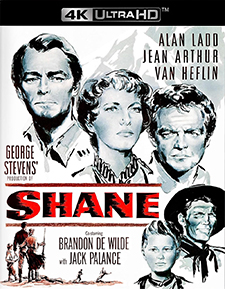
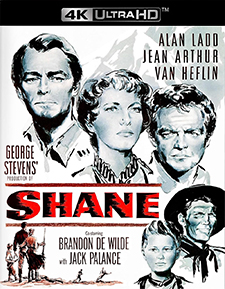
The Kino Lorber 4K Ultra HD release of Shane is a two-disc set that includes a Blu-ray with a 1080p copy of the film. There’s also a slipcover that duplicates the theatrical poster artwork on the insert. The following extras are included (note that most of the trailers sourced from SD have been upscaled to 720i here, with the exception of Gunfight at the O.K. Corral, which is full 1080p):
DISC ONE: UHD
- Audio Commentary by Alan K. Rode
- Audio Commentary by George Stevens Jr. and Ivan Moffat
DISC TWO: BD
- Audio Commentary by Alan K. Rode
- Audio Commentary by George Stevens Jr. and Ivan Moffat
- Trailer (Upscaled SD – 1:59)
- Whispering Smith Trailer (Upscaled SD – 1:01)
- The Plainsman Trailer (Upscaled SD – 2:21)
- The Lonely Man Trailer (Upscaled SD – 2:18)
- Tomahawk Trailer (Upscaled SD – 2:20)
- High Noon Trailer (HD – 1:37)
- Gunfight at the O.K. Corral Trailer (Upscaled SD – 2:13)
- The Big Country Trailer (HD – 2:56)
- No Name on the Bullet Trailer (Upscaled SD – 2:05)
- Horizons West Trailer (Upscaled SD – 2:22)
Kino Lorber has added an all-new commentary featuring author and film historian Alan K. Rode, who calls Shane the most personal of Stevens’ films, and a triumph of cinematic craftsmanship over tight-fisted studio controls—his track record of success gave him more leeway with the studios than most other directors from the era were granted. Rode provides a wealth of detail regarding the production of the film, including the differences between the book and the film, as well as the lengthy 15-month editorial process. He also breaks down the history of the Homestead Act and the Johnson County War, which inspired Jack Schaefer’s novel and many, many other Western tales. He even dives into minutiae like how Bill Scott created the opening titles by painting sawdust that he molded into lettering, as well as the aspect ratio controversy. It’s a great commentary, and unquestionably one of the best places to start if want to learn more about Shane.
The archival commentary with George Stevens, Jr. and producer Ivan Moffat was originally included on Paramount’s 2000 DVD release of Shane. They provide more of a first-hand perspective on the making of the film, both from their own experiences, and from sharing the notes that George Stevens Sr. had made during the production. As a result, they dive even deeper into his thought processes regarding the story and themes of Shane. They’re more prone to stopping to watch what’s happening onscreen, but there’s still plenty of valuable insights in this track.
While archival commentary is the only significant extra that’s appeared on multiple releases throughout the years, the aforementioned Eureka Blu-ray did include an interview with Neil Sinyard and the vintage Lux Radio Theatre adaptation of Shane. But Kino adds a great new commentary of their own, and the video quality here puts all other previous versions to shame. It’s not even close (unless you’re really, really insistent on 1.66:1 as an aspect ratio, and even if you do, you can always just zoom in if your players and/or display allows it). It’s a mandatory upgrade for fans of George Stevens and classic Westerns, and it belongs in any serious film lover’s library.
- Stephen Bjork
(You can follow Stephen on social media at these links: Twitter, Facebook, BlueSky, and Letterboxd).