
Robert Taylor Collection (Blu-ray Review)
Director
Anthony Mann/William A. Wellman/Richard Thorpe/Richard BrooksRelease Date(s)
1950/1951/1953/1956 (January 13, 2026)Studio(s)
Metro-Goldwyn-Mayer (Warner Archive Collection)- Film/Program Grade: See Below
- Video Grade: See Below
- Audio Grade: See Below
- Extras Grade: B-
- Overall Grade: A-

Review
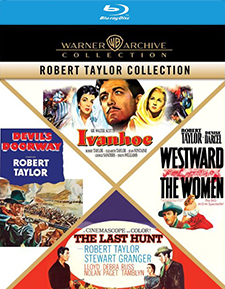
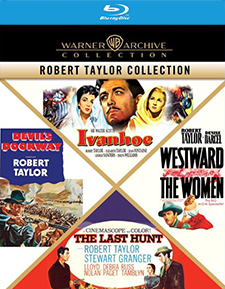
Yet another Warner Archive 4-fer, this set focuses on actor Robert Taylor (1911-69), hugely popular throughout the 1930s-’50s, yet unlike contemporaries like Henry Fonda and Jimmy Stewart, almost forgotten today. I long held an aversion to Taylor, partly because he spent most of his career at MGM, whose typical vehicles I often didn’t care much for, but mostly because of Taylor’s far-right politics as a co-founder of the Motion Picture Alliance for the Preservation of American Ideals and because of his testimony before HUAC, where he named names and helped get a number of people blacklisted. Yet, over time, I’ve come to respect him more as an actor. His stern looks and steely-blue eyes made him suited to villainous roles as much as MGM leading man-type parts, yet he was undeniably versatile, though his range wasn’t great.
Taylor’s abilities are exemplified in this four-movie set. Three of the films are outstanding, and the fourth is very good and somewhat unusual, if unsubtle, overwritten by its ambitious director.
Though less well-known than his Westerns for Universal-International (usually with Jimmy Stewart), Anthony Mann’s Devil’s Doorway (1950) is as great as the best of those, a searing drama of white bigotry toward Native Americans. Conventional wisdom regards Henry King’s The Gunfighter, Delmer Daves’s Broken Arrow, and Mann’s own Winchester ’73 as the seminal Western films of 1950, movies that transformed the genre, but Devil’s Doorway is no less deserving of that honor. Indeed, somehow, it’s more brutally honest, more realistic and uncompromising than Daves’s otherwise superb Broken Arrow. In some respects, Devil’s Doorway is more like Mann’s Border Incident (1949), which he made immediately prior, about the human trafficking of Mexican migrant workers, in its similar directness and condemnations. Both Devil’s Doorway and Border Incident were two full decades ahead of their time, and still shocking seen today.
Civil War veteran and Medal of Honor recipient “Broken Lance” Poole (Taylor), a full-blooded Shoshone Indian, returns home to Medicine Bow, Wyoming, after the war, where the town’s mostly white population resent his success with a large cattle ranch on a large and valuable tract of prime land. Openly racist, opportunistic attorney Verne Coolan (Louis Calhern) organizes sheepherders to homestead, Coolan earning money as an advisor, and legally if immorally strip Poole of his property.
Poole engages pioneering female attorney Orrie Masters (Paula Raymond), but they learn that, regardless of Poole’s Medal of Honor and years of valiant military service, the U.S. government does not regard him nor any other Indian as American citizens, but wards of the federal government; he can’t even obtain a proxy to homestead on his behalf and essentially has no rights of any kind. When Coolan eggs the sheepherders on to dispossess Poole of his land by force, he and other Shoshone who’ve fled the reservation stand their ground, using Poole’s cabins as a makeshift fort. A desperate Masters telegraphs the U.S. Cavalry to prevent a bloodbath, but on whose behalf will they fight?
Ricardo Montalbán, under contract to MGM at this time, probably would have been a better casting choice than Taylor, whose steely blue eyes aren’t remotely Native American, nor can the obvious hairpiece he wears help create much suspension of disbelief, but his strong performance impresses. The multi-layered screenplay by Guy Trosper (One-Eyed Jacks, Birdman of Alcatraz, The Spy Who Came in from the Cold) provides Taylor with one of his best screen characters. Poole served his country honorably, and the thanks he gets from the government he served is they allow blatant racists to steal his ancestral land and even enforce their legal right to do so. A diplomatic, even empathetic sheepherder (Marshall Thompson) attempts to obtain through Masters water and grazing rights, but Poole outright refuses to even consider this reasonable compromise. By stubbornly refusing to give an inch, Poole seals his fate, no matter that he’s morally in the right.
Until... well, recently, such out-in-the-open public racism was largely confined to the American South, and the confrontations between Poole and Coolan are disturbingly tense. Louis Calhern, maybe MGM’s best actor after Spencer Tracy, plays Coolan as highly intelligent and manipulative, getting others like cowboy Ike (James Millican) to make the most bigoted attacks on Poole, as bystanders look on in unreactive shock (or support). He’s much like William Shatner’s racist instigator in Roger Corman’s brilliant The Intruder (1962), except like his name Coolan keeps a cooler head than true believer Shatner does.
There are numerous awful moments, such as when Poole rides into town, to confront a doctor (Henry Antrim) who simply refuses to treat Poole’s dying father (Fritz Leiber, Sr.), or when a previously welcoming bartender (Tom Fadden) nervously declines to serve Poole anymore because a territorial law forbidding him to sell alcohol to Indians.
Adding to the tragic realism of the story is that racism manifests even in Poole’s supporters. The local marshal (Edgar Buchanan) and Masters defer to “the law” even when that law is unjust – she won’t even touch him when he tries to help her down from her buggy. There’s much attention to detail: the movie opens with Poole still in his uniform and at first doesn’t seem like an Indian at all. Over the course of the story, however, he gradually sheds his white man’s clothes as if being reborn, an influential device reused later on the Charles Bronson film Chato’s Land and doubtless other Westerns.
In black-and-white and standard (1.37:1) aspect ratio, the video transfer of Devil’s Doorway is very good, though not quite excellent. First released as a single disc in May 2024, the audio is DTS-HD Master Audio (2.0 mono) with optional English subtitles. The disc, like the other four films in this set, is region-free. A trailer and two cartoons, The Chump Champ and Cue-Ball Cat, are tossed in as extra features, somewhat undermining the film’s greatness.
DEVIL’S DOORWAY (FILM/VIDEO/AUDIO/EXTRAS): A/A-/A/B-
An exceptional, frequently surprising film, Westward the Women (1951) is an underrated William A. Wellman-directed Western adapted from a story by Frank Capra. Its qualities seem much more Wellman’s doing than Capra’s, who had wanted to direct it himself with Gary Cooper in the lead, but in any case, the picture deserves to be better known. Robert Taylor stars as a wagon master leading 140 women across the 2,000-mile trail from Chicago to California, grimly and rightly predicting a lot of them will die along the way. He’s very good in this.
Based on a true story, the film opens in 1851 California, where prosperous rancher Roy E. Whitman (John McIntire, a part that like Ward Bond in Wagon Master, obviously led to his casting, as Bond’s replacement in fact, on Wagon Train), wanting to invest in his beloved valley’s future, decides to bring good women from back east to marry and start families with his hard-working ranch hands. He hires experienced scout Buck Wyatt (Taylor) to lead the ambitious wagon train, and after three months the two reach Chicago. Whitman approves 140 of the candidates, even though very few have any practical experience driving mules or firing guns. They actually need about 100 women but both Whitman and Buck expect a third will die along the way. Whitman refuses to take obvious prostitutes west, but allows French-born Fifi Danon (Dense Darcel) and Laurie Smith (Julie Bishop), who’re obviously eager to quit the trade and start life over again. Other women include Patience Hawley (Hope Emerson), the no-nonsense middle-aged widow of a New England sea captain; Mrs. Maroni (Renata Vanni), an Italian widow who speaks no English and who travels with her nine-year-old son, Antonio (Guido Martufi); Rose Meyers (Beverly Dennis), secretly pregnant with an illegitimate baby; and Maggie O’Malley (Lenore Lonergan), a farm girl and one of the few women who’s a crack shot. Buck hires 15 men to accompany them but their numbers dwindle quickly. He demands no fraternization with the women but they don’t take him seriously until Laurie is raped and Buck coldly, unhesitatingly shoots dead the offender for all to see.
(Mild Spoilers) Early on in fact, all but four of the men defect, leaving only Buck, Whitman, and two others: Ito (Henry Nakamura) a diminutive (even by Japanese standards) but very capable Asian cook, and a trail hand (Pat Conway), who has fallen in love with Rose (Beverly Dennis), though they’re keeping their feelings secret from Buck. When the men defect, a little less than halfway to California, Whitman assumes Buck will want to turn back but, partly to protect his own reputation, Buck insists on pressing forward, although that will mean the already exhausted women will have to work even harder.
Westward the Women is as remarkable as the women and their accomplishments. Though produced in 1951, near the peak of the Production Code’s authority over edgy content, and by MGM, still the most conservative of film studios even after liberal producer Dore Schary took over, the film is brutal, unsentimental, and largely uncompromised. As if to show it means business, the first to die on the trail is lovable nine-year-old Antonio, who is killed in a gun accident. Mrs. Maroni goes mad.
The picture holds little back in other ways. Darcel’s reformed-yet-untamed prostitute is unusually authentic (Darcel herself became a stripper in the 1960s and exudes raw sensuality here) and her French profanity is véritable. How it got past the censors is a wonder. (Nakamura also speaks untranslated Japanese much of the time.)
More importantly, the film’s depiction of these heroic women is never at all condescending in the usual Hollywood manner. Instead, most are simply inexperienced, but they adapt quickly and, in the film, realistically lose all pretense of glamour and are as sweaty and dirty and as hardworking as the men. A few complain but most do not. The actresses would, by and large, have been unfamiliar even to 1952 audiences—Taylor is the only real star—and this adds to the film’s verisimilitude.
An early scene demonstrates this well. Buck, much less optimistic about the women’s chances than Whitman, grills the candidates about their experience. “Who knows how to fire a gun?” Reasonably, only two out of the 140 women raise their hand but, when pressed to demonstrate their skill, they casually hit their target dead-on like seasoned gunfighters. Buck and Whitman are amused.
The film has very little underscoring, and the use of real but unfamiliar locations for the audience creates a stark image of how agonizingly difficult wagon train life must have been like. In another scene a wagon is slowly lowered down an impossibly steep, boulder-filled mountainside. The carriage becomes loose and with its woman driver still inside, it crashes spectacularly at the bottom. One of the women screams at the awful sight, but all realize there’s little to do but move on, and to get the next wagon in place.
Westward the Women’s transfer, again 1.37:1 and in black-and-white is a tad softer than I was expecting, but otherwise it’s fine and completely acceptable. And again, the disc is region-free with DTS-HD Master Audio (2.0 mono) and optional English subtitles. Supplements include an informative audio commentary by film historian Scott Eyman, a Lux Radio Theatre broadcast adapting the film (with Taylor and Darcel reprising their role), and an interesting 11-minute featurette released theatrically ahead of the movie’s premiere, Challenge the Wilderness, which includes some great footage of the cast and Wellman during production, along finally two Tom & Jerry cartoons: Texas Tom and Duck Doctor. Most of this was previously part of Warner Archive’s DVD version. A trailer is also included.
WESTWARD THE WOMEN (FILM/VIDEO/AUDIO/EXTRAS): A/A-/A/B+
Ivanhoe (1952) is superb for reasons completely different from the two earlier titles. Lavishly produced in Britain in Technicolor for $3.7 million, it’s old-fashioned in the best sense, a rousing, even stirring historical adventure excellent in practically every way, from its strong screenplay to its beautiful cinematography (by Freddie Young) and art direction (by Alfred Junge, formerly with Powell & Pressburger) and its all-star cast. Restored from the original black-and-white separation negatives, even the complex process shots are flawlessly executed and nearly imperceptible.
Adapted from Sir Walter Scott’s Ivanhoe: A Romance (1819), it may have been the original “crossover” story, with Robin Hood a supporting character in the story, Scott’s depiction influencing later refinements and adaptations that eventually had Robin and his Merry Men surpassing in popularity Scott’s literary hero. Richard the Lionheart is presumed dead, having vanished returning from the Crusades, but the Saxon Wilfred of Ivanhoe (Taylor) is certain Richard’s brother, Prince John (Guy Rolfe), ruling in his absence, is aware and possibly complicit in the king’s kidnapping, and that he’s being held prisoner in Europe. In the opening scenes, Ivanhoe locates King Richard in a castle in Austria.
Back in England and masquerading as a minstrel, Ivanhoe encounters Norman knights Sir Brian de Bois-Guilbert (George Sanders) and Sir Hugh de Bracy (Robert Douglas), Ivanhoe leading them to lodgings at the castle of Saxon Cedric (Finlay Currie), Ivanhoe’s estranged father, and where Ivanhoe’s betrothed, Rowena (Joan Fontaine), also resides. Ivanhoe hopes to raise 150,000 Austrian marks required as ransom to free Richard, but after his father rebukes Ivanhoe’s plea for help, he turns to displaced Jewish moneylender Isaac (Felix Aylmer), whose beautiful but lonely young daughter, Rebecca (Elizabeth Taylor), instantly falls for Ivanhoe. The Jewish community in England, spurred by Ivanhoe’s sincere promise that Richard will formally recognize the Jews and with help from Robin of Locksley (Harold Warrender) and his men of Sherwood Forest, unite all of England, begin raising the money to free Richard, but Prince John, Bois-Guilbert and Sir Hugh are soon on to Ivanhoe and his plans, and plot his destruction.
Although it changes and omits certain aspects from the original novel, the film of Ivanhoe doesn’t dumb it down, either, retaining its intelligent, and mostly historically correct political and religious divides. And while the important Jewish persecution subplot is present in Scott’s story, it becomes more significant in the film, perhaps reflecting the establishment of Israel and the idealized views held by many American Jews and gentiles, which soon after reached a kind of apex with Otto Preminger’s absurd Exodus.
In many respects, Ivanhoe is even better than Warner Bros.’s similarly-plotted classic The Adventures of Robin Hood (1938). I’m generally not much of a fan of historical swashbucklers, but everything in Ivanhoe clicks – it’s a perfect film of its kind, from Miklós Rózsa’s stirring musical score, to the superb stunt work supervised by the estimable Yakima Canutt. Robert Taylor, much like Charlton Heston immediately after, has the right look and all-in sincerity to pull off such larger than life figures, as precious few American actors can. It’s the kind of part that requires a committed performance, one that instead of winking at the audience and making light of the material, through Taylor the audience can truly believe Ivanhoe’s loyal and determination to restore for Richard the throne. (Heston in El Cid is another good example of this kind of acting. Christopher Reeve in Superman is a later example.) In turn, Taylor’s sincerity lifts the entire film. It has a grandeur and purpose usually lacking in other films of this kind. In this restored version, it becomes unexpectedly stirring, even moving, as well as colorful and action-packed.
All the actors come off well, most surprisingly George Sanders, who despite winning an Academy Award playing Addison DeWitt in All About Eve two years before, rarely appeared in roles worthy of his talent after that. Instead of the expected conniving cad, Sanders plays a knight subtly jockeying for power at the beginning of the story, but who becomes a tragic figure by the story’s end, all because he can’t help but fall in love with Rebecca, Elizabeth Taylor’s character. Taylor, for her part, was never better photographed than by Freddie Young. There’s a close-up of her near the end of the film that may be the best of her entire career.
Warner Archive’s Blu-ray of Ivanhoe, again in 1.37:1 standard frame, is another three-strip Technicolor stunner from the label. Probably owing to Freddie Young’s influence, the bright primary colors pop like crazy, but not in the garish manner that was MGM’s house style. While it’s definitely a product of early 1950s color cinema, rarely does it become distractingly artificial. First released in December 2021, the region-free disc has DTS-HD Master Audio (2.0 mono) supported by optional English subtitles. Supplements are scarce, limited to a single cartoon, The Two Musketeers, and a trailer.
IVANHOE (FILM/VIDEO/AUDIO/EXTRAS): A/A/A/C
An unusual, grim Western, The Last Hunt (1956) in many respects doesn’t look or play like other ’50s Westerns at all. Personally produced by Dore Schary (soon to be fired as head of production at MGM) and writer-director Richard Brooks, the film anticipates both the rougher, grimier Westerns of Sam Peckinpah and others, while its story incorporates environmental themes that wouldn’t fully blossom in movies for another 15 years. From its casting on down to its strange, unexpected but satisfying final scene, The Last Hunt impresses though as entertainment it’s pretty darn bleak.
Economic necessity forces modest rancher Sandy McKenzie (Stewart Granger), once a celebrated buffalo hunter, back into the trade in partnership with Charlie Gibson (Robert Taylor). The partnership seems doomed from the start: McKenzie has done enough buffalo killing for one lifetime, while shooting buffaloes and Indians alike is a veritable narcotic for Gibson. Indeed, slaughtering an entire standing herd of bison is virtually the only thing that seems to satiates his craving.
(There’s far too much real-life footage of buffalo getting shot, filmed as part of the National Park Service’s culling of herds. Even so, a seemingly gleeful Brooks includes every scrap of footage of buffalo dropping in their tracks he could lay his hands on. It’s so relentless it becomes depressing.)
The pair hire two buffalo skinners: peg-legged alcoholic "Woodfoot" (Lloyd Nolan) and half-breed Jimmy (Russ Tamblyn), the latter eager to shed his Native American identity in the racist West. Gibson kills a small band of Indian raiders, taking possession of an "Indian Girl" (Debra Paget; her character never gets a name) for sex. She is attracted to McKenzie’s kindness toward her but also endures Gibson’s cruelty as she has nowhere else to turn.
As the buffalo population dwindles rapidly, Gibson obsesses about finding new herds to slaughter, and like Humphrey Bogart in Treasure of the Sierra Madre, he becomes crazed with paranoia when a rare white buffalo hide, sacred to the Indians, disappears, and Gibson wrongly assumes McKenzie stole it. Indeed, another problem with the film is that Taylor’s character is obviously completely nuts, racist, and a boor from the get-go; imagine how insufferable Sierra Madre would have been if Fred C. Dobbs acted that way all the way through.
Grimmer even than the psychological Westerns of Anthony Mann and less poetic than the Westerns of John Ford (though both it and Ford’s The Searchers prominently use J.P. Webster’s “Lorena”), The Last Hunt offers Western towns ankle-deep in mud, its citizenry openly racist toward Indians, even the women. With his shock of red hair, Billy obscures his half-breed caste status, only to have to listen to almost everyone other than McKenzie and Woodfoot disparage all Native Americans as less than human. The emphasis on death is everywhere: valleys littered with bleached bison skeletons, and even as McKenzie exits a barbershop, another customer enters, hanging a live chicken upside-down on a coatrack, presumably payment for the man’s shave and a haircut.
Taylor is excellent, believable in The Last Hunt playing a certifiable, paranoid psychopath. He goads a childhood Indian friend of Billy’s into a lopsided gunfight just for the fun of killing the young man, and delights in terrorizing the never-named (a major oversight) "Indian Girl." Gibson’s arrogant white privilege is so deeply ingrained that introspection is clearly beyond his abilities. One of the interesting qualities of The Last Hunt is how the other three men respond to Gibson’s heinousness: by doing nothing. No one can match Gibson’s quick-draw, and his complete lack of any sense of decency gives him a decided edge whenever violence is involved.
Debra Paget had already played, memorably, an Indian maiden in the seminal Western Broken Arrow (1950) when she was just 16. Here she plays the same character in all but name but that’s forgivable: the film began shooting with Anne Bancroft in the part. After three weeks of shooting Bancroft was reportedly injured and had to be replaced, or maybe she walked off the film. Either way, it appears the picture’s climax was shot first and reworked with Paget. Bancroft herself is visible in at least two long shots at the very end, and Paget’s close-ups were clearly done at the studio, giving the movie’s last ten minutes a slight awkwardness absent from the rest of the movie.
Lloyd Nolan made only a couple of Westerns before this, including starring in the MGM B-film Apache Trail (1942), and was far more identified with crime thrillers. He’s an inspired choice for the role of Woodfoot, a philosophical drunk admired by McKenzie and who believably bonds with Billy. Stewart Granger, meanwhile, is okay as McKenzie but the actor doesn’t bring all that much to the table beyond what was already in the script.
American bison once roamed the country in the millions, from as far south as Mexico and east as the Atlantic seaboard. By the end of the 19th century they were nearly extinct but gradually their numbers were brought back and, with a population of about 500,000, are no longer threatened.
Filmed in early CinemaScope, The Last Hunt looks remarkably good. The folks at Warner Archive seem to have tweaked all the color and resolution possible out of the image, and even on big screens the video transfer looks and sounds impressive, with the DTS-HD Master audio (2.0 stereo), audio adapted from the original 4-track magnetic stereo release. The four-tracks are a little distorted in the opening reel, but so robust I’m glad they kept it instead of a cleaner but mono version. English subtitles are provided on this region-free disc.
Supplements include two excerpts from MGM Parade, the studio’s veritable ’50s informercial series promoting its upcoming releases. One segment offers a short interview with Russ Tamblyn, but the longer segment includes much behind-the-scenes footage and interviewers with Brooks and Schary, albeit all of it obviously carefully scripted. A trailer rounds out of the extras.
THE LAST HUNT (FILM/VIDEO/AUDIO/EXTRAS): B+/A-/A/B+
In the end, even movie fans who never heard of Robert Taylor will want to buy this set, with its three great films and one very good one, especially if they passed on them as separate releases. Highly recommended.
- Stuart Galbraith IV