
Retribution (4K UHD Review)
Director
Guy MagarRelease Date(s)
1987 (February 24, 2026)Studio(s)
Taurus Entertainment Company (Severin Films)- Film/Program Grade: B-
- Video Grade: A-
- Audio Grade: B+
- Extras Grade: A

Review
Director Guy Magar worked on a number of television shows throughout the early 1980s, including The A-Team and Buck Rogers in the 25th Century, before independently making his first film, Retribution. Unfortunately, the film was barely released to theaters in 1987 and wound up on rental shelves pretty fast, where it began to make its slow crawl out of financial failure into cult classic, one that still doesn’t quite have as big of an appreciative audience as it perhaps should. For an effective thriller from the 1980s with makeup effects by Kevin Yagher and a score by John Carpenter protege Alan Howarth, it’s still flying somewhat under the horror movie radar.
Troubled painter George Miller (Dennis Lipscomb) jumps from the roof of his apartment building on Halloween night to his death, much to the dismay of the many onlookers, including his fellow tenants. However, something otherworldly prevents him from actually entering the afterlife, and he wakes up in the hospital, cursed with visions that he doesn’t understand. Helping him to recover is Dr. Curtis (Leslie Wing), a dedicated psychiatrist who takes a personal interest in George. Fully healed, he’s released from her care and sent back out into the world. He moves back into his old apartment, with his landlord and tenants fully supporting his return, including Angel (Suzanne Snyder), a prostitute who takes a liking to him. Though now he feels healthy with reasons to live, George is plagued by nightmares in which he murders total strangers in supernatural ways, without ever leaving his bed. Distraught, he turns to Dr. Curtis, who’s also approached by police lieutenant Ashley (Hoyt Axton), believing that George is insane, but unable to fully connect him to the real murders. Meanwhile, George fears going to sleep and attempts to uncover why he’s having these horrible nightmares, which leads him down a dark path.
The chief reason that Retribution is so successful a narrative is because of how reality-based it feels. There’s an authenticity to it that you don’t really get in most thrillers because of the actors and the setting. It feels like a real place with real people in it, as opposed to beautiful-looking people with faces made for the big screen. If you went in the other direction, you could get amateur actors who aren’t the cream of the crop either, but appear genuine. In this case, you get the best of both worlds, a group of people who look the part and act it, with some strong performances, especially from Dennis Lipscomb. His sad sack but sweet demeanor makes him very likable, not so much in a leading man way, but in a pitiful way. The plot is nothing particularly groundbreaking, but it works because of who’s in front of the camera and how they’re portrayed.
On top of that, you get some amazing special make-up effects that are genuinely unnerving at times, as well as set design that’s at once diverse, but also stylized and competent. Retribution doesn’t look like a low budget film, and according to its makers, it cost just over a million dollars to produce, which is amazing considering just how slick it is. Then there’s Alan Howarth’s driving synthetic score that could only have been produced in the 1980s. It’s mostly beneficial, though at times it can be a bit overwrought, though not at the expense of the performances.
The biggest hurdle that Retribution faces is in its pacing. It’s a slow-moving film, one that takes its time to get to know its characters and flesh them out before getting to the carnage. According to Guy Magar, another editor, Alan L. Shefland, was cutting the film in a different way and he took over because he wasn’t happy with the results. In essence, Magar was a jack of all trades on the film; directing, producing, co-writing, co-editing, and even acting, portraying a loud-mouthed cab driver that gets into an odd kerfuffle with George.
Knowing all of that, it’s clear that Retribution was a passion project for Guy Magar and he wanted as much control over its creation as possible. It’s a very interesting and entertaining film, one that takes some genuine chances, has a lot of surprising pathos for its lead character, and manages to be visually striking, despite its meager budget.
Director of photography Gary Thieltges shot Retribution on 35mm film with Arriflex 35 BL3 cameras and spherical lenses, finished photochemically, and presented in the aspect ratio of 1.85:1. Severin Films debuts the film on Ultra HD with a new 4K scan of the theatrical and unrated versions from the original camera negative, graded for High Dynamic Range in HDR10, and encoded to a triple-layered BD-100 disc. It’s a very organic and natural picture that puts the previous presentations to bed since those used standard definition inserts for the unrated version. The opening titles and other opticals are sourced from the interpositive and they’re the least-appealing (I personally prefer this over re-creating them digitally), but the quality for the majority of the film is very high. A steady layer of medium grain is maintained with bitrates sitting in the 70 to 90Mbps range, even beyond that in some instances. Retribution is stylish as hell, with interesting sets and a variety of hues in its palette, which the HDR10 grade takes advantage of, enhancing the vivid colors and improving contrast with deeper blacks. Some of the highlights are a little too bright in places, particularly in Dr. Curtis’ sun-soaked office, but nothing is over-the-top. There’s also some mild instability in places, as well as mild speckling and scratches, but the overall presentation is strong and organic to its source. The unrated version extends the make-up effects shots that were trimmed for the MPAA, making them more effective.
Audio is included in English 2.0 DTS-HD Master Audio with optional subtitles in English SDH. The film was released in Dolby Stereo, but this isn’t necessarily a stereo-driven soundtrack. It’s tighter than that, but it gives Alan Howarth’s score plenty of room to breathe. Dialogue is discernible and sound effects have some nice impact. Only a very mild hiss is present on this problem-free track.
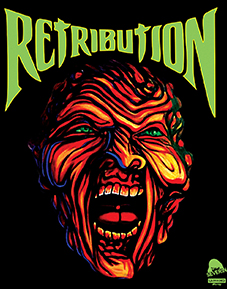
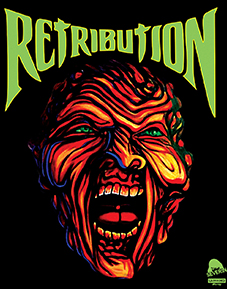
The Severin Films Limited Edition 2-Disc 4K Ultra HD release of Retribution sits in a black Amaray case alongside a 1080p Blu-ray and an insert that features artwork from one of the film’s US theatrical posters. It’s housed in a Limited Edition slipcover, though Severin is also offering a standard version without it. The following extras are included on each disc:
DISC ONE (UHD)
- Audio Commentary with Guy Magar and David Gregory
- Trailer #1 (HD – 1:29)
- Trailer #2 (HD – 1:29)
DISC TWO (BD)
- Audio Commentary with Guy Magar and David Gregory
- Writing Wrongs (HD – 12:18)
- Shock Therapy (HD – 8:06)
- Angel’s Heart (HD – 6:47)
- Santa Maria, Mother of God, Help Me! (HD – 9:09)
- Settling the Score (HD – 8:15)
- Visions of Vengeance (HD – 7:18)
- The Art of Getting Even (HD – 6:35)
- Living in Oblivion (HD – 9:38)
- Promotional Trailer Show Reel (SD – 6:40)
- Trailer #1 (HD – 1:29)
- Trailer #2 (HD – 1:29)
- Stills & Poster Gallery (HD – 2:18 – 27 in all)
- Bingo with Optional Commentary by Guy Magar (HD – 1:59)
The audio commentary with director Guy Magar, moderated by David Gregory, plays over both versions of the film. Guy Magar drives the conversation, commenting upon events in the film as they happen, with David stepping in occasionally to ask him questions about the production. The conversation drops out occasionally, likely for legal reasons, but it’s an interesting and educational chat nonetheless.
Next are a series of interviews. In Writing Wrongs, co-writer and associate producer Lee Wasserman talks about getting the film off the ground, having a hardworking crew, the quality of the effects, and dealing with ratings and distribution. In Shock Therapy, actress Leslie Wing discusses working in ballet, the difficulties on the set of Retribution, and her feelings about the experience today. In Angel’s Heart, actress Suzanne Snyder delves into how and why she became an actor, exploring the nature of her character, doing night shoots, and her reaction to the final film. In Santa Maria, Mother of God, Help Me!, actor Mike Muscat talks about being a character actor, joining the army and being a part of his local theatre group, being invited by Guy Magar to appear in Retribution, and pulling from reality to make his performances more effective.
In Settling the Score, composer Alan Howarth discusses working with John Carpenter before going out on his own, his approaches to film scores, satisfying directors while still providing the film with quality material, and the disappointment of the film’s release. In Visions of Vengeance, special effects artist John Eggett talks about forming Court Wizard Special Effects, how he and his company did the effects for the film, and working with Guy Magar. In The Art of Getting Even, artist Barry Fahr delves into what it was like working in the 1970s and 1980s, creating artwork for the film, and dealing with the financial difficulties in the aftermath. In Living in Oblivion, production designer Robb Wilson King talks about working on low budget films, creating sets in and around Los Angeles, and seeing the film today.
The trailer is presented with and without voiceover, while the Stills & Poster Gallery contains 27 images of posters, promotional materials, and production photos. Last is Guy Magar’s student short film Bingo, which briefly demonstrates that winning can be deadly. It can be viewed with and without Guy Magar’s commentary.
Not included from Severin’s 2021 Limited Edition Blu-ray release is a CD soundtrack. Also missing from previous DVD and Blu-ray releases is Guy Magar’s 2012 audio commentary recorded for the R-rated version of the film.
Retribution is a wild film that has qualities worth appreciating. It manages to hit all the right marks and make you care enough for George’s outcome that the great special effects and cinematography are icing on the cake. Severin’s 4K upgrade gives it an added boost, making for a fine UHD presentation of a film that deserves far more eyes on it than it has. Highly recommended.
- Tim Salmons
(You can follow Tim on social media at these links: Twitter, Facebook, BlueSky, and Letterboxd. And be sure to subscribe to his YouTube channel here.)