
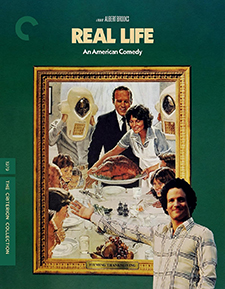
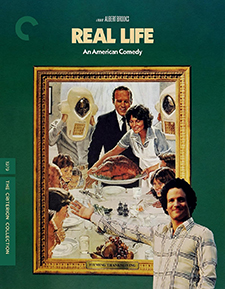
Real Life (4K UHD Review)
- Review Date: Aug 05, 2025
- Format: 4K Ultra HD
-


Director
Albert BrooksRelease Date(s)
1979 (August 27, 2025)Studio(s)
Paramount Pictures (The Criterion Collection – Spine #1231)- Film/Program Grade: B+
- Video Grade: A-
- Audio Grade: B+
- Extras Grade: C+

Review
Albert Brooks has always been a conceptual artist as much as a comedian—in other words, he’s a comedian’s comedian, deconstructing not just comedy but performance art in general. In his unforgettable appearance on The Flip Wilson Show in 1972, he did a deliberately awful but unforgettably hilarious ventriloquist act that mercilessly skewered all of the tropes of the genre. Similarly, in a 1983 appearance on The Tonight Show, he used a Speak & Spell toy in a way that demolished the very notion of prop comedy. There was also an element of self-parody to all of that, with Brooks not just mocking what others have done, but also mocking himself for his own apparent ineptitude in trying to replicate their work. Brooks parlayed that style into a series of short films, many of which played on Saturday Night Live, before finally making the leap into feature films with Real Life in 1979. It was a ruthless deconstruction of something that has since become the ultimate in performance art: reality television.
While that may make Real Life look like it was ahead of its time, it was actually inspired by a program that had aired six years earlier: the PBS documentary series An American Family. Producer Craig Gilbert had spent seven months in 1971 following the Loud family in Santa Barbara, California, filming everything that happened to them, for good or for ill—often the latter, as it turned out, because the documentary ended up inadvertently tracing the dissolution of the marriage between Bill and Pat Loud. The 12-part series that eventually aired on PBS in 1973 was hugely successful, but it drew fair criticism for the fact that the presence of the cameras had altered the way that the Louds behaved. Gilbert was also accused of having intentionally manipulated the events in order to juice up the drama, and there were even rumors that he may have had a relationship with Pat. Regardless, An American Family still became a cultural landmark, even though its real legacy wouldn’t be felt until decades later when MTV picked up the mantle with their long-running program The Real World.
Yet Albert Brooks saw the potential in An American Family long before MTV did, and in keeping with his love of deconstruction, he decided to make a film that didn’t just parody it, but also parodied himself as a director for having the temerity to think that history wouldn’t repeat itself under the same fundamentally flawed circumstances. In the screenplay that he co-wrote with Monica Johnson and Harry Shearer, Brooks plays Albert Brooks, a desperate filmmaker looking to make a name for himself by making a feature film inspired by An American Family. After an arduous selection process, he settles on the Yeager family in Phoenix, Arizona: veterinarian Warren Yeager (Charles Grodin), his wife Jeanette (Frances Lee McCain), their daughter Lisa (Lisa Urette), and their son Eric (Robert Stirrat). Brooks spares no expense, setting the Yeagers up in a home designed for filming (and building a separate more comfortable residence for himself at the same time.) Yet despite all of his efforts, the whole project ends up going dreadfully wrong.
In Real Life, Brooks hit on the key factor that was the undoing of An American Family: reality television is an inherent contradiction in terms. No matter how noble that the intentions of the filmmakers may be, no matter how much that they try to be as unobtrusive as possible, they always reshape the supposed reality that they’re documenting. Regardless of whether or not Craig Gilbert had deliberately tried to manipulate the circumstances that surrounded the Loud family, he still ended up influencing them, and the presence of his cameras didn’t help. The Albert Brooks in Real Life tells everyone to be themselves, all while pushing and prodding them to get the results that he wants. He can’t stop inserting himself into their activities, either, especially as he gets more and more desperate for results. Even his own attempts at being unobtrusive end up backfiring spectacularly. He spares no expense on the cameras, making his crew members wear absurdly oversized custom Ettinauer 226XL digital helmet cams:
“Only six of these cameras were ever made. Only five of them ever worked. We have four of those.”
These cameras end up making the camerapeople (including an unseen Shearer) look like Martians, drawing even more attention to them and distracting not just the Yeagers, but everyone else as well. The psychologists that Brooks brings along in order to oversee the integrity of the project aren’t happy with the results, nor is the studio that’s funding the project. (In a hilariously meta moment, real-life disaster movie producer Jennings Lang plays the producer of the film who keeps insisting that they need to add some celebrity cameos). Yet the more that Brooks fails to capture “authentic” reality, the more that he tries to create that reality himself instead—and the more that he fails, often spectacularly so.
Real Life would have been amusing enough as a simple parody of An American Family, but the fact that Brooks also parodied the hubris required to make so-called reality television in the first place, all while poking fun at himself at the same time, is what takes it over the edge. It’s the ultimate in conceptual comedy, deconstructing the subject that it’s satirizing while simultaneously deconstructing its own satire. Brooks even skewered the idea of a montage decades before Trey Parker and Matt Stone did the same thing in Team America: World Police, throwing in arguably the single most meta conceptual joke that he’s ever created: filming tortoises moving in slow motion. If that idea doesn’t strike you as inherently funny, then Real Life may not be the film for you. But if it does, then you’re in for a treat from the master of conceptual comedy.
Cinematographer Eric Saarinen shot Real Life on 35mm film using Panavision cameras with spherical lenses, framed at 1.85:1 for its theatrical release. This version is based on a 4K scan of the original camera negative, cleaned up and graded for High Dynamic Range in HDR10 only, with the final results approved by Brooks. While Real Life was shot on 35mm, it embraces the aesthetic of a 16mm cinéma vérité documentary (albeit one shot with fictional digital Ettinauer cameras). The encode handles the moderate grain quite well, even during challenging material like the white rooms of the test facility at the beginning of the film. The frequent use of on-screen titles like the day ticker means that a fair number of shots are opticals, and they look like it, too. Otherwise, the rest of the film is about as sharp as could be expected, and there’s no significant damage remaining. The colors all seem accurate, at least within the bounds of the documentary aesthetic that Brooks and Saarinen were trying to achieve. In other words, Real Life isn’t dazzling in 4K, but it looks like it should.
Audio is offered in English 1.0 mono LPCM, with optional English subtitles. It’s clean, clear, and free of noteworthy artifacts or distortion. The music by Mort Lindsay is surprisingly important to the experience of watching Real Life, especially in his kitschy title theme, and it’s also reproduced well here.
The Criterion Collection 4K Ultra HD release of Real Life is a two-disc set that includes a Blu-ray with a 1080p copy of the film. It also includes a 12-page foldout booklet with an essay by A.S. Hamrah. There are no extras on the UHD, but the following extras are on the Blu-ray only:
- Albert Brooks (30:25)
- Frances Lee McCain (14:42)
- 3D Trailer (3:08)
Albert Brooks is an interview with, well, Albert Brooks. (You can’t accuse Criterion of burying the lede.) He points out how he always liked deconstructing comedy, and explains how his fake Esquire ad for a comedy school led to his short film Albert Brooks Famous School For Comedians, his SNL gig, and eventually an offer from David Geffen to make his first feature film at Warner Bros. (That came to a crashing halt when Geffen left the studio, forcing Brooks to make the film independently instead.) Brooks breaks down the production of Real Life, including some interesting thoughts about the line between Albert Brooks the filmmaker and Albert Brooks the character in the film (he says that his co-writer Monica Johnson was particularly good at the latter). He also explains why he made the completely unrelated 3D trailer for the film.
Frances Lee McCain is an interview with—well, you’re getting the idea by now. McCain describes some of her other roles prior to Real Life and how she got the role of Jeanette. She says that the key to her character is that Jeanette wasn’t really in the same film as the rest of the family—she never got sucked into the mystique of the cameras. She also says that Real Life was carefully scripted, so the only improvisatory moments happened naturally as a part of scenes like where the crew members are introduced. McCain never had any children, so she finds it interesting that Real Life launched her career of playing a variety of different mothers throughout all the Eighties in films like Gremlins.
Finally, the 3D Trailer that Brooks mentioned is also included. Like some of his other trailers, it’s essentially a short film of its own that has little to do with Real Life, although Brooks is clearly playing the character of Albert Brooks from that film, not his real self. (And no, I won’t spoil the conceptual gag that underlines the whole thing.)
Surprisingly enough for a film that hasn’t exactly received an abundance of special edition love, there’s actually an extra from a previous release that isn’t included here: Paramount’s 2001 DVD had a different interview with a significantly younger version of Albert Brooks (the real life one, not the one from Real Life). But at 11 minutes, it’s more than supplanted by the new interview that Criterion conducted here—and it’s worth pointing out that this is the first time that Real Life has appeared in HD on physical media, let alone Ultra HD. So, let’s just say that it’s a huge upgrade, and it’s a must for fans of conceptual comedy in general and Albert Brooks in particular. Just be ready to think about what it means to film tortoises in slow motion. Take your time; we’ll wait for you.
- Stephen Bjork
(You can follow Stephen on social media at these links: Twitter, Facebook, BlueSky, and Letterboxd).