Phantom of the Opera, The (1998) (4K UHD Review)
- Review Date: Mar 27, 2026
- Format: 4K Ultra HD
-


Director
Dario ArgentoRelease Date(s)
1998 (February 24, 2026)Studio(s)
Medusa Distribuzione/October Films (Vinegar Syndrome)- Film/Program Grade: B-
- Video Grade: A-
- Audio Grade: B+
- Extras Grade: B+

Review
Dario Argento’s 1998 adaptation of Gaston Leroux’s The Phantom of the Opera wasn’t his first rodeo when it came to operatic horror, at least in terms of subject matter; just a decade earlier, he had set his film Opera at the Teatro Regio opera house in Parma, Italy. Yet Opera was a fairly traditional giallo, albeit one that threw in a generous dose of Thomas Harris’ acts of Becoming from Red Dragon. The Phantom of the Opera, on the other hand, is fully operatic in every sense of the term: exaggerated, theatrical, grotesque, melodramatic, and even openly pulpy. It’s as much De Palma’s Phantom of the Paradise as it is Leroux’s The Phantom of the Opera, but taken to the Théâtre du Grand-Guignol extremes that De Palma’s PG rating precluded. Although to be fair, there was always a pulp element to Leroux’s serialized novel that many other adaptations have elided. Not so with Argento’s version, which goes for the jugular in nearly every conceivable sense of the term. And therein lies the problem for Argento, one that would dog him for the rest of his career: expectations.
Argento made a name for himself with a string of classic gialli during the early Seventies, and that resulted in many of his fans expecting a certain kind of film from him. Yet he’s always been willing to play with forms, and starting with Suspiria in 1977, he ended up moving in and out of the giallo orbit to varying degrees. (And people to this very day are still debating whether or not Suspiria qualifies as a giallo, which is one of the most pointlessly “missing the forest for the trees” arguments in cinematic history.) The farther that he moves outside that orbital plane, the harder that it is for some fans to keep up with him. The Phantom of the Opera moved far enough astray from expectations that it became something of a breaking point, an unintentional dividing line between his earlier gialli or giallo-adjacent films and his later work that continued to defy expectations. The edge of that line arguably started with The Stendhal Syndrome in 1996, but it became a wide gulf two years later with The Phantom of the Opera.
To a certain extent, that’s perfectly understandable. Anyone expecting a standard Argento giallo or even a traditional Gaston Leroux adaptation is bound to be confounded by Argento’s version of The Phantom of the Opera, which he cowrote with Gérard Brach. It’s filled with broad and even quite earthy humor, and plenty of frank nudity that’s equally earthy (and humorous). Humor has always been an element in Argento’s work, but this was the first time that it was front and center throughout. There’s even a couple of rat catchers who are straight out of a Jean-Pierre Jeunet or Terry Gilliam film, right down to their anachronistic steam-powered rat catching sled. (In fact, the sled scene owes more than a passing debt to the Cleaners in Jim Henson’s Labyrinth.) And while gory makeup effects have been part and parcel to Argento’s filmography since the beginning, the gore in The Phantom of the Opera goes to such extremes that it also borders on parody. It’s pure Herschell Gordon Lewis territory, right down to the inevitable tongue-ripping scene.
The Phantom of the Opera also leans into the supernatural elements of the story, with this version of the Phantom (the late Julian Sands) having been raised by rats a la the penguins in Batman Returns—and exhibiting, if not actual supernatural gifts, then at least preternatural ones. And some of that element is bound to make people uncomfortable, since this Phantom wasn’t just raised by rats; he also communes with them, if you catch the drift. Dario Argento fans going to see The Phantom of the Opera for the first time in 1998 probably didn’t have “rat sex” on their bingo cards, but they scored nonetheless (or at least the Phantom scored, anyway). Yet the bridge too far for many people is probably the fact that this particular Phantom isn’t physically disfigured at all, but rather as handsome as, well, Julian Sands. Yet he’s still disfigured on the inside, and it’s an interesting inversion of the standard horror movie trope that monstrous-looking individuals always end up acting monstrously. As history has proven time and time again, it’s the emotional scars that really drive human behavior (with or without any bestiality).
Any discomfort engendered by the Phantom becoming one with his rats also extends to other elements in Argento’s adaptation of The Phantom of the Opera, from an openly pedophiliac supporting character to the eroticism surrounding this version of the Phantom’s muse, opera singer Christine Daaé. The Phantom of the Opera was the third film in a row where Dario cast his own daughter Asia in a leading role, and all three parts involved nudity and/or sexuality to varying degrees. While at least one shot in this film likely involved a body double in order to cover up Asia’s tattoos, that’s her topless elsewhere, or wearing a diaphanous gown, and engaged in some appropriately animalistic sex with this version of the Phantom. (There are even some bizarrely Ken Russell-esque CGI/video composite rooftop trysts that feature a particularly dubious image of her in slinky underwear with blood running down the inside of her thigh.) To the two of them, it may have all been in a day’s work as filmmakers and not uncomfortable at all, but for some viewers, combining it with their offscreen relationship can feel a little creepy, so caveat emptor.
Yet aside from those dodgy CGI and video effects in the rooftop scenes and the questionable nature of any sexuality involving Asia, none of the other elements in The Phantom of the Opera are inherently problematic. They’re only problematic for anyone who approaches the film with expectations of a different sort, and as is often the case, expectations can be the enemy of appreciation. So, forget about The Bird with the Crystal Plumage and Deep Red. Forget about Suspiria and even an undeniable oddity like Phenomena. Let go of expectations and appreciate The Phantom of the Opera for what it is: an intentionally immoderate, bombastic adaptation of Gaston Leroux that owes just as much to Ken Russell, Jean-Pierre Jeunet, Terry Gilliam, Lucio Fulci, and yes, the unpredictable mind of Dario Argento himself. No, it’s not a misunderstood masterpiece, but it’s still an unfairly maligned addition to the Argento canon.
Cinematographer Ronnie Taylor shot The Phantom of the Opera on 35mm film using Panavision Panaflex cameras with spherical lenses, framed at 1.85:1 for its theatrical release. This version is based on a 4K scan of the original camera negative, digitally remastered and graded for High Dynamic Range in Dolby Vision and HDR10. The Phantom of the Opera long carried a curse of its own on digital disc, with a problematic DVD release and an equally problematic HD version via a German Blu-ray in 2016. Scorpion releasing rectified that situation with their own 2020 Blu-ray, but even compared to that, this new 4K version is an across-the-board upgrade.
Between the sets, the costuming, and the rocky caverns in The Phantom of the Opera, there’s plenty of opportunity for improvements in terms of fine details, and they’re beautifully resolved here. Like some other Argento films from that period, there’s a moderate layer of grain present, but the encode handles it well. Still, the biggest improvements come from the HDR grading, from the sharp contrast to the appropriately vivid colors. The shimmering blues in some costumes, the brilliant reds in the roses, and the deep reds (no pun intended) of the blood help to turn The Phantom of the Opera into the Technicolor nightmare that it was always intended to be. Whatever you may think of the film itself, there’s no denying that it looks gorgeous here (well, aside from those ugly rooftop video composites, but they are what they are).
Audio is offered in English and Italian 5.1 DTS-HD Master Audio, with optional English SDH subtitles for the English and newly translated English subtitles for the Italian. The topic of English vs. Italian is usually a hot one with Argento films, and The Phantom of the Opera is no exception. Argento’s international productions were generally shot with many of the primary actors speaking English on set, but the majority of the dialogue was post-synced later, so it usually comes down to the quality of the dubbing. The tipping factor in this case is the English track uses mostly production audio for Asia Argento, Julian Sands, and a few others as well, so it’s noticeably superior to the post-synced dialogue for the other actors. Asia did dub her own voice for the Italian track, but the dialogue for the main characters sounds better in English. The English dubbing of the supporting characters is quite broad, but it’s equally broad in the Italian version. As usual, audition both and decide for yourself.
Either way, it’s a fairly potent mix with some genuinely thunderous thunder during the rainstorms. The emphasis is on the front channels, but some of that thunder and other ambient effects are steered to the surrounds. Between the halls of the opera house and the catacombs underneath it, there’s plenty of opportunity for that kind of ambience. But unsurprisingly, the centerpiece of the mix is the lush score by Ennio Morricone, which eschews the trademarked prog rock of most Argento films and even the trademarked quiet dissonance of Morricone’s other horror scores in favor of something a bit more lush and romantic.
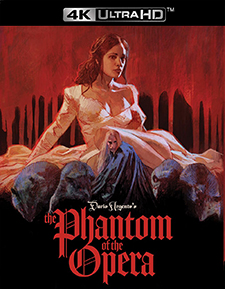
The Vinegar Syndrome 4K Ultra HD release of The Phantom of the Opera is a two-disc set that includes a Blu-ray with a 1080p copy of the film. The insert is reversible, featuring alternate artwork on each side. Vinegar Syndrome is also offering a Limited Edition version featuring a spot gloss slipcover designed by Robert Sammelin that’s available directly from their webstore and at a few select retailers, limited to 8,000 units. Either way, the following extras are included, all of them in HD:
DISC ONE: UHD
- Commentary with Troy Howarth and Nathaniel Thompson
DISC TWO: BD
- Commentary with Troy Howarth and Nathaniel Thompson
- Of Screams and Arias (22:32)
- Acts of Fear (10:59)
- Opera of Wounds (19:47)
- Like a Thunder (20:34)
- Behind the Camera (12:28)
- Behind the Red Curtain (18:07)
- In the Phantom Cave (18:13)
- Welcome to the Opera (18:08)
- Alternate English Titles (7:38)
Vinegar Syndrome has added five new interviews for this release. Of Screams and Arias is with Nadia Rinaldi, who played the boisterous lead opera singer Carlotta Altieri, and she says that she only took the role on the condition that she didn’t have to deal with rats or reptiles. She still had to deal with a few other challenges, like the opera training and Julian Sands’ intensity during attack scenes. Acts of Fear is with Gianni Franco, who played the journalist Montluc. His biggest issue was having to work in English, but he wanted to work with Argento so he accepted the challenge. Opera of Wounds is with effects artist Sergio Stivaletti, who as usual takes an entirely humble and self-deprecating view of his own work (although his assistant is the one who ended up with pneumonia after working in the cold water in the canals). Like a Thunder is with editor Anna Napoli, who recounts her career and how she has worked for different members of the Argento family. Finally, Behind the Camera is with camera operator Marco Pieroni, who admits that his memories aren’t super accurate, especially since he worked on at least five or six films a year back then, but he still tells some interesting stories about working for Argento and Ronnie Taylor.
The rest of the extras are archival, starting with a commentary that reteams Nathaniel Thompson from Mondo Digital with Troy Howarth, author of Murder by Design: The Unsane Cinema of Dario Argento (which hadn’t been published at the time of recording). It was originally produced for the 2020 Blu-ray from Scorpion Releasing. They affirm up front that they both enjoy The Phantom of the Opera, so they’re not just going to rag on it for two hours—they like the fact that Argento went for broke on this one. They describe the genesis of film, its revisionary nature, the humor, and the gore, saying that it’s more Fulci-esque than anything else that Argento had done up to that point (it also draws inspiration from Ken Russell and Federico Fellini). They acknowledge that it’s probably the most divisive of Argento’s films, mostly because of where it fell into his filmography—by the next decade, fans were starting to expect the unexpected. They also address the question of English vs. Italian, falling firmly on the side of the Italian because they feel that Julian Sands’ voice is too weak. (Again, listen to both and decide for yourself, but I disagree.)
Last but not least, there’s a set of Alternate English Titles and three more interviews from the Scorpion Releasing Blu-ray. Behind the Red Curtain is with Dario Argento, who discusses his interest in Leroux’s story, the changes that he made to it, the locations, working with his daughter, and dealing with Julian Sands’ peculiarities. (Never fear, he also covers the rat catching sled.) In the Phantom Cave is with production designer Antonello Geleng, who describes finding the locations, his sets, and helping Stivaletti with the aforementioned sled. Welcome to the Opera is with producer Guiseppe Colombo, who first met Argento when he was working for Cannon Films. (Interestingly enough, he says that this version of the Phantom wasn’t disfigured because Sands refused to play it that way, which upset Gérard Brach at the time.) His collaboration with Argento was fine at first but it ultimately wasn’t a happy one, leading to lawsuits, and they never worked together again.
That’s all of Scorpion’s extras plus a healthy dose of new ones, but there are still a few bits and bobs missing from other releases. There were two different 1998 making-of featurettes and a brief interview with Julian Sands, all of which have been included on various DVDs and Blu-rays. The 2016 Region B Blu-ray from X-Rated in Germany included a German-language commentary with Dr. Marcus Stiglegger and Kai Naumann, while the 2025 UHD from Plaion Pictures added what appears to be a different German commentary with Stiglegger working solo. The Plaion disc does include the two making-of featurettes and the Sands interview, as well as three of the five Vinegar Syndrome interviews and two of the three Scorpion interviews, but it doesn’t include the Thompson/Howarth commentary.
In the balance, even compared to the Plaion, Vinegar Syndrome’s 4K Ultra HD release of The Phantom of the Opera has the clear edge for English-language viewers. It does lack the vintage featurettes, but it’s otherwise the most comprehensive set out there (the German-language commentaries won’t be much of a loss). And The Phantom of the Opera has never looked better than it does here, so you can safely retire any other Blu-ray or DVD versions that you own. Vinegar Syndrome is on a tear right now with their 4K upgrades of underappreciated late-period Dario Argento films, and this one is no exception. It’s recommended for anyone who can set aside their expectations and appreciate films for what they are.
- Stephen Bjork
(You can follow Stephen on social media at these links: Twitter, Facebook, BlueSky, and Letterboxd).