
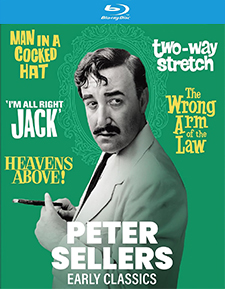
Peter Sellers: Early Classics (Blu-ray Review)
Director
Roy Boulting/Jeffrey Dell/John Boulting/Robert Day/Cliff OwenRelease Date(s)
1959-1963 (March 10, 2026)Studio(s)
Charter Film Productions/Romulus Films/British Lion Films (Kino Lorber Studio Classics)- Film/Program Grade: See Below
- Video Grade: See Below
- Audio Grade: See Below
- Extras Grade: B
- Overall Grade: A-


Review
Peter Sellers: Early Classics is a 5-Disc Blu-ray compendium of previously-released titles by Kino Lorber Studio Classics, all of which were reviewed by Stuart Galbraith IV (Man in a Cocked Hat, I’m All Right Jack, and Heavens Above!) and Dennis Seuling (Two-Way Stretch and The Wrong Arm of the Law). The disc-based content is identical, but they’re now presented in a single Amaray case with a slipcover.
MAN IN A COCKED HAT
First, let’s get this business with the title out of the way. This is a British comedy from the Boulting Bros., released there as Carlton-Browne of the F.O. (1959) but in the United States as Man in a Cocked Hat, possibly cut from its original 89 minutes. Kino’s release opts for the latter title on the spine and cover of this Blu-ray release, though this is the complete version of the film and its title card onscreen identifies it as Carlton-Browne of the F.O., no matter what the Blu-ray case claims. Given that Anchor Bay released the film on DVD way back in 2003 under the original British title, why Kino would revert to its less-remembered U.S. moniker when the title card contradicts it is anyone’s guess.
Regardless, the film, like many British comedies of the 1950s, is often misidentified as an Ealing Comedy, which it is not; that studio stopped making new movies in 1957. Nevertheless, the classic “Ealing Comedy” style continued elsewhere, such as the similar run of films made by the Boulting brothers: John (primarily a producer, but sometimes director or co-director) and Roy (primarily a writer and director or co-director, as here). Where the Ealing comedies were typically gentle satires of British cultural and government institutions, the Boulting brothers’ films tended to be both broader and at times more bitingly critical (if less subtle), targeting everything, from the highest echelons of the British government to working-class charwomen, though Ealing also did this, earlier, in films like The Man in the White Suit (1951).
Such films were quite popular in Britain and to a lesser extent in the U.S. The Ealing comedies helped make Alec Guinness an international star, while the Boulting brothers films established former Goon Show player Peter Sellers, as well as Terry-Thomas. (Terry-Thomas, in fact, replaced Sellers for the film It’s a Mad, Mad, Mad, Mad World when Sellers became too expensive to hire.)
Compared to the crude slapstick that dominated American film comedy of the 1950s, these smaller-scale British films, not large-budgeted but usually more intelligent, wittier, polished and featuring excellent ensemble casts, somehow seemed better and funnier than Hollywood’s program comedies of the period. I found most of these pictures hilarious when I first saw them as a teenager and in my 20s but, watching them today, most of them, even the classic ones like the Boulting Bros.’s I’m All Right Jack (also 1959), not anywhere as funny as I had remembered them, though they all still have scattered amusing moments and occasionally funny dialogue. They’re still fun to watch for their casts—the Boulting brothers films use recognizable names and faces, even for tiny roles—but movies like Carlton-Browne of the F.O. especially seem unusually labored and unfunny when viewed today.
With a plot similar to that same year’s The Mouse That Roared, also starring Sellers and made in Britain but predominantly an American production shot there, Carlton-Browne of the F.O. revolves around a (fictitious) island nation called Gaillardia, a former British colony granted self-rule in 1916, though Britain’s Foreign Office (the F.O. of the title) failed to notify its representative, Davidson (Miles Malleson), still stationed there more than 40 years later. No one at the Foreign Office has ever heard of Gaillardia, and after the assassination of its President it’s decided to send the bumbling head of “Miscellaneous Territories,” Cadogan De Vere Carlton-Browne (Terry-Thomas), to investigate, accompanied by military representative Col. Bellingham (Thorley Walters). Also traveling to Gaillardia, incognito, are Mr. Jones (Ian Bannen), the Oxford-educated heir to the throne, and Gaillardian citizen Iiyena (Luciana Paluzzi), actually a princess herself, daughter of the dead President’s main rival, the Grand Duke (John Le Mesurier). Upon arrival they’re greeted by hopelessly corrupt Prime Minister Amphilbulos (Peter Sellers), who seems aware of the country’s rich and untapped cobalt deposits, which soon attract not only British, but also U.S. and Soviet representatives, all wanting a piece of the action.
In the movie, Gaillardia, located somewhere on the 33rd parallel, is a mishmash of French, Italian, and Spanish influences, tropical but not explicitly north or south. The deliberate vagueness of the island’s location is somewhat amusing, but the film has the same problem virtually all comedies and dramas have when creating imaginary countries, like the nonexistent communist states seen in myriad Cold War-era Hollywood films and TV shows. That is, it’s much harder to generate biting satire about nation that doesn’t exist as opposed to one that does; this kind of thing only works when the true target of the satire is obvious, as in The Great Dictator. The more forthright the filmmakers are in their satire, Kubrick’s Dr. Strangelove, for instance, the more comic weight it can carry. Carlton-Browne is trifling and forgettable.
Peter Sellers was on the cusp of stardom when the film was released, explaining his undeserved co-starring billing, second after Terry-Thomas when, in fact, Sellers isn’t in the film all that much, and both Ian Bannen and Thorley Walters have much larger parts. Like the rest of the cast of Gaillardians, Sellers performs with a jumble of Italian, Spanish, and French, but it’s not remotely a standout performance. Terry-Thomas, emblematic British cad and toff, is somewhat cast against type, here a clueless if low-key bungler, but the aimless script generates little empathy and less interest for the character. The Ian Bannen and Luciana Paluzzi parts, feeling rather shoehorned into the plot, fare somewhat better; Paluzzi (billed here as Paoluzzi) is undeniably beautiful and only in her early 20s.
The good news is that Kino’s new Blu-ray sources a new 4K scan of the original camera negative, the result being that this black-and-white, 1.66:1 widescreen film looks positively gorgeous. The DTS-HD Master Audio (2.0 mono) is also excellent, supported by optional English subtitles. The disc is Region “A” encoded. Bonus materials include the following:
- Audio Commentary by Laurence Lerman
- Trailers:
- The Wrong Arm of the Law (HD – 3:12)
- I’m All Right Jack (HD – 3:08)
- Two-Way Stretch (SD – 2:53)
- The Ladykillers (HD – 2:35)
- A Shot in the Dark (SD – 3:47)
- The Party (SD – 2:02)
There’s but a single new extra feature: a new audio commentary by film journalist Laurence Lerman that’s both well-researched and well-organized. The rest consists of trailers for other Peter Sellers films distributed by Kino.
Movies like Carlton-Browne of the F.O. seem better remembered than they actually are. Not unpleasant and certainly not shoddy, it’s compactly but expertly produced, and its cast of familiar British character actors in every scene is a plus; it’s just not nearly as funny as one remembers.
MAN IN A COCKED HAT (FILM/VIDEO/AUDIO/EXTRAS): B-/A/A/B-
(Stuart Galbraith IV)
I’M ALL RIGHT JACK
I must admit the Boulting Brothers’ I’m All Right Jack leaves this reviewer somewhat bemused. While it’s easy to imagine 1959 British audiences laughing in recognition at this satire of British capitalism run amok at all levels, from unscrupulous upper-class businessmen to corrupted Cockney proletariat, I’m not certain it travels as well to modern American or even British audiences. Though it’s got a great cast and has many funny moments, it does have odd and/or dated qualities, such as very middle-aged Ian Carmichael playing a supposedly fresh-faced young Oxford graduate of 23. Despite its classic status as one of the all-time best British comedies, after seeing it now three times through the years, I still don’t like it any better than the first time I saw it.
Technically, the film is a sequel to Privates’ Progress (1956), an army comedy also directed by John Boulting and produced by his brother, Roy. Carmichael, Richard Attenborough, Dennis Price, Terry-Thomas, and Miles Malleson reprise their roles from that film, while other actors return playing different characters. In I’m All Right Jack (no comma), Stanley Windrush (Carmichael), from a wealthy family, seeks employment as a business executive, this despite the fact that he’s a wide-eyed boob with no experience.
Nevertheless, he makes the rounds touring various big companies. In an amusing sequence he’s given a tour of a candy factory, complete with Willy Wonka-like machinery, eventually becoming violently ill from all the free samples. Also, like Willy Wonka, there’s some very funny black humor: one factory worker sneezes all over the sweets, while another blithely files her fingernails over the assembly line.
Eventually, Stanley gets a job as a blue-collar worker at Missiles, Inc., a factory owned by his uncle Bertram (Price), as part of a scheme by the uncle and army comrade Sidney DeVeere Cox (Attenborough) to drive up the price of a new missile contract at Cox’s rival firm. At the factory, militant-but-dumb-as-a-sack-of-bricks communist shop steward Fred Kite (Peter Sellers, in a breakout role) takes a liking to Stanley, inviting him to stay at his house, where Stanley and his busty daughter, Cynthia (Liz Fraser), soon fall in love. At the factory, however, Stanley is duped by Waters (John Le Mesurier), hired to conduct a time and motion study, with Stanley innocently, unwittingly demonstrating how dramatically productivity could be improved with far fewer union workers. Outraged, Kite calls a strike and sends Stanley “to Coventry” (i.e., ostracize him). But reporters covering the strike, learning that Stanley was essentially fired for “working too hard” turns sympathy against Kite and the strikers, while sympathy strikes across the nation threaten the entirety of British industry.
The cast of I’m All Right Jack is almost unmatched. In addition to those mentioned above, also appearing are Margaret Rutherford (as Stanley’s rich dotty aunt), Irene Handl as Mrs. Kite, Marne Maitland as the Middle Eastern missile buyer, and Victor Maddern, Kenneth Griffith, David Lodge, Terry Scott, Sam Kydd, Donal Donnelly and others as factory workers. Even Sheila Sim (Attenborough’s actress wife) and Stringer Davis (Rutherford’s husband) make cameo appearances. It’s hard to completely dislike a film where elderly scene-stealer Miles Malleson, as Stanley’s father, amusingly spends all his screentime lounging in the nude, a wicker basket in his lap.
I’m All Right Jack is so iconoclastic no British institution emerges unscathed in this farce: capitalism and the rich, advertising, television, trade unions, middle management, higher education, communism—everything. Malleson’s nudist and the colony next-door are the subject of racy double-entendres but, clearly, they’re the happiest, most care-free lot. Kite’s workforce is absurdly lazy, playing cards all day and generally working very hard to do very little. Sellers’s memorable characterization is pompous and dictatorial, quoting communist/unionist homilies he doesn’t understand, full of words he can’t even pronounce correctly. Carmichael’s Stanley is a complete nitwit and, oddly, not very sympathetic even when he tries his best but keeps screwing up; the audience doesn’t care whether he ends up with Liz Frazer or not.
The billboards and commercial jingles for the fictitious firms Stanley visits are funny and dead-on in their inanity, and some of the performances are funny: Attenborough’s unethical businessman is a grotesque caricature unlike anything he played (except, of course, in Privates’ Progress); character comedian John Le Mesurier has an amusing, involuntary nervous twitch, and Margaret Rutherford is droll just entering a room. Terry-Thomas, so hilarious opposite Carmichael in the superior School for Scoundrels, also 1960, is curiously subdued here.
Besides the racy naked female buttocks (always seen in long shot), I’m All Right Jack was something of a groundbreaker with its double-entendre humor, sort of prefiguring the Carry On film series, which itself debuted with an army comedy, Carry On Sergeant, the year before, while its follow-up, Carry On Nurse, was the top-grossing British film of 1959, just ahead of I’m All Right Jack. The Carry Ons didn’t get this smutty for another year or two.
Kino’s new Blu-ray, licensed from StudioCanal, presents the black-and-white film in its original 1.66:1 widescreen format. The transfer is a bit curious; straight cuts look great but all opticals (dissolves, optical matte shots) are in notably poor shape and even blurry, so scene transitions especially are sometimes rather jarring, especially on big home theater screens. The DTS-HD Master Audio (2.0 mono) is fine, though, with optional English subtitles provided on this Region “A” encoded disc. Bonus materials consist of the following:
- Audio Commentary by Gemma Ross and Robert Toss
- Interview with Liz Fraser (HD – 9:57)
- Trailers:
- I’m All Right Jack (HD – 3:08)
- Two-Way Stretch (SD – 2:53)
- The Ladykillers (HD – 1:26)
- The Party (SD – 2:02)
- The Road to Hong Kong (HD – 3:16)
Extras consist of an audio commentary with British film comedy historians Gemma and Robert Ross, who know their stuff, a trailer, trailers for other released by Kino Lorber, and an archival interview with actress Liz Fraser, who died in 2018.
In some ways I’m All Right Jack is the ultimate British farce, at least of the early postwar period, like The Loved One, of its particular time and place, with something to offend everyone. Recommended.
I’M ALL RIGHT JACK (FILM/VIDEO/AUDIO/EXTRAS): A-/A-/A/B
(Stuart Galbraith IV)
TWO-WAY STRETCH
Heist caper films intrigue audiences with their methodical planning, amassing information, long hours observing the target, and split-second timing. In Two-Way Stretch, the caper film is taken to comic heights.
Three Cockney pals are serving a three-year prison term for robbery. The criminal mastermind is Dodger Lane (Peter Sellers, The Ladykillers) and his accomplices are Jelly Knight (David Lodge, I’m All Right Jack) and Lenny Price (Bernard Cribbins, The Mouse on the Moon). Because of the progressive policies of the warden (Maurice Denham, Sink the Bismarck!) and Chief Police Officer Jenkins (George Woodbridge, Jack the Ripper), there’s a relaxation of disciplinary policies. In fact, the three convicts have been made trustees and enjoy unusual privileges, including fresh milk delivery, an unlocked cell door, and a pet cat.
With just days before their release, the friends receive a visit from co-conspirator Soapy Stevens (Wilfred Hyde White, My Fair Lady), pretending to be their minister. Left alone with them for a “private counseling session” to prepare them for life on the strait and narrow, the ostensible minister has something rather different in mind. He suggests that the trio sneak out of jail the night before their imminent parole to rob a collection of valuable diamonds to be transported by the army through London, then sneak back into prison the same night for a perfect alibi the following morning.
Dodger devises a plan and the trio’s preparations all go smoothly until an unexpected wrinkle occurs. The congenial Jenkins retires. The new Chief Police Officer, Crout (Lionel Jeffries, Camelot), is an officious bureaucrat and rigid disciplinarian. He’s also familiar with the trio’s past criminal record and the cushy life they’ve had in this prison, and is intent on cracking down on them. Because of Crout’s eagle eye, the heist plan is threatened.
The ensemble of Sellers, Lodge, and Cribbins is comic magic. They’re completely comfortable with each other, their performances are natural, and they never overdo the gags, allowing them to land consistently. The dialogue is funny and the comedy relies on characters and situations rather than on a series of one-liners. The British style of comedy at the time was more subtle than that of American comedies, so the pacing and timing may take a bit of time to get used to. The three “convicts” are laid back, calm, and methodical, yet manage to convey silliness as well.
Wilfrid Hyde White provides considerable laughs as he assumes a number of roles to facilitate the robbery plan. Elegant in appearance, with an upper class demeanor, he easily fools the prison officials into granting him private counseling time with his “parishioners”—actually vital planning sessions.
The film’s undisputed scene-stealer is Jeffries as the harsh Crout. A classic comic villain, Crout is the butt of slapstick and assorted sight gags that considerably diminish his stature, and Jeffries is expert at trying, unsuccessfully, to maintain his dignity.
Later in the film, Army Colonel Parkwright (Thorley Walters, Murder She Said), in charge of transporting the jewels with a convoy of vehicles and many soldiers, becomes the target of additional slapstick gags when his duty-bound determination to deliver the gems goes awry.
The combination of these veteran performers results in a clever comedy that has the viewer rooting for the robbers to succeed. Director Robert Day has cast wonderful British character actors in small roles to amp up the humor.
There are little moments, too, that add to the fun. The warden’s cigarette box is a magnet for the light fingers of the inmates. A beautiful woman raises her dress to adjust her stockings, distracting the guards while visitors to the prison fork over contraband to their incarcerated loved ones. Pompous Col. Parkwright gets a lesson in public relations when his barking orders backfire. Good-natured Jenkins happily runs errands for Dodger and his two cellmates. The warden nervously escorts a group of visiting ladies to the rehabilitation unit, trying to put the prison’s best efforts on display.
Peter Sellers, of course, would go on to great success as Inspector Clouseau in The Pink Panther and other American films, but in Two-Way Stretch he was at the beginning of his career, already showing signs of the international star he would become.
Two-Way Stretch was shot by director of photography Geoffrey Faithfull on 35mm black & white film with spherical lenses, finished photochemically, and presented in the aspect ratio of 1.66:1. The film lacks the pristine, silvery look of other Kino Lorber releases of older films, but contrast and clarity are good. The picture is clean, with no dirt specks, scratches, emulsion clouding, and speckling. Night scenes of the robbery open up the picture from the confines of the prison, where most of the action takes place. Special effects include an explosion that’s the basis of a sight gag.
The soundtrack is English 2.0 mono DTS-HD Master Audio. English SDH subtitles are an available option. Dialogue is clear and distinct, as many of the actors had stage experience. Sound effects include truck engines, an explosion, a crane lifting a truck, a manhole cover being moved, and soapy water being splashed onto an army officer.
Bonus materials on the Region A Blu-ray release from Kino Lorber Studio Classics include the following:
- Audio Commentary by Gemma Ross and Robert Ross
- Trailers:
- Two-Way Stretch (Upscaled SD – 2:54)
- The Ladykillers (HD – 1:26)
- The Party (SD – 2:02)
- The Lavender Hill Mob (HD – 2:30)
- After the Fox (SD – 2:50)
- The Italian Job (SD – 3:12)
Audio Commentary – In this track by authors and comedy historians Gemma Ross and Robert Ross, we learn that on the first day of filming, director Robert Day shot the first scene in the script to establish the dynamic of the three prisoner pals. Peter Sellers, in “the first flush of stardom,” was able to get many of his actor friends into the film. Shortly after filming began, Sellers was sulky and upset because he wished he had played the role of Soapy Stevens. The commentators provide affectionate and knowledgeable background on the many character actors in the picture, even those with small roles. They point out similarities of Two-Way Stretch to The Lavender Hill Mob. The original tile of Two-Way Stretch was Nothing Barred, a title later given to another British Lion film. Many of the gags were recycled from other prison break movies. The film was shot in six weeks in late 1959 and released in 1960. Sellers had pneumonia during the final week of shooting. The commentators observe that the film reflects “the three having a great time.” Though he’s the lead, Sellers is part of a team. Chaplin’s influence on him is apparent in his body language and expressions. A “throw-away film,” Two-Way Stretch is “God’s gift to film lovers.”
Two-Way Stretch grabs you from its first scene, when the three inmates receive their daily delivery of milk and breakfast staples. Not as frenetic as typical farces, the film takes its time building its humor on a foolproof plan to make a huge score with an airtight alibi. At a mere 87 minutes, the film is refreshingly brisk and avoids unnecessary exposition. Its richness lies in the outstanding British cast, with all members contributing their own quirky contributions.
TWO-WAY STRETCH (FILM/VIDEO/AUDIO/EXTRAS): A/B+/A/B
(Dennis Seuling)
THE WRONG ARM OF THE LAW
Best known for his portrayal of the inept Inspector Clouseau in a series of Pink Panther films, Peter Sellers previously starred in a series of British comedies before Hollywood beckoned. The Wrong Arm of the Law stars Sellers at a significant period in his career. On the verge of international stardom, he was able to showcase his ability to play multiple characters and assume foreign accents for comic effect, talents that were to become his trademark.
“Pearly” Gates (Sellers) has a cushy life, running the prestigious Maison Jules haute couture fashion house in London, catering to the elite and dating one of his models, Valerie (Nanette Newman). But this is merely a front. He makes a far better living running a crime syndicate from the back of his shop. His clients’ gossip cues him in on plenty of lucrative targets. A cocky Cockney criminal, Pearly, along with his team, engineers elaborate robberies which are pulled off with meticulous planning... until now.
There’s a new gang in town, a trio of Australians who disguise themselves as police, catching criminals in the act after every job and pretending to make arrests as they make away with the original thieves’ ill-gotten gains. Because no arrests are actually made, Pearly comes to realize that someone in his organization is betraying him, and that the supposed cops are, themselves, robbers robbing the robbers.
Pearly and fellow mob boss “Nervous” O’Toole (Bernard Cribbins) form a truce and join forces with Scotland Yard to eliminate the foreign competition and return things to normal. Complicating the plan is the inspector put in charge of the operation, Fred “Nosy” Parker (Lionel Jeffries), whose bumbling incompetence manages time and again to undermine the operation.
Though Sellers is the star of The Wrong Arm of the Law, he’s not the film’s best ingredient. His Pearly is played on a single note and is only mildly funny. He does adopt an accent as the fashion entrepreneur and has a few good moments, but the excellent supporting cast elicits most of the laughs.
This is Lionel Jeffries’ film all the way. His inspector is, by far, the funniest character in the film and the linchpin of most of the gags. Because Inspector Parker is so dedicated to his job and the law in general, his inability to assess situations, play his part efficiently, defer to others, and work effectively with his associates, he’s a magnet for mishaps and chaos. Jeffries plays Inspector Parker as a stiff-upper-lip representative of the law whose main attributes are blundering and fumbling. Jeffries is perfect casting and the comic heart of the film.
Cliff Owen masterfully directs his talented cast and stages an exciting climactic comic car chase that starts with one unforeseen setback and escalates into a series of sight gags and slapstick reminiscent of the best of silent comedy. The script by Ray Galton, Alan Simpson and John Antrobus is fast-paced, witty, and cleverly silly. With most of the characters playing their roles with deadpan expressions, the comedy derives from the premise of phony cops on the loose being confused with real ones, and career criminals being inconvenienced in their otherwise smooth operations. Mistaken identity and the unlikely collaboration of the police and London’s underworld figures for a mutual goal also create opportunities for humor. The Wrong Arm of the Law is a smartly satirical film that develops, one comic building block at a time. The British sense of humor here is more subtle than in American films, but the payoff is extremely rewarding.
The Wrong Arm of the Law was shot by director of photography Ernest Steward on black & white 35mm film with spherical lenses, finished photochemically, and presented in the aspect ratio of 1.66:1. The Blu-ray from Kino Lorber Studio Classics features a 2023 HD Master from a 4K scan of the original camera negative by StudioCanal. London streets are rendered in crisp detail, as are police uniforms, bricks on buildings, patterns in clothing, and objects in the police station. There are no visible imperfections. During the outdoor chase sequence, streets look a bit too deserted, likely because they were blocked off for filming. Greyscale is nicely rendered, suggesting the film is fairly modern, not 62 years old.
The soundtrack is English 2.0 mono DTS-HD Master Audio. English SDH subtitles are an option. Dialogue is clear and distinct. The actors enunciate perfectly, which reflects stage training. Sound effects include car and trucks speeding through streets, a merry-go-round, and a small explosion. Composer Richard Rodney Bennett provides a suitably upbeat and jaunty score, reflecting the film’s silly antics and escalating comic confusion.
Bonus materials on the Region A Blu-ray release from Kino Lorber Studio Classics includes the following:
- Audio Commentary by Laurence Lerman
- The Long Arm of the Screenwriter: John Antrobus Remembers The Wrong Arm of the Law (HD – 19:45)
- Trailers:
- The Wrong Arm of the Law (HD – 3:12)
- Two-Way Stretch (SD – 2:53)
- The Ladykillers (HD – 1:26)
- The Party (SD – 2:02)
- I’m All Right Jack (HD – 3:08)
Audio Commentary – Film journalist Laurence Lerman notes that The Wrong Arm of the Law takes place in pre-swinging London and stars Peter Sellers “right at the cusp of becoming an international sensation.” The film was targeted to a homegrown British audience. Filled with one-liners, comic thieves and equally comic police, the film is referred to as “a highly entertaining little gem.” Though Sellers is the star, already adept at playing multiple roles and adopting assorted accents, the film is an ensemble piece. Lionel Jeffries was known for playing “eccentric, very Britishy kinds of roles.” He was in the musicals Chitty Chatty Bang Bang and Camelot as well as the sci-fi picture The First Men in the Moon. By the 1970s, he moved on to writing and directing, and was a beloved figure in the British film industry for many decades. During production, Sellers confided to Jeffries, “Lionel, I’ve made a mistake. I’ve picked the wrong part.” Jeffries’ career was bolstered by Peter Sellers’ rising popularity. Commentator Lerman provides brief career overviews of the supporting cast members, singling out Graham Stark, a friend of Sellers who appeared in several films with him. Stark also played the put-upon waiter in Victor/Victoria. British comedy had changed little up to the end of the years after World War II. With peace came all kinds of social upheavals and popular screen entertainment changed. Ealing Studios became known for British comedies reflecting what was happening in contemporary England. Their films were more satirical, with a sense of absurdity. Some of these include the crime comedy caper films King Hearts and Coronets, The Lavender Hill Mob and The Ladykillers, films that reflected Britain’s post-war spirit. The Wrong Arm of the Law represented a new set of comic sensibilities. Director Cliff Owen was active from the late 1940s to the mid 70s. During World War II, he served as radio operator and disc jockey where he was introduced to drama. After the war, he got into filmmaking and worked on comedies, thrillers, war films and dramas as assistant director. He worked for Alfred Hitchcock on the feature Under Capricorn and worked extensively in British television on such shows as The Avengers and ITV Playhouse. “A clear-eyed and efficient director,” Owen leaned more toward the comedic in the second half of his career. The Wrong Arm of the Law was one of the twelve most popular films released in the U.K. in 1963.
The Long Arm of the Screenwriter – Co-screenwriter John Antrobus discusses his career. He was in the military, but felt it wasn’t a good fit for him and dropped out. He knew he could write and decided to give it a try professionally. Through connections, he got an agent and eventually wrote scripts for TV and radio programs. He found he had a facility for writing comedy. He tried being a comedian, but was too nervous to succeed. He had visions of being a playwright and his The Bed Sitting Room eventually opened in a West End theater in London. His success, however, led him to drink excessively. He got sober in the late 1960s and re-invented his career. Antrobus recalls that the making of The Wrong Arm of the Law was “just like magic.” It was fun and there were no obstacles. Though Peter Sellers was the star, Lionel Jeffries stole the picture. The film was a popular, critical, and financial success. Antrobus and Peter Sellers agreed to do a BBC show but, as Antrobus states, Sellers “disappeared.” He went off to Hollywood for a project. Later, Antrobus was asked by Sellers to come to Hollywood to doctor the script of The Fiendish Plot of Fu Manchu. Antrobus concludes the interview by plugging his book, Goon But Not Forgotten, containing his comic take about working as a screenwriter.
The Wrong Arm of the Law is a wonderful farce as only the British could make. The film renders the term “silly” a plus rather than a detriment, since the script is so well-constructed in accentuating human foibles, targeting bureaucracy and taking revered institutions down several notches. It’s worth a look for its sheer fun component and a terrifically wacky performance by Lionel Jeffries.
THE WRONG ARM OF THE LAW (FILM/VIDEO/AUDIO/EXTRAS): A/A/A/B
(Dennis Seuling)
HEAVEN’S ABOVE!
A follow-up, of sorts, to I’m All Right Jack (1959), the Boulting Brothers’ Heavens Above! (1963) is atypically Capra-esque in its first-half, and overall has the tone of Capra’s Mr. Deeds Goes to Town and Meet John Doe, if filtered through the Boulting’s cynical, biting British satire. Star Peter Sellers creates a beguiling character that’s almost a kind of proto-Chance from Being There (1980), but the film is overlong at nearly two hours and, oddly enough, is rather over-produced, with its last half-hour too epic for its own good. One suspects the Boultings had trouble coming up with an ending; the last ten minutes venture into fairly elaborate science fiction that feels shoehorned in and is neither funny nor meaningful. The first hour of Heavens Above! Is much superior to its second.
Sellers plays Rev. John Smallwood, a vicar mistakenly assigned to the English country town of Orbiston Parva, home to a prosperous laxative/sedative factory owned by the Despard family, who exert enormous influence over the region. Obliging, diplomatic Archdeacon Aspinall (Cecil Parker) intended to send a vicar also named John Smallwood (hence the mistake), a harmless type guaranteed to not ruffle the feathers of the Despard family, particularly rich widow Lady Lucy Despard (Isabel Jeans).
Naïve but genuine in his desire to put into practice the teachings of Christian charity, Smallwood immediately causes a stir by appointing a friendly black garbageman, Matthew (Brock Peters), as the new churchwarden, and by allowing a huge itinerant family—a brood of unruly children, the adults lazy and petty thieves—evicted from an illegal encampment, property being developed by the Despards, into the large house acting as the vicar’s residence. However, Smallwood’s frankness with Lady Despard (camel passing through the eye of the needle and all that) inspires her to sell her considerable shares in the company to buy and distribute food free-of-charge to everyone in town, regardless of their income or religious affiliation.
Alas, no good deed goes unpunished, and very soon greed among the townsfolk sets in, causing a chain reaction of religious and racial intolerance and, in upsetting the delicate balance of British capitalism, creates a nationwide labor and distribution crisis.
Sellers’s vicar is rather fascinating, nudging his flock to apply the teachings of Christianity in practical terms, unconcerned that his well-meaning persuasiveness with Lady Despard upsets the British capitalist system of supply-and-demand. In providing free food to all, local butchers, grocers, and vegetable dealers soon face bankruptcy. The people of Orbiston Parva stop working and thus stop earning, and they’re upset when their television sets are repossessed for non-payment. Those not in need take advantage of her generosity—one lady arrives in a chauffeured limousine—and soon everyone is fighting over portions and hurling religious and racial slurs at one another.
All this results in an epic crisis with scenes of huge crowds overflowing Orbiston Parva’s streets and resultant national news media coverage a la I’m All Right Jack, but the Boultings this time don’t seem to quite know how to resolve this conflict they’ve created. The film was better when it more intimately zeroes in on Sellers’s Smallwood character. He has no use for political niceties or economic consequences; for him they’re simply irrelevant; a true believer, his calm manner and infinite patience yet dogged determination stymie everyone around him.
That should have been the focus of Heavens Above! all the way through, but the narrative loses its way, particularly in its last 10 minutes, when science fiction aspects rather jarringly enter the picture, Smallwood reassigned to the British space program on a remote island in Scotland, he appointed “Bishop of Outer Space,” effectively to get rid of him. These final scenes are unexpectedly lavish, rivaling the previous year’s Dr. No with its elaborate mission control sets, matte shots of the launch pad, etc. Indeed, the production overall appears much more expensive than the average “little” British comedy.
Sellers, Irene Handl (as a squatter married to Eric Sykes), Miles Malleson (as a psychiatrist), Kenneth Griffith (as a fiery Pentecostal reverend) and others from I’m All Right Jack return, along with that film’s star, Ian Carmichael, who has a funny, extended cameo as the “real” Smallwood. William Hartnell is amusing as the nosy, intolerant next-door neighbor, while Roy Kinnear has an early role as convict who takes advantage of Smallwood’s honesty. George Woodbridge, atypically not a publican, and veteran actor Cecil Parker (befitted with a wig and eyebrows that make him look like a late-career Ray Milland), are very funny as bemused church officials.
Kino’s Blu-ray, licensed from StudioCanal, presents the film in 1920x1080p, the black-and-white film mostly looking great—impressively crisp with deep blacks—in its original 1.66:1 widescreen. A minor complaint is that the transfer slightly under-scans the frame: the right side of the image displays beyond the edge of the photographed frame line, so that white lines and even film gate (?) markings are occasionally visible, but this is only mildly distracting. The DTS-HD Master Audio (2.0 mono) is fine, and optional English subtitles are provided on this Region “A” encoded disc.
- Audio Commentary by Gemma Ross and Robert Ross
- Trailers:
- I’m All Right Jack (HD – 3:08)
- Two-Way Stretch (SD – 2:53)
- The Ladykillers (HD – 1:26)
- The Party (SD – 2:02)
- The Man in the White Suit (SD – 2:47)
The new extra feature is an audio commentary by British comedy historians Gemma and Robert Ross, who know these films and their casts and crews inside-out. Also included are trailers for other Kino Lorber releases.
Most of Heavens Above! is quite charming, and Peter Sellers’s performance and character are particularly good, though the overlong film definitely loses its way before it’s over.
HEAVEN’S ABOVE! (FILM/VIDEO/AUDIO/EXTRAS): B+/A-/A/B
(Stuart Galbraith IV)