
Monster Shark aka Devil Fish (Blu-ray Review)
- Review Date: Aug 06, 2025
- Format: Blu-ray Disc
-


Director
Lamberto BavaRelease Date(s)
1984 (July 29, 2025)Studio(s)
Distribution Lanciamento Film (Severin Films)- Film/Program Grade: C
- Video Grade: B+
- Audio Grade: B
- Extras Grade: B
- Overall Grade: B+
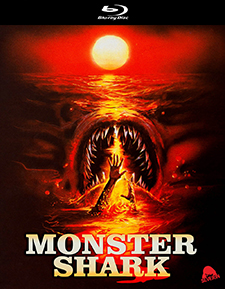
Review
When a film becomes not just a blockbuster success but also a cultural touchstone, it inevitably spawns imitators that can keep coming for many years. Such was the case with Steven Spielberg’s Jaws. While the animal attack genre was nothing new in 1975, Jaws struck such a nerve that a wave of imitators followed in the Orca’s wake (including one called, well, Orca). Some of them exchanged the seagoing thrills for monsters of far more terrestrial origin, but the killer shark movies just kept coming and coming for more than a decade. Never one to miss an opportunity to make a buck, Italian exploitation filmmakers got in on the game, and as is often the case, they took the genre far afield from its origins. Such was the case with Lamberto Bava’s 1984 effort Monster Shark, which takes bits and pieces of Jaws 3-D (as well as arguably the Hank Searls novelization of Jaws 2), Piranha, Tentacles, and even giallo, shaking and stirring them into an unforgettably weird contribution to the cycle. What Steven Spielberg began, Lamberto Bava helped to finish, and then some.
Appropriately enough for a film that’s such a stew of different elements, Monster Shark went by a slew of different titles, from Shark: Rosso Nell’oceano to Devouring Waves and Jaws Attack 2. It made its way to the United States as Devil Fish, in a devilishly re-edited version that eventually became fodder for Mystery Science Theatre 3000 in 1998. In its original form, it’s still not exactly a model of narrative coherency, but the clumsy re-editing in the American version didn’t do it any favors (which is one reason why it caught the attention of Mike and the bots). The script had contributions from a witch’s brew of screenwriters including Luigi Cozzi, Luciano Martino, Sergio Martino, Gianfranco Clerici, Vincenzo Mannino, Dardano Sacchetti, and Hervé Piccini. So, it’s not too surprising that the results don’t exactly cohere. (Neither does the international cast including Michael Sopkiw, Valentine Monnier, Gianni Garko, William Berger, Iris Peynado, and Dino Conti, but that’s a different matter.)
For part of its running time, Monster Shark feels like two different trains that aren’t running on the same track. The first is a monster mystery, with bodies being discovered off the coast of Florida, and the hunt for the marine creature responsible for the deaths. The second is an industrial murder mystery with a hitman knocking off some victims of his own at the behest of a mysterious benefactor. The latter is where Monster Shark feels more like a giallo than an animal attack film (although it’s also where the story bears a passing resemblance to the disconnected mafia sublot in Hank Searls’ novelization of Jaws 2). Yet both of these trains do get to the same station eventually. This devil fish and/or monster shark isn’t even a fish or a shark in the first place, but rather a hybrid creature with industrial origins (shades of Piranha). In fact, in all but name only, it bears more than a passing resemblance to a monster from a later SyFy telefilm produced by Roger Corman (Roger Corman borrowing ideas from someone else? Say it ain’t so!)
Of course, that brings Monster Shark full circle with Spielberg’s Jaws, because regardless of any pretense toward being a film about a great white shark, Jaws is pure, unadulterated monster movie from start to finish. As is Monster Shark, despite any temporarily confusing sublots. What it lacks is a convincing monster, but Bava did his best to pull a Spielberg by keeping it offscreen as much as possible. Oh, there are plenty of fair questions to ask about the film, like why do the Coast Guard divers yell like Sgt. Fury’s Howling Commandos when they jump into the water? Did Bava even bother to watch television medical dramas featuring defibrillators before shooting his own bizarre scene featuring one—let alone bother to learn how they actually work in real life? Why does the English language dialogue feature someone describing a Late Devonian period fossil as having lived 320 years ago (the Italian version does say 320 million years, although even that date isn’t quite correct).
In the end, none of that really matters. Either you’re already the core audience for a film like Monster Shark, or else you never will be. It’s an exploitation film, pure and simple, not a documentary about sharks (or even a summer blockbuster about a monstrously large one). It’s pure Italian monster movie, with all that entails, for good and for ill. In other words, it’s good clean fun—well, as clean as a film featuring severed body parts and full-frontal nudity can be, anyway. If you have any doubts, one line of dialogue will let you know exactly what to expect out of Monster Shark:
“Look, from a woman who has the sensitivity of a slut, to the point of giving her lover an identical watch she gave her husband for an anniversary present, I will not accept lessons.”
That pretty much sums up the whole film. Know thyself.
Cinematographer Giancarlo Ferrando shot Monster Shark on 35mm film using spherical lenses. This version is based on a 4K scan of the original uncut camera negative (in other words, the Monster Shark version), framed at 1.66:1—although it doubtless would have been matted to 1.85:1 for its North American release. Regardless, there aren’t any framing issues at 1.66:1 aside from a gate hair or two at the bottom edge of the frame. There are some light scratches and speckling visible throughout, but there’s no major damage that really draws attention to itself. The contrast range can appear a little flat at times, but the colors look as natural as they can, and the original grain has been preserved. Monster Shark lacks the stylization that Bava brought to films like Demons and Demons 2, so it’s not visually dazzling, but Severin has done a credible job of bringing it to life in High Definition.
Audio is offered in English and Italian 2.0 mono DTS-HD Master Audio, with optional English SDH subtitles for the former and standard English for the latter (and the SDH subtitles do replicate the 320 years error perfectly). The English audio may sound a little thin compared to the Italian, but that’s because the Italian track is louder and more compressed. That really affects the dialogue, which is distorted and rather boxy in Italian—literally boxy, as in it sounds like it was recorded from the inside of a small cardboard box. While much of the English dialogue was post-synced as well, it still sounds a bit more natural in comparison, so it’s definitely the better choice between the two. Just turn up the volume to match. (There is a touch of excessive sibilance in the English dialogue, but it still beats the boxy-sounding Italian.) The cheesy synthesizers in Fabio Frizzi’s score don’t do it any favors, but that also means that it doesn’t really strain the frequency response of the track, so it sounds as good as it can here.
Severin’s Limited Edition Blu-ray release of Monster Shark is a two-disc set that includes a CD with Fabio Frizzi’s soundtrack, as well as a slipcover. (Note that we were sent a check disc version, so I can’t comment further on the actual packaging of the final release.) The following extras are included, all of them in HD:
DISC ONE: FEATURE FILM (BD)
- Audio Commentary with Stephen Scarlata, Josh Miller, and Matt Mercer
- They Call Him John Old Jr. (14:09)
- Man Versus Devil Fish (10:53)
- Trailer (2:29)
The commentary unites Stephen Scarlata, director of the 2023 documentary Sharksploitation, with screenwriter Josh Miller and actor/filmmaker Matt Mercer. They open by recalling their own first experiences with Monster Shark/Devil Fish, from worn VHS copies at mom & pop video stores to seeing it during season 9 of Mystery Science Theatre 3000. They do point out some of the differences between the Monster Shark and Devil Fish cuts, as well as a few tidbits about the cast and the crew, but this is more of a reaction track than an informational commentary. It would be a stretch to call it an appreciation, since they have no illusions about this being the second coming of Jaws, but they’re still affectionate about all of its foibles.
They Call Him John Old Jr. is an interview with Lamberto Bava, who pretends to direct his own intro before explaining why he used the pseudonym John Old Jr. on some of his early films. He says that he had the most fun making Monster Shark since he loved being around the sea, although he also has no illusions about how it turned out. (He still wishes that the producers hadn’t spent so much money on the useless animatronic monster.) He also tells some stories about the shoot, the convoluted history of the script, and his experiences working with Michael Sopkiw & Gianni Garko.
Man Vs. Devil Fish is an interview with the aforementioned Sopkiw, who talks about his own sordid past transporting drugs by boat before making an unplanned change of career after being arrested. He also had a lot of fun making Monster Shark since he was able to do some of his own stunts, and got to spend a lot of time in the water. He enjoyed working with Bava, although the producers tried to shaft him out of overtime and he ended up never working with any of them again.
But wait, that’s not all!
DISC TWO: SOUNDTRACK (CD)
- Seq. 1 (1:03)
- Seq. 2 (2:42)
- Seq. 3 (2:46)
- Seq. 4 (1:57)
- Seq. 5 (1:50)
- Seq. 6 (1:57)
- Seq. 7 (3:13)
- Seq. 8 (1:12)
- Seq. 9 (3:20)
- Seq. 10 (2:30)
- Seq. 11 (2:29)
- Seq. 12 (1:47)
- Seq. 13 (1:57)
- Seq. 14 (1:46)
- Unavailable Shark (2:35)
More Fabio Frizzi is always a welcome addition, even if he wasn’t quite able to work the wonders with synthesizers here that he did for his other soundtracks from the era. While I don’t have the 2018 Blu-ray from Code Red in order to do a direct comparison, the presence of the soundtrack CD alone gives Severin’s version the edge. Code Red did offer a brief introduction by Michael Sopkiw and Bill Olson, as well as their own commentary track with Sopkiw, Olson, and Damian Packard. However, the addition of the new commentary, interviews, and the CD definitely tips the balance in Severin’s favor. Monster Shark isn’t the kind of film that’s likely to gain many new fans in any version, but for existing fans, Severin’s Limited Edition version is preaching to the choir.
- Stephen Bjork
(You can follow Stephen on social media at these links: Twitter, Facebook, BlueSky, and Letterboxd).