
Man and a Woman, A (Blu-ray Review)
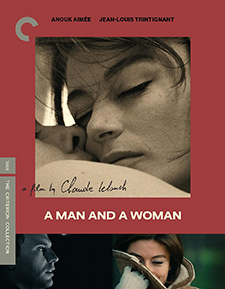
Director
Claude LelouchRelease Date(s)
1966 (March 31, 2026)Studio(s)
Les Films 13 (The Criterion Collection – Spine #1304)- Film/Program Grade: B
- Video Grade: B
- Audio Grade: A
- Extras Grade: A


Review
The French film A Man and a Woman took the world by storm in 1966 with the story of a tender romance between a widow and widower drawn together by grief over their past tragedies. Simple in structure, the film encompasses a range of emotion as it explores the complexities of unexpectedly finding new love while retaining fond memories of the lost love.
Every Sunday, script supervisor Anne Gauthier (Anouk Aimee) travels north from Paris to Deauville to visit her young daughter Francoise at boarding school. Race car driver Jean-Louis Duroc (Jean-Louis Trintignant) does the same to visit his young son, Antoine. One Sunday in winter, Anne misses the last train back to Paris and gets a lift home with Jean-Louis. During the ride, obvious chemistry develops between them, but both say they’re married and still wear their rings. Eventually they reveal that their respective partners have passed away. For Anne, the memory of her stuntman husband, Pierre (Pierre Barouh), feels quite alive.
Jean-Louis invites Anne to drive up to Deauville with him the next weekend. She welcomes the convenience despite her ambivalence. Though they don’t aggressively pursue a romance because the memory of their late partners still hovers over them, their encounters develop into an actual relationship and they fall deeply in love.
Director Claude Lelouch prevents this romantic story from bogging down into pure sentimentality by having the principal characters work in exciting, glamorous professions—the motion picture industry and professional racing. There are sequences of Anne and Pierre on movie sets with elaborate stunts staged and lengthy scenes of Jean-Louis zooming around race tracks with crowds filling the stands. The time demands of their jobs explain why they need to have their children in a good boarding school.
The two leads are attractive and have excellent screen chemistry, which is why the relationship between their characters works so effectively. These are not dewy-eyed teenagers experiencing first love. They’re mature adults coping with grief and with life after a beloved spouse’s death.
Anouk Aimee has a soulful look that makes her instantly sympathetic. Her Anne conveys interest in Jean-Louis, while the ghost of Pierre is still very much with her. Perhaps guilt at being attracted to another man or simple caution compel her to move slowly.
Trintignant appears to be typically cast as the dashing hero but his Jean-Louis has suffered loss and questions himself about pursuing Anne. Trintignant infuses his character with both irresistible magnetism and insecurities about his new romance. The actor looks right at home in the race car sequences as Jean-Louis speeds, fully aware of the inherent dangers of the sport. He’s a good, devoted father and makes time for his son.
Director Lelouch uses varying film stocks and both black & white and color to tell the story. These shifts are often confusing since they often don’t seem to be thematic. Lelouch says in the accompanying interview that he used black & white because he couldn’t afford to shoot the entire film in color. Lelouch gives many scenes a romantic cast with a wintry, windswept beach almost empty except for the two leads. Francis Lai’s music, especially the main theme, is often heavy-handed and becomes intrusive when used repeatedly. Incorporating it more subtly in fewer scenes would have enhanced its effect. The theme becomes a way for Lelouch to hammer home the romantic tone. Aimee and Trintignant generate plenty of heat without Lai’s music reminding us that their characters are in love.
The director uses flashbacks to show how the protagonists’ partners died but never really establishes how powerful their love was in life. This is essential in having us understand the hesitancy of both Anne and Jean-Louis to move on. The former partners aren’t adequately developed and we never know them fully as emotional beings.
The film hasn’t aged well. What caused all the excitement in the mid 1960s now seems awfully sappy and cliched. A smoke-filled train station, a windswept wintry beach, extreme close-ups of extended kisses, and passionate bedroom scenes may have raised eyebrows sixty years ago but seem uninspired today. The performances of Aimee and Trintignant still resonate, but the trappings no longer do.
A Man and a Woman won the Palme d’Or at Cannes and the Academy Award for Best Foreign Film and Best Screenplay, among many other awards. In his lengthy career, director Lelouch never duplicated the success with this low-budget, acclaimed film. In 1986, he made A Man and a Woman: Twenty Years Later and cast Anouk Aimee and Jean-Louis Trintignant in the same roles, but without the same box office success.
Claude Lelouch served as his own director of photography, filming A Man and a Woman in both color and black & white on Eastman 35mm film with spherical lenses. The film was processed by Laboratoires Eclair, Paris, France, and presented in the aspect ratio of 1.85:1. The Blu-ray from The Criterion Collection features an aspect ratio of 1.66:1. A new 2K restoration, supervised and approved by Lelouch, was created from the original camera negative. The Monte Carlo Rally was shot with a 16mm camera to give the sequence a newsreel quality. The cinematography is often evocative, with many scenes played out in montage. To give the film a classic-Hollywood look, director Lelouch shoots a mist-laden beach, a smoke-filled train station, and foggy streets. Anouk Aimee and Jean-Louis Trintignant are filmed in ambient light for outdoor scenes, creating a natural rather than an overly glamorized look.
The soundtrack is French 1.0 LPCM. English subtitles are shown at the bottom of the screen. Dialogue is clear and distinct. Sound effects include the roaring of race cars speeding around the track, explosions in a film Anne and Pierre are working on, and ambient crowd noise at a race track. Francis Lai’s score is a mix of jazz-pop and instrumental themes. The love theme is a lilting melody that nicely reflects the relationship of the new lovers, but so overused that it distracts from the story.
Bonus materials on the Region A Blu-ray release from The Criterion Collection include the following:
- New Interview with Claude Lelouch (23:33)
- Making-of Documentary (22:41)
- Archival Footage of Lelouch at the 1966 Cannes Film Festival (11:28)
- C’etait un rendez-vous, a Short Film by Lelouch (11:47)
- Trailers:
- International Trailer (1:24)
- French Trailer (1:50)
Interview with Claude Lelouch – This interview recorded in Paris in 2025 was conducted in French. English translations are shown at the bottom of the screen. The director reflects on the making of A Man and a Woman. The film is about love, about people who think their lives are over, and the impossibility of loving twice. “You can love many times,” Lelouch asserts. Clips from the film are interspersed with the interview. Cinema played an important part of Lelouch’s life from a very young age. To protect him from the Gestapo during World War II, his parents hid him in movie theaters for six hours a day. He loved watching films. He did poorly in school because he skipped classes and went to the movies every day. Music is like a character in his films. He wrote the script with Jean-Louis Trintignant in mind for the lead role. Trintignant suggested Anouk Aimee. Lelouch had seven technicians doing all the work. He used Normandy as a location because his mother was from that region and introduced him to it when he was a child. To get advantageous camera angles, Trintignant actually entered the Monte Carlo Rally and Lelouch shot in 16mm like a journalist. He tended to use color for outdoor scenes and black & white for interiors. According to Lelouch, when you switch from color to black & white “you give more strength to color.” Before A Man and a Woman, Lelouch made six films that didn’t do well and was in debt. He was amazed at the worldwide embrace of A Man and a Woman and went on to make 51 more films.
Making-of Documentary – This featurette is conducted in French, with English subtitles at the bottom of the screen. Made in 1966, it follows director Claude Lelouch and stars Anouk Aimee and Jean-Louis Trintignant during the making of A Man and a Woman. Lelouch, on camera, films from the open trunk of a Buick Century. He speaks about techniques that enable shots to be made more quickly than in the past; he could complete 100 shots in a day. The film story takes place over three weeks. The actual shooting schedule was four weeks. In one sequence, Lelouch loses his temper and shouts at his crew for ruining a take. He speaks thoughtfully with Trintignant about his performance in an upcoming scene. An off-screen interviewer questions Anouk Aimee about details of making the movie. The film is a fantasy Lelouch says he’d love to have lived.
Archival Footage of Lelouche – This 1966 television program follows director Claude Lelouch and actors Anouk Aimee, Pierre Barouh, and Jean-Louis Trintignant as they present A Man and a Woman at the Cannes Film Festival.
Booklet – The accordion-style booklet includes the critical essay Modern Lovers by Carrie Rickey, list of cast and key crew, several photos from the film, and information about the 2K restoration of the film, supervised and approved by the director.
C’etait un rendez-vous – This 1976 short film by Claude Lelouch was shot in a single take. With the camera strapped to the car’s front bumper, Lelouch speeds through Paris to meet the woman he loves. In a new appreciation filmed in 2025, Lelouch reflects on his passion for cars and talks about making the short film.
A Man and a Woman is a romantic’s romance. Those with a fondness for love stories will enjoy watching two beautiful people fall in love. Director Lelouch struck gold with this simple tale and benefited from winning performances by Aimee and Trintignant. The choice to use black & white or color seems haphazard and is a distraction. Francis Lai’s music, though lovely in appropriate doses, is overused. The racing scenes are excitingly shot but too lengthy, reflecting Lelouch’s affection for cars but impeding narrative flow. The film is an example of mid-20th century French New Wave filmmaking.
- Dennis Seuling