
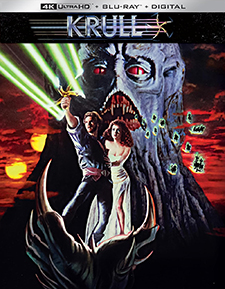
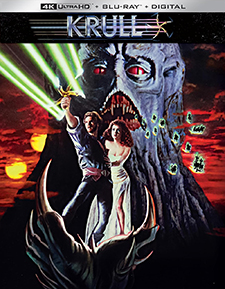
Krull: Steelbook (4K UHD Review)
- Review Date: Sep 22, 2025
- Format: 4K Ultra HD
-


Director
Peter YatesRelease Date(s)
1983 (September 16, 2025)Studio(s)
Columbia Pictures (Sony Pictures Home Entertainment)- Film/Program Grade: C+
- Video Grade: A
- Audio Grade: B+
- Extras Grade: B-

Review
While the runaway box office success of Star Wars in 1977 led to a resurgence in fantasy filmmaking, much of that was understandably confined to overt science fiction settings. Yet by the early eighties, the scales briefly tipped in favor of sword and sorcery thanks to moderately successful films like Clash of the Titans, Excalibur, Conan the Barbarian, and The Sword and the Sorcerer. The genre seemed like fertile ground for enterprising producers wanting to make a buck, so enter... Ted Mann? Mann was primarily known as the owner of multiple movie theatres in the Midwest and elsewhere (including, for a time, the Chinese Theatre in Hollywood), but he occasionally dabbled in motion picture production. He took his own shot at sword and sorcery in 1983 with Krull, which unfortunately shared something in common with other Eighties fantasy fare like Dragonslayer, Sheena, and Conan the Destroyer: it bombed at the box office. Yet it has still managed to find a cult following over the years, albeit a slightly less enthusiastic one than for the likes of successes like Excalibur or even other failures like Dragonslayer.
Mann had just set up a multi-picture deal at Columbia, and along with producer Ron Silverman, he was tasked by Columbia president Frank Price to make a fantasy film a la Dungeons & Dragons. They hired screenwriter Standford Sherman to come up with a script, which Price greenlit with Peter Yates attached to direct. Originally titled The Dragons of Krull, the story is fairly standard fantasy fare, with Prince Colwyn (Ken Marshall) set to marry Princess Lyssa (Lysette Anthony) in order to unite two competing kingdoms on the planet of Krull. When an otherworldly invader called the Beast disrupts the wedding with his army of Slayers, killing Colwyn’s father and kidnapping Lyssa, the new King Colwyn is forced to go on a quest to the Beast’s Black Fortress to save her. Along the way, he picks up followers like Ynyr (Freddie Jones), Ergo (David Battley), Rell the Cyclops (Bernard Bresslaw), the Seer & his apprentice Tich (John Welsh & Graham McGrath), as well as the bandit Torquil (Alun Armstrong) and his gang of thieves (Liam Neeson, Robbie Coltrane, Dicken Ashworth, and Todd Carty). Needless to say, they face many perils along the way like the Widow of the Web (Francesca Annis) and her giant crystal spider. But Colwyn has an ace up his sleeve: a mystical weapon called the Glaive (this despite the fact that the bladed disc bears no resemblance whatsoever to an actual glaive, but never mind minor technicalities like that).
If only the making of Krull had been as relatively easy as Colwyn’s perilous journey. Yates eventually brought in his Breaking Away screenwriter Steve Tesich to do multiple rewrites, and the production began constructing sets based on that script. Yet no one was really that happy with it, so they ended up bringing back Sherman to do further rewrites in order to make the existing sets work within the framework of his previous drafts. Sets were also struck and rebuilt in the process, leading to a marked lack of coherency in the final product. Yates did his best to hold everything together through all the behind-the-scenes chaos, although according to visual effects artist Brian Johnson, he lost interest at one point and went on vacation right in the middle of production, forcing it to be temporarily suspended—although to be fair, it’s worth mentioning that Johnson didn’t actually work on Krull, but only claimed that he heard the story second-hand via the actual visual effects supervisor Derek Meddings (so take Johnson’s version with as many grains of salt as necessary).
While the effects in Krull do vary a bit in quality thanks to some rough-looking travelling mattes, the miniature work is generally up to Meddings’ usual high standards. There are some impressive hanging foreground miniatures and forced perspective shots, especially in the latter case with a massive 1/6 scale (40’x30’) version of Colwyn’s castle that allowed riders and their horses to approach it while crossing the plane of what would have otherwise been a matte line. Former Ray Harryhausen crew member Steven Archer also did some fine stop-motion animation work for the crystal spider. Combined with memorable production design by Stephen Grimes (the Giger-esque interiors of the Black Fortress are a highlight) and accomplished cinematography by Peter Suchitzky, Krull does offer some impressive visuals. (A fine score from James Horner as well, although unsurprisingly, it borrows heavily from his prior work on Battle Beyond the Stars and especially Star Trek II: The Wrath of Khan.)
Yet the post-production period on the film wasn’t without its own series of challenges, like Frank Price deciding that he didn’t like Lysette Anthony’s voice and/or accent and insisting on having her overdubbed with an uncredited Lindsay Crouse. (Even Robbie Coltrane didn’t escape that kind of indignity, as he was dubbed by an uncredited Michael Elphick.) On the other hand, there doesn’t appear to have been any other significant disagreements during the editorial process, but coherency on the back end can’t make up for a lack of conceptual coherency from the start. That’s always been the biggest issue with Krull: a lack of a clear and consistent vision for exactly what it wanted to be.
World building is everything when it comes to fantasy films like this, but while Krull does offer some tantalizing glimpses of the broader peoples and cultures that exist on its titular planet, it never feels like a fully functioning world that exists beyond the borders of the film frame. The narrative is structured as a fairly basic quest journey, travelling from point A to B with countless rest stops in between, and with Colwyn picking up every stray dog along the way like he’s The Outlaw Josey Wales. The trouble is that every one of these destinations and encounters feels random and disconnected from the ones that preceded it, with no real narrative, geographical, or cultural flow. Successful world building can cover over a multitude of sins, just like it had done for The Dark Crystal the previous year, but Krull lacks that kind of conceptual coherency, and the final film suffered as a result.
Krull was expensive to produce in 1983, and while Columbia backed it enthusiastically, the studio ended up taking a bath on it. Worse, for a family-friendly fantasy film following in the wake of Star Wars, Columbia’s attempts at merchandising faltered badly. Parker Brothers did produce a card game and a board game, while Atari made a notoriously difficult video game for their 2600 console, but proposed action figures from Knickerbocker Toys failed to materialize. Krull never stood a chance of making money in or out of movie theatres in 1983, and so any plans for a sequel (let alone a franchise) vanished in a puff of smoke quicker than the Black Fortress did in the film.
Still, while Krull’s flaws are real, so are its strengths, although you have to be willing to accept the former in order to fully appreciate the latter. That’s exactly what fans have been doing ever since its original release, and Krull now has a small but loyal cult following thanks to memorable imagery like the Glaive (regardless of the stupid name). However much that Columbia may have fumbled the merchandising back in 1983, unauthorized prop replicas of the weapon have become a cottage industry (and courtesy of The Prop Store, Adam Savage managed to handle a very real one from the film on an episode of Tested). Where there’s a will, there’s a way, and fans always find a way to keep their dreams alive. There’s no getting around the fact that Krull is a deeply flawed film, but if you’ve only seen it once and were disappointed, do give it another chance to work its spell on you. You just need to be willing to look past those flaws in order to dig for the nuggets hidden beneath them.
Cinematographer Peter Suschitzky shot Krull on 35mm film using Panavision Panaflex cameras with anamorphic lenses. 35mm release prints were framed at 2.39:1, while 70mm prints were full-frame blowups at 2.20:1. This version is based on a 4K scan of the original camera negative, cleaned up and graded for High Dynamic Range in both Dolby Vision and HDR10, with the final results approved by Suschitzky. Typical for Sony, everything looks immaculate yet the grain hasn’t been managed excessively. There are a lot of optical effects in Krull, so all of that footage was derived from dupe elements and displays the expected degradation in quality. The opening credits look soft, with coarse grain, but as soon as they are over the image tightens up considerably. The gorgeous exteriors were shot in Italy, Spain, and the United Kingdom, and they’re beautifully rendered here down to the last rock and blade of grass. Even the quicksand in the studio (which was actually made out of cork) looks sharper and clearer than it ever has before. The colors are all rendered equally well, perfectly saturated while resisting the temptation to turn up the HDR dial to 11. The highlights like the magical effects are vivid without appearing blown out, and the blacks are deep without displaying significant crush. There’s little to criticize here, with the only real flaws being inherent to the original production.
Primary audio is offered in English Dolby Atmos, 5.1 DTS-HD Master Audio, and 2.0 DTS-HD Master Audio. Krull was released theatrically in optical Dolby Stereo on 35mm prints and 6-track mag Dolby Stereo on 70mm prints (“baby boom” format, so the surrounds were also mono). The 2.0 track here does appear to be the original Dolby Stereo mix with encoded surrounds, while the 5.1 is the same remix that has appeared previously (although it sounds better here than it did on Mill Creek’s 2014 Blu-ray). The surrounds are still mono, but overall balance between elements sound different, so either it’s based on the 6-track mix or else some additional work was been done to it. The new Atmos mix sounds significantly different than either of them, and while a few new sound effects may have been added here and there, for the most part it seems to be a reworking of the original stems. There’s now discrete surround activity, like when the Glaive flies past the camera off screen left during the opening credits and returns on screen right (it’s a simple mono surround effect on both the 2.0 and 5.1). It also adds some directional dialogue, steering it to the left or right as appropriate.
It’s not quite that simple, however. The dialogue has more clarity in the Atmos mix than it does in either 2.0 or 5.1, and it’s more prominent in the mix. The music, on the other hand, sounds more recessed in Atmos, with the stereo spread being somewhat constricted (especially compared to 5.1). Yet there’s a harsh edge to the music in 5.1 that’s been rolled off in Atmos, making it sound a little smoother even if it lacks the spread and presence of the 5.1. So, what to do? After switching back and forth quite a bit, I ended up preferring the Atmos despite the fact that it introduces issues of its own, but your own mileage may vary. As always, audition everything and decide for yourself—although it’s fair to say that few people are going to prefer the original 2.0, so it’s probably going to come down to either Atmos or 5.1.
Additional audio options include French, Italian, and Spanish 2.0 DTS-HD Master Audio, plus German 5.1 DTS-HD Master Audio. Subtitle options include English, English SDH, Arabic, Chinese (Traditional), Danish, Dutch, Finnish, French, German, Italian, Korean, Norwegian, Portuguese, Spanish (Spain), Spanish (Latin America), Swedish, Thai, and Turkish.
Sony’s 4K Ultra HD Steelbook release of Krull is a two-disc set that includes a Blu-ray with a 1080p copy of the film. It also includes a J-card slipcover and a Digital code on a paper insert tucked inside. There are no extras on the UHD, but the following extras are included on the Blu-ray only:
- Cast & Crew Commentary
- Behind-the-Scenes Commentary
- Journey to Krull (SD – 22:09)
- Theatrical Trailer (HD – 2:07)
The Cast & Crew Commentary featuring Peter Yates, editor Ray Lovejoy, Ken Marshall, and Lysette Anthony was originally produced for the 2001 Special Edition DVD of Krull. It’s a curated track with the participants recorded separately and edited together, which is probably for the best in this case since they’re definitely not on the same page about Krull. Peter Yates is surprisingly enthusiastic about the film, and if it’s true that he lost interest partway through the production, he had regained it over the years since then. (Ray Lovejoy joins Yates partway through to re-inforce what the director has to say.) Ken Marshall is unabashedly enthusiastic about Ken Marshall, with all other considerations secondary. Lysette Anthony wastes no time pointing out that Frank Price was the one who made the decision to redub her voice, which became a point of contention when she later married his son David (she jokes that she’s not bitter about it at all). Between the four of them, they offer an interesting portrait of the making of Krull as viewed through their own unique perspectives.
The Behind-the-Scenes Commentary isn’t a commentary at all, but rather a reading of Dan Scaperotti’s preview for Krull from the November/December 1982 double issue of Cinefantastique (which appears to have had variant covers, one for Krull, the other for The Thing). Scaperotti visited the set to see the work in progress and interviewed key participants, so it’s not a postmortem like Cinefantastique’s classic July 1992 “It Came from Development Hell” cover story on Alien3, but it does provide glimpses of the challenges that occurred during the production. (Note that since this isn’t a scene-specific track, it only runs about 73 minutes.)
Journey to Krull is a promotional making-of featurette that originally aired on television in 1983. Narrated by Tom Bosley (because of course it is), it offers some interesting behind-the-scenes footage of script readthroughs and the physical training under stunt coordinator Vic Armstrong, as well as footage of the sets and miniatures. It includes interviews with Peter Yates, Ron Silverman, Vic Armstrong, Derek Meddings, Stephen Grimes, Ken Marshall, Freddie Jones, Lysette Anthony, Robbie Coltrane, David Battley, Graham McGrath, Bernard Bresslaw, and prosthetic makeup designer Nick Maley. It even includes glimpses of Bresslaw without his Cyclops makeup, and more importantly, Anthony and Coltrane speaking with their own voices. (Note that there are encoding issues here that lead to interlacing artifacts and stuttering on lateral pans, but it’s still watchable enough.)
The only extra from previous editions that’s missing here is the “motion comic” version of Marvel’s two-issue adaptation of Krull from 1983. It was originally offered as an Easter egg on Sony’s 2001 DVD, although it was later included as a regular feature on the 2019 Blu-rays from Sony in the U.K. and Umbrella in Australia. If it’s included here as an Easter egg, I wasn’t able to find it. Odds are that there’s a licensing issue so it’s not here at all, but we’ll update this if someone manages to track it down. Regardless, considering that the North American Blu-ray from Mill Creek was bare-bones, this is the first time that any of these extras have been offered since the DVD days, and Sony’s new 4K master is a significant upgrade from any and all previous versions. Krull is still Krull, but it’s never looked better on home video, so Sony’s Steelbook is the way to go if you’re willing to give the film a second chance—and loyal fans will be thrilled.
-Stephen Bjork
(You can follow Stephen on social media at these links: Twitter, Facebook, BlueSky, and Letterboxd).