
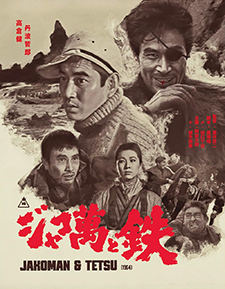
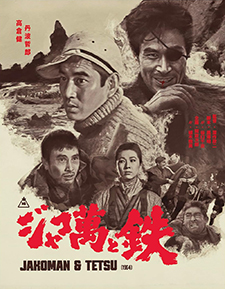
Jakoman and Tetsu (Blu-ray Review)
- Review Date: Aug 11, 2025
- Format: Blu-ray Disc
-


Director
Kinji FukasakuRelease Date(s)
1964 (April 22, 2025)Studio(s)
Toei Co., Ltd. (88 Films)- Film/Program Grade: B+
- Video Grade: A-
- Audio Grade: A
- Extras Grade: A-

Review
Atypical for the Japanese studio Toei, director Kinji Fukasaku, and star Ken Takakura, Jakoman and Tetsu (Jakoman to Tetsu, 1964) is a remake of a 1949 Toho release (not Toei, as the IMDb erroneously claims; Toei didn’t even exist then). That original was notable for starring Toshiro Mifune in an early role, its screenplay written by Akira Kurosawa and its director, the much-under-valued Senkichi Taniguchi, who came up the ranks at Toho alongside Kurosawa and another contemporary, Ishiro Honda, the director of the original Godzilla (1954). Takakura saw the film when he was 18 years old and fell in love with it; as his star rose at Toei in the ‘60s he convinced Toei to purchase the remake rights.
On its own terms the remake is pretty good, though the casting of the three leads is a little off, with Takakura particularly deviating sharply from his emerging stoic screen persona. Though he plays Mifune’s old role, his performance is more like a quirky Wakadaisho (Yuzo Kayama’s clean-cut character from that ‘60s film series) than he is like Mifune.
Now a period film, the story takes place just after the end of World War II in northernmost Hokkaido, where Kyubei (Isao Yamagata) runs a herring fishing business hiring seasonal workers, most ex-cons from the island’s Abashiri Prison, for the intricately-timed catch when the herring spawn close to the rocky, icy shores. The men live in primitive dormitory conditions and are paid low wages, with Kyubei heavily in debt, barely scraping by. Into this environment comes Jakoman (Tetsuro Tamba), a one-eyed ruffian who brutishly takes over the entire upper-level bunks, lollygags about and drinks sake all day. None there have the courage to kick this lout out. He’s there seeking revenge against Kyubei, who stole his boat and left him stranded in Russian in the last days of the war.
Soon after arrives Tetsu (Takakura), Kyubei’s son, a sailor in the Imperial Navy everyone in Tetsu’s family assumed was dead. The bulk of the film follows the buildup to the big fishing haul, Jakoman’s revenge plans, and Tetsu’s strange relationship with the scalawag—eccentric Tetsu unafraid of a big showdown but strangely empathetic toward the combative Jakoman, while also siding with the workers rather than his blustery father when the workers embark on a last-minute strike against the fishery.
To the best of my knowledge, the original Jakoman and Tetsu has never been released in any English-friendly home video format anywhere in the world; a likely explanation is that Toho wants too much money for home video rights. But insofar as it was likely written with Mifune in mind for the lead, one can easily imagine how Mifune would have played this eccentric, unpredictable character as almost a warm-up to his would-be samurai in the later Seven Samurai. Try as he might, Takakura can’t convey those aspects of the character convincingly, though he’s in there swingin’. At one point, to entertain the men, Tetsu performs a nonsensical, supposedly Malay song-and-dance, in English something akin to “You put da lime in da coconut, you drank ‘em bot’ up,” and while Takakura is reasonably amusing, it doesn’t take much imagination to visualize how much more captivating a young Mifune would have been.
Part of the problem may lie in the fact that Takakura and Fukasaku did not get along, Takakura the rising star with a pet project for which, no doubt, he had particular ideas about how it should be done, with Fukasaku, out of his element and not yet the star director he later became, not happy to be more or less along for the ride. Despite both working at Toei for years, by mutual agreement they rarely worked together after this.
The similarly difficult part of Jakoman is likewise a bit beyond Tetsuro Tamba’s reach (Ryonosuke Tsukigata played Jakoman in the original). By 1964 Mifune would have been ideal as Jakoman, but at the time he was deeply embroiled in the production of Kurosawa’s Red Beard, and couldn’t have done it even if he had been asked. Further, Isao Yamagata (Gate of Hell) is hammy as Kyubei; his scenery-chewing in the film’s early scenes border on insufferable.
Nevertheless, the film has many good points, most particularly Fukasaku and cinematographer Makoto Tsuboi’s use of harsh, mountainous coastline locations, and the authentic period and place details. Filmed in stark black-and-white Toeiscope like Abashiri Prison (1965), this more than that film show northern Hokkaido off in all its inhospitable beauty. The herring fishing scenes, some shots accomplished via miniatures, look harrowing and grueling work besides, a dedicated Takakura even jumping into the icy waters wearing nothing but a loincloth (and supposedly requiring three days to recover from the instant hypothermia).
Somewhat better, and playing to Takakura’s strengths, are scenes of Tetsu wandering off to help the family of a fellow sailor also presumably lost at sea, a budding romance with a young farmer girl and her father, the two men axing tree stumps like Alan Ladd and Van Heflin in Shane (1953).
88 Films’ Region “A”/”B” Blu-ray of Jakoman and Tetsu looks okay if a little scratchy at the beginning and a bit softer than expected; the Toei black-and-white/’scope A Fugitive from the Past from 1965 looks slightly better on Blu-ray, and that was filmed in 16mm and blown up to CinemaScope size. The mono Japanese-only audio is okay, and the subtitles are good, however. The packaging comes with a reversible sleeve.
Extras include a thorough booklet essay by Chris D; an introduction to the film by Japanese film critic Mark Schilling, and a new audio commentary track by Tom Mes and Jasper Sharp.
Even though Jakoman and Tetsu could, at best, be considered a partial success, it’s an intriguing, welcome release, and a nice break from the usual yakuza and chanbara titles one usually expects, particularly from Toei. Recommended.
- Stuart Galbraith IV