
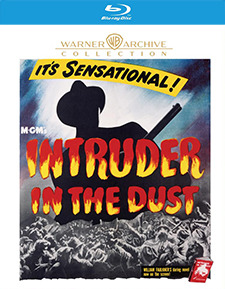
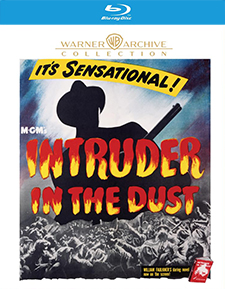
Intruder in the Dust (Blu-ray Review)
- Review Date: Sep 29, 2025
- Format: Blu-ray Disc
-


Director
Clarence BrownRelease Date(s)
1949 (August 26, 2025)Studio(s)
Metro-Goldwyn-Mayer (Warner Archive Collection)- Film/Program Grade: B+
- Video Grade: A
- Audio Grade: A
- Extras Grade: B-

Review
Intruder in the Dust joined the handful of films released around the same time, such as Pinky, Home of the Brave, and No Way Out, that dealt forthrightly with racial bias. Based on the novel by William Faulkner, Intruder in the Dust explores the deep-seated prejudices of white people toward Blacks, particularly in the American South, that simmered over generations.
Lucas Beauchamp (Juano Hernandez), an elderly Black man, is proud of the ten acres in Jefferson, Mississippi he inherited from a white forbear. Accused of having shot a white man in the back, Lucas awaits trial behind a series of iron doors for security as a crowd of angry white folks itch to exercise their own form of justice—lynching, though the term is never used. As he’s marched into jail, he asks a boy in the crowd, Chick Mallison (Claude Jarman, Jr.), to ask his uncle, John Stevens (David Brian), to defend him.
In a flashback, we see why Lucas turned to Chick for help. Chick was hunting on Lucas’ property when he fell into an icy pond. Lucas rescued the boy and gave him warm clothes and hot food. Chick, having grown up with the same ideas about Negroes as his white neighbors, is both grateful and surprised that a Black man would offer such kindness to a white trespasser. In addition to owing Lucas a big favor, Chick cannot believe that he would commit murder.
Chick convinces his uncle that Lucas is a decent man deserving of representation in court. Elderly Miss Habersham (Elizabeth Patterson) and Sheriff Hampton (Will Geer) join Chick and his uncle as the only townspeople standing firm against the crowd’s agitation to take justice into their own hands. What especially irks the townsfolk is Lucas’ proud bearing and refusal to act obsequiously. His silent dignity and refusal to be cowed by intimidation doesn’t fit their idea of how a Negro should behave.
The old lady, the sheriff, and the lawyer follow up on information the boy gives them and exhume the body of the murdered man to retrieve the bullet that killed him and see if it matches bullets from Lucas’ hunting gun. The film is a mystery whodunit as well as a portrayal of small-mindedness and multi-generational bias.
Hernandez is sympathetic as Lucas. His scenes with Chick in the flashback display Lucas’ compassion and ability to see the person beneath his skin color. With piercing eyes and a serious countenance, Lucas strikes an imposing figure. Hernandez is also a tall man, so his Lucas towers over many of the men who want to see him hanged. Given little dialogue, Hernandez uses body language, facial expression, and his physicality to convey an inherent dignity and sense of righteousness.
It’s odd but understandable that the role of Lucas isn’t played by a Black actor. Hollywood frequently cast white actors in ethnic roles. Charlie Chan, the famous Chinese detective, was played on screen by white actors Warner Oland and Sidney Toler. Even Boris Karloff put on elaborate make-up to play the title character in The Mask of Fu Manchu. Both Natalie Wood and George Chakiris (of Russian and Greek heritage, respectively) played Puerto Ricans in West Side Story. Hernandez, son of a Puerto Rican sailor, made a career of portraying Black characters for over 40 years. Only in the last two decades have motion picture and TV directors and casting agents offered greater employment opportunities for minority talent.
Much of the story in Intruder in the Dust is told through Chick’s eyes. Jarman has a look of wonderment as his Chick is cared for by Lucas and his wife. Chick has seen Black people only from a distance and heard only disparaging language about them his whole life. Now that Chick sees Lucas as a kind, compassionate man who deserves respect, Jarman’s close-ups convey gratitude and admiration. We can see how Chick’s attitude is evolving.
Lawyer John Stevens is a decent man who agrees to defend Lucas because Chick pleads his case so enthusiastically. Brian’s portrayal of Stevens suggests an Atticus Finch type, bucking nearly the whole town to prevent a lynching and represent a Black person in court.
Director Clarence Brown filmed much of Intruder in the Dust in Faulkner’s home town of Oxford, Mississippi. The woods, fields, and small town add atmosphere. The faces of the extras are notable because they convey many things—impatience, anger, hatred, and even pity. As Lucas is marched into the police station, director Brown does a slow tracking shot showing mostly men lined up watching the proud Lucas being led inside.
The screenplay by Ben Maddow moves briskly. The film has no romantic interest, a welcome choice in an era when this was practically de rigueur in Hollywood films. It’s not clear why Miss Habersham is so motivated to protect Lucas, but perhaps the point is that an 80-year-old woman can have more courage than younger, able-bodied men, and more wisdom. Her age and experience may have been a factor in seeing injustice and acting to stop it. The villains are more stereotypes than fully developed characters, which reduces them to metaphors for blind prejudice. Greater focus on one or two with backstories could have given them some interesting facets.
That a major studio made this picture is unusual. Dore Schary was head of production at MGM during this period and he championed films that dealt with social issues. The threat of violence pervades the film, though there’s little of it on screen. Director Brown creates tension by building suspense. The crowd can turn into a mob at any minute and there aren’t enough fair-minded people to protect Lucas if that happens. We fear for Lucas, knowing that his race, his alleged murder of a white man, and the fact that he lives where Blacks are regarded as second-class citizens, all militate against him.
Intruder in the Dust was shot by director of photography Robert Surtees on 35mm black & white film with spherical lenses and presented in the aspect ratio of 1.37:1. Clarity and contrast on the Blu-ray are excellent, especially in the many outdoor scenes. Director Clarence Brown makes dramatic use of close-ups of the townsfolk to show how they feel about Lucas. A cemetery scene shot at night is appropriately eerie as a body is exhumed. A full moon throws atmospheric shadows on the small group. Lucas’ humble house has no modern amenities but his land is sprawling, with lots of game to provide food. Quicksand provides the basis of a key scene. Location filming, unusual for the time, adds plenty of local color.
The soundtrack is English 2.0 mono DTS-HD Master Audio. English SDH subtitles are an option. Dialogue is clear and distinct. The “N” word is used a number of times, once by Chick, which illustrates how customary it was for white Southerners to refer to Black people that way. Sound effects include crowd rumblings, car engines, gun shots, and horses’ hooves on a dirt road. Crickets break the silence in the cemetery scene. The score by Adolph Deutsch contributes to the film’s tension and speeds up in some scenes to highlight the time factor’s importance in solving the murder before Lucas is lynched.
Bonus materials on the Blu-ray release from the Warner Archive Collection include the following:
- Playlands of Michigan (9:11)
- Counterfeit Cat (7:07)
- Theatrical Trailer (2:30)
Playlands of Michigan – This 1949 Technicolor MGM Fitzpatrick Traveltalk focuses on Saugatuck, Michigan, near the Kalamazoo The town derives its name from Native Americans. Sailboating, water skiing, and speedboating are popular in the town. Percy Adams, the “Magic King,” performs two illusions. At a Tulip Festival, costumed participants perform a traditional Dutch dance. We see folks fishing on Lake Michigan and we’re told the lake yields 9 million pounds of fish each year. Finally, dune buggies make their way across the white sand dunes of Silver Lake.
Counterfeit Cat – This 1949 MGM Technicolor cartoon was directed by Tex Avery. As Blackie the Cat searches for food in a trash can outside a house, he hears a canary singing. He enters the house and is chased by Spike the bulldog, who’s guarding the canary. Blackie steals the headpiece of a dog to deceive Spike and get a chance to eat the canary. The disguise works for a while until Spike gets wise and kicks the cat out of the house. Angry, Blackie goes back into the house and chaos ensues. The situation comes to a head with Blackie and Spike the worse for wear.
Intruder in the Dust is a powerful film that confronts racial preconceptions while dealing with a murder mystery. With a fine performance by Juano Hernandez, the film exposes intolerance and bias in a small Southern town. The story is engrossing, with a message that’s strong but not hammered heavy-handedly. This is one of Hollywood’s pioneering efforts at showing the depths of racial prejudice in America.
- Dennis Seuling