
Innkeepers, The (Blu-ray Review)
- Review Date: Mar 26, 2026
- Format: Blu-ray Disc
-


Director
Ti WestRelease Date(s)
2011 (February 4, 2026)Studio(s)
Dark Sky Films/Glass Eye Pix (Umbrella Entertainment)- Film/Program Grade: B+
- Video Grade: B+
- Audio Grade: A-
- Extras Grade: B+
Review
[Editor’s Note: This is a Region-Free Australian Blu-ray import.]
While writer/director Ti West has made at least one atypical horror film in the form of the sequel Cabin Fever 2: Spring Fever (hey, sometimes you have to take a paycheck), his bread-and-butter has always been slow-burn horror, going all the way back to his debut feature The Roost in 2005. Yet while his experience making Cabin Fever 2 was an unpleasant one, enough so that he requested (unsuccessfully) that his name be taken off the final film, it was a watershed moment in his career since it was his first collaboration with cinematographer Eliot Rockett. Their next film together, The House of the Devil, is what really cemented the template for the kind of horror that West wanted to make. Just as importantly, it also established the way that West and Rockett would use a variety of different visual techniques in order to ground their films in specific settings. While West continued to work with cinematographer Eric Robbins on a few projects, it’s no accident that his films with Rockett are the ones that have been the most prototypically “A Film by Ti West.”
Yet The House of the Devil had one other impact on West that led directly to his next film. It was shot on location in Connecticut, where the cast and crew ended up staying at the Yankee Pedlar Inn in Torrington. The historic hotel has long had a reputation for being haunted by (among other things) the spirits of the original owners Frank and Alice Conley, with rooms 295 and 353 in particular being noted for supposed supernatural activities (sorry, Shining fans, no room 237). It was an evocative setting, so it provided the inspiration for his follow-up The Innkeepers—and rather than translating that experience into a more generic setting, West got permission to shoot his new film at the actual hotel. Werner Herzog preferred shooting where historical events occurred due to what he called the “voodoo of location,” and West tapped into that with The Innkeepers. Haunted or not, the Yankee Pedlar Inn was the perfect setting for a slow-burn ghost story.
The basic narrative for The Innkeepers is a fairly straightforward “haunted hotel” story, with the primary twist coming from the protagonists. Appropriately enough, given West’s own working-class roots, they’re a pair of nobodies who have taken lowly jobs as clerks at the Inn. Yet Claire (Sara Paxton) and Luke (Pat Healy) aren’t really interested in their day jobs; they know the hotel’s history and have brought along paranormal investigative gear like EVP recorders in order to try to capture some of the supernatural shenanigans for their website. In between dealing with guests like an angry mother (Alison Bartlett), an aging actor (Kelly McGillis), and a creepy old man (George Riddle)—to say nothing of having to deal with the irritating local barista (Lena Dunham)—they take turns trading shifts and trying to record ghostly activity. Yet as with most things Ti West, there’s both more and less going on at the Yankee Pedlar Inn than meets the eye, and ultimately one of these amateur Ghostbusters is going to have to face their fears alone.
West pulled out all the haunted house stops for The Innkeepers, from eerie things half-glimpsed in the shadows to repeated false jump scares (what Roger Ebert used to call “cat scares.”) There’s constant tension throughout thanks to Jeff Grace’s effective score and a persistent low frequency droning effect that kicks in whenever West wanted to create a sensation of unease. Hell, there’s even a few slamming doors and a body in a bathtub thrown in for good measure. Most of that is territory that was already mined by Robert Wise in his 1963 adaptation of Shirley Jackson’s The Haunting of Hill House, but while West’s version of the Yankee Pedlar Inn may share a certain lack of sanity with Hill House, the context is quite different, and that’s the critical factor in analyzing West’s approach to slow-burn horror.
Wise’s team of paranormal investigators were the epitome of wealth and privilege, with only the reluctant Eleanor as the odd one out, culturally speaking. Claire and Luke, on the other hand, are pure working-class shmoes—and they’re full-blown nerds, too. The Yankee Pedlar Inn may represent old money, but West’s protagonists are pretty much broke, working as lowly wage slaves while trying to make their big break online. The genius of The Innkeepers is that it takes the basic setting from films like The Haunting and The Shining and then inserts Dante Hicks and Randal Graves into the middle of it—and unfortunately for them, they are supposed to be here today. Claire and Luke are something that Dr. John Markway, Luke Sannerson, Theodora, and even Eleanor were not: relatable. Like Dante and Randal, they don’t take their jobs particularly seriously, and they can barely disguise the disdain that they feel for the few remaining residents of the hotel. They’re far more concerned with their pop culture fantasies, in this case haunted house stories—only for them, fantasy will slowly turn into reality.
The key to that, of course, is the word “slowly.” West had pulled a similar stunt with his breakthrough film The House of the Devil, taking his own sweet time to establish Sam as a character before unleashing unholy Satanic hell on her. The reason why The Innkeepers works as well as it does is that West was far more interested in Claire and Luke than he was in the haunted hotel itself. The real-life Yankee Pedlar Inn may have provided the basic inspiration, but West’s focus remained on his two protagonists. As a result, they feel quite real, which is crucial when dealing with a story that’s inherently unreal. Claire and Luke keep everything grounded even as their situation turns more and more untethered, and that’s the key not just to The Innkeepers, but to West’s approach to slow-burn horror in general. It’s not really slow-burn horror at all; instead, it’s slow burn character development, and that’s what ends up making his horrors so effective. Come for the Satanists, ghosts, axe-wielding matrons, and serial killers, but stay for the babysitters, hotel clerks, housewives, and aspiring actors instead—and never fear, the horrors will come, too. Eventually.
Cinematographer Eliot Rockett shot The Innkeepers on 35mm film in 2-perf Super-35 format (the modern equivalent of Techniscope) using Aaton Penelope cameras with Zeiss Master Prime and Angénieux Optimo lenses. Post-production work was completed as a 2K Digital Intermediate, framed at 2.39:1, which then had an anamorphic squeeze applied and was scanned back out to film for theatrical release prints. There’s no information available about what kinds of stocks that Rockett may have used, but there’s a fine layer of grain throughout that’s reasonably even regardless of the shooting conditions. Given that the lighting is generally low-key and somewhat dim, the contrast can seem a bit soft at times, but that’s just the nature of the material (it gets much stronger during the rare daylight exteriors). The black levels are solid, though, and while The Innkeepers has a muted color palette, there’s still plenty of contrast between the colors as well. It may not be dazzling, but that’s because The Innkeepers isn’t supposed to be dazzling.
Audio is offered in English 5.1 and 2.0 DTS-HD Master Audio, with optional English subtitles. The Innkeepers was released theatrically in 5.1, with very carefully modulated sound design by long-time Ti West collaborator Graham Reznick, so give the 2.0 a hard pass. It’s a fascinating mix filled with all of the usual ambient surround effects that you would expect in a haunted house story, but there’s so much more to it than that. Subwoofers will get a thorough workout thanks to his use of those low frequency drones, almost a throb, that will keep viewers appropriately ill at ease. It’s a way of providing a subjective experience that mimics the obvious discomfort felt by Claire and Luke. That subjectivity is handled in other ways as well, like when Reznick dials out the sound after Claire puts on a pair of headphones, which almost forces you to lean in to hear what’s happening (something that first time viewers will soon regret). The haunting (natch) score by Jeff Grace also supports the experience, subtle when it should be and in-your-face whenever a kick in the seat of the pants is called for. It’s a great mix.
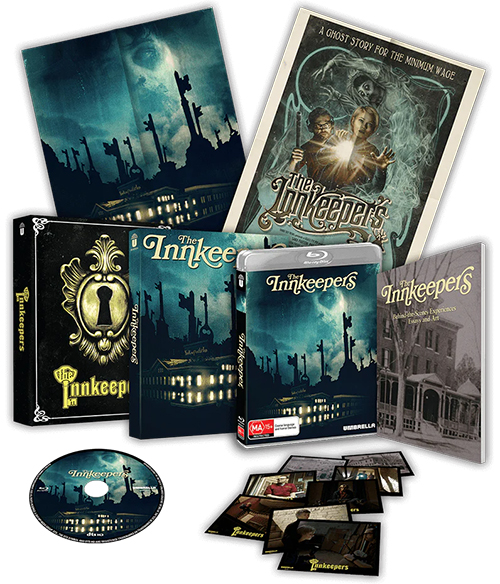
The Umbrella Entertainment Region-Free Collector’s Edition Blu-ray release of The Innkeepers includes a slipcover, 8 art cards, an A3-sized foldout poster, and a 48-page booklet featuring essays by Kieran Fisher and David Michael Brown, plus an anti-torrenting plea that Ti West wrote during the original VOD release of the film. As with most Umbrella releases, the insert is reversible, with the same cover art on each side but with the alternate one being free of the mandatory Australian Classification Board ratings label. Everything comes housed in a rigid hardbox. Umbrella is also offering a standard version that eliminates the hardbox and all of the swag (although it does still offer a slipcover). Regardless of which version that you choose, the following disc-based extras are included, all of them in HD:
- Commentary with Ti West, Larry Fessenden, Peter Phok, and Graham Reznick
- Commentary with Ti West, Sara Paxton, and Pat Healey
- Commentary with Alexandra Heller-Nicholas
- The Innkeepers: Behind the Scenes (7:27)
- From Fear to Eternity: How the Living Haunt the Dead (9:35)
- Trailer (2:03)
Umbrella has added two new extras for this release. The first is a commentary featuring Alexandra Heller-Nicholas, author of multiple books including 1000 Women In Horror, 1895-2018. The Innkeepers is her own personal favorite of all of Ti West’s films partly because it’s even more low-key than his other horror efforts. Her love of the film’s deliberately anachronistic spirit is tied to her love of the characters; as West has said, it’s a traditional ghost story led by unconventional modern characters who don’t really belong in a horror movie (it’s “charming,” in his own words). Heller-Nicholas believes that female protagonists in West’s films like The Innkeepers reflect the changing nature of female horror protagonists in general. She also reads from interviews with West where he emphasizes that he isn’t intentionally making slow-burn horror; it’s just that the structure of his films fits into his own personal taste, which is to establish the characters first before letting the horror elements take over. Heller-Nicholas always offers valuable contributions to the discourse surrounding horror and exploitation, and this commentary is no exception.
From Fear to Eternity is a visual essay by critic Martyn Conterio, who examines the nature of ghost stories and how they interact with the workplace comedy of The Innkeepers. It reflects how cheap technology has transformed ghost hunting from academic settings to the working-class milieu of reality television and viral videos. Conterio also feels that the laid-back nature of West’s filmmaking matches the bored wage slave status of the protagonists in The Innkeepers.
The archival extras kick off with two different commentaries, each of which features Ti West paired with either the crew members or the cast. The crew commentary includes producer Peter Phok and sound designer Graham Reznick (producer Larry Fessenden joins them partway through). They discuss the backstory behind the conception of The Innkeepers (which needless to say means that they cover the key location), and they provide plenty of practical detail about the making of the film. It’s filled with juicy little details like the fact that the ghost in the cheap jump scare at the beginning is actually a distorted clip of Heather Robb from The House of the Devil. West takes the opportunity to point out that the scare isn’t just a way of fulfilling a standard horror movie trope, but it also flags the fact that the film might be sillier than you expect. West also reminds listeners that The Innkeepers isn’t really about the ghost(s), it’s a character study of Claire and Luke. He acknowledges that the Steadicam work in a hotel inevitably evokes The Shining, but it’s still nothing more than a charming ghost story with two equally charming lead characters.
Speaking of which, the cast commentary pairs West with the aforementioned Claire and Luke, aka Sara Paxton and Pat Healy. They naturally focus more on the performances in the film (not just their own), but there are still some interesting stories here, like how West got the idea for the Leanne Rease-Jones character after seeing Dee Wallace’s self-help activities during the making of The House of the Devil. There’s some inevitable overlap, but the cast commentary still makes a nice companion piece to the one with the crew.
Side note: the web address for the faux website that was created for Luke’s Yankee Pedlar page, which is described in one of the commentaries as still being available as of 2012, is no longer active as of 2026. Even the links on the Wayback Machine are broken, dammit. But if you’re want to try to do some digging on your own, here it is.
The Innkeepers: Behind the Scenes is a cursory promotional making-of featurette that was shot on set during the production of the film. It includes interviews with West, Paxton, Healy, Phok, Fessenden, and Reznick, as well as Kelly McGillis, producer Derek Curl, production designer Jade Healey, and George Riddle (who mostly stays in character). It also includes plenty of behind-the-scenes footage, but you’ll still learn much more from listening to the commentaries.
That’s all the extras from the original 2012 MPI Blu-ray, but there are a few things missing here from Second Sight’s 2025 UHD release in the U.K. They recorded their own interviews with West, Healy, Fessenden, Rockett, Jeff Grace, and line producer Jacob Jaffke. Of course, the elephant in the room there is that the Second Sight version was in 4K, but while there are visible improvements with that 4K master, the differences weren’t exactly dramatic. Umbrella has added some nice new extras of their own, with the Heller-Nicholas commentary providing a fine counterpoint to the cast and crew commentaries, and since Second Sight’s Limited Edition version is long sold out at this point, Umbrella’s Collector’s Edition packaging is the best that’s currently available. Regardless, The Innkeepers is a film that belongs in the library of any horror fan, and Umbrella’s set is big step up from the old MPI Blu-ray.
- Stephen Bjork
(You can follow Stephen on social media at these links: Twitter, Facebook, BlueSky, and Letterboxd).