
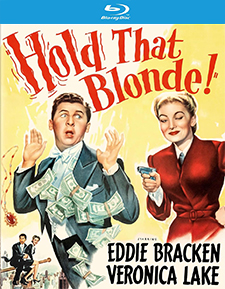
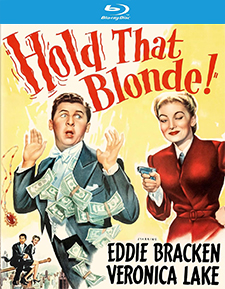
Hold That Blonde! (Blu-ray Review)
Director
George MarshallRelease Date(s)
1945 (January 27, 2026)Studio(s)
Paramount Pictures (Kino Lorber Studio Classics)- Film/Program Grade: C+
- Video Grade: A-
- Audio Grade: A
- Extras Grade: B-

Review
A perceptive user of the IMDb, one “utgard14,” sharing his thoughts on Hold That Blonde! (1945), headlined his review, “Just Don’t Expect Preston Sturges.” That pretty much sums up this extraordinarily perfunctory screwball/slapstick comedy starring Eddie Bracken (of Sturges’s The Miracle of Morgan’s Creek and Hail the Conquering Hero) and Veronica Lake (Sullivan’s Travels), and which features other members of Sturges’s stock company.
Nevertheless, if held at gunpoint and forced to name the single greatest comedy performance in a Hollywood-made feature film, my first instinct would be to choose Eddie Bracken in The Miracle of Morgan’s Creek, a tour de force of hilarious skittishness and sincerity and puppy-dog love, a performance both side-splittingly funny and sweetly touching, his body and facial expressions choreographed with the precision of a Fred Astaire dance solo. Bracken, in that film, is a wonder.
It was Sturges’s last big hit, earning $9 million against a cost of just $775,000. No doubt Paramount wondered if Bracken had the chops to star in comedy vehicles outside Sturges’s unique universe, and when Bob Hope became embroiled in a contract dispute with Paramount, Hold That Blonde! (which even sounds like the title to a Hope comedy) was retooled for Bracken.
Unfortunately, the picture, allegedly based on Paul Armstrong’s 1914 play The Heart of a Thief but really an original work by Walter DeLeon and Earl Baldwin, is profoundly routine, with standard screwbally-type situations not even done all that well.
Ogden Spencer Trulow III (Bracken), having lost at love, is so psychologically traumatized from the experience that he becomes an unwitting kleptomaniac, stealing items big and small without realizing it. His psychiatrist (George Zucco—Would you take medical advice from George Zucco?) insists the only cure is for Ogden to fall in love again, and very soon he does, with Sally Martin (Veronica Lake), part of a gang of inept jewel thieves led by Mr. Phillips (Frank Fenton). She starts out as a tough dame in the Barbara Stanwyck mode, incredulous when Ogden almost immediately proposes marriage to her, but soon enough, through the story’s complex machinations, comes around to loving this hopeless schlemiel.
Predictably, Ogden become entangled in the gang’s activities via overly-familiar comedy situations: he hiding under their lunch table as they plot their caper, later masquerading as a foreign waiter; he dangling on the ledge and flagpole of a skyscraper (which Sturges did with Harold Lloyd soon after, in The Sin of Harold Diddlebock); he pretending to be a magician at a swanky party while trying to get stolen diamonds back from Sally, she masquerading as a maid, etc.
Despite a background in film comedy and occasionally memorable films (in all genres) such as Destry Rides Again and The Ghost Breakers, director George Marshall was usually no better than workmanlike. Later in his career he helmed weaker Jerry Lewis features, TV shows (again, in every genre), and some of the worst comedies of the 1960s, including Boy, Did I Get the Wrong Number! And The Wicked Dreams of Paula Schultz. To wit: when he dangles from the ledge and later the flagpole of a high-rise, Bracken flails about admirably without a net because Marshall and the writers are of no help at all. Into the fray they toss in Jack Norton playing (What else?) a drunk, but their interaction is meaningless.
Four years later, Jules White directed the two-reel comedy Hokus Pokus (later remade as Flagpole Jitters using most of the same footage), with Moe, Larry, and Shemp in a virtually identical situation, yet the results are hilarious. In both films the flagpole eventually breaks, sending Bracken/the Three Stooges crashing through an apartment window below. In Hold That Blonde!, however, it’s into an apartment where an ordinary man (Eddie Laughton, a Three Stooges regular). Wouldn’t a fat lady in curls, or maybe a dignified dowager been obviously funnier than an anonymous man in pajamas? George Marshall didn’t think so.
Bracken tries hard, though he’s more subdued than in The Miracle of Morgan’s Creek, and even squeezes out a couple of laughs in tired, overworked material, such as his nervous magic trick scene, or trying to convince a butler (Bobby Watson, here billed as Robert Watson and between stints impersonating Hitler) he has a party invitation when he hasn’t. Mostly, though, it’s the same old-same old, such as the climax that has Bracken and Lake sneaking around an old dark house. (There is, however, a gag that fans of Peter Medak’s The Changeling will appreciate.)
There’re also a couple of good moments from Willie Best, featured also in Marshall’s The Ghost Breakers, as Willie, Ogden’s valet. Interestingly, the part is less the demeaning “Sleep ’n’ Eat”-type racial stereotype with Best playing something more like an ancient antecedent of Leon from Curb Your Enthusiasm. Best was a solid comic actor and he’s in good form here. Veronica Lake, too, is a bit of a surprise, she taking to the aimlessly silly material like a duck to water; it’s too bad she didn’t do more films, better films, of this type.
Kino’s Region “A” Blu-ray, licensed from Universal, presents the 1.37:1 standard frame, black-and-white film in a strong high-def transfer. The image is sharp with excellent contrast; there’s a little negative damage here and there but mostly it looks great. The DTS-HD Master Audio (2.0 mono) is fine, supported by optional English subtitles.
The lone extra feature is a new audio commentary track by Julie Kirgo and Peter Hankoff.
Fans of the great comedy master Preston Sturges and fine comic actor Eddie Bracken should see this ineffectual knock-off once. It certainly makes one appreciate Sturges all the more, and while it isn’t funny most of the time, because of its connections it is moderately fascinating to watch.
- Stuart Galbraith IV