
Godzilla: The First 70 Years (Book Review)
- Review Date: Sep 23, 2025
- Format: N/A
-


Director
Steve Ryfle and Ed GodziszewskiRelease Date(s)
2025 (July 15, 2025)Studio(s)
Abrams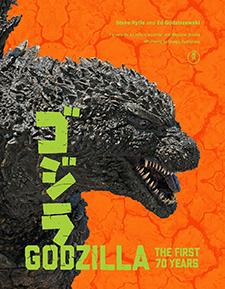

Review
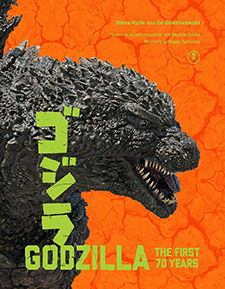
Weighing in at nearly six pounds, Godzilla: The First 70 Years is a coffee table-type book fans of Japanese science fiction films have been dreaming about for decades, a photo-heavy work rife with fascinating and colorful behind-the-scenes images but also with exhaustively researched and carefully considered writing yielding surprising observations and new information.
Godzilla the oldest ongoing movie franchise in film history, though the movies themselves have had a staggeringly varied range of peaks and valleys: from serious-minded movies with the creature a terrifying symbol of atomic terror and total war to Godzilla as goofy savior of the earth, flying and even talking while battling other giant monsters in tag-team wrestling-like matches. Following Ishiro Honda’s 1954 original, a somber film exploring postwar Japan’s tenuous reconstruction while atomic tests and the cold war portend even more unimaginable disasters, the series eventually evolved into colorful Toho Scope showcases for special effects wizard Eiji Tsuburaya’s miniature effects, expertly-crafted films that drew audiences of all ages. Concurrent with the decline of Japan’s film industry, the Godzilla series of the late-1960s increasingly became fodder for teenage moviegoers and finally kiddie matinees, Toho’s “Champion Matsuri” film festivals of the 1970s, before seemingly going kaput in 1975.
But Godzilla never really dies, and his revival in 1984 launched a new wave of “Heisei” era productions, many quasi-remakes that mixed nostalgia with Hollywood-influenced plot elements and technically improved (though not necessarily better) effects. By the later, “Millennium” series entries, the films became pretty dire and Toho licensed the character to Hollywood, whose movies had far bigger budgets but which also, somehow, proved far worse. Then Toho’s team of artists and craftsmen showed up the Americans with Shin Godzilla and Godzilla Minus One, movies made for less than $15 million but which looked as good or better than Hollywood Godzilla films costing 20 times as much.
Authors Steve Ryfle and Ed Godziszewski have lived and studied this genre for more than half those 70 years, Godziszewski the editor and publisher of Japanese Giants, one of only two major American fanzines that, way back in the 1970s, took Godzilla and his brethren seriously at a time when “serious” film critics scoffed and even most general audiences regarded Japanese sci-fi as a punchline. Godziszewski, however, went so far as to interview filmmakers and visit Japanese movie sets beginning in the late-1970s, long before Japan became everyone’s favorite tourist destination. Ryfle, meanwhile, a fan since his mother took him to see Godzilla vs. the Smog Monster in 1972, wrote Japan’s Favorite Mon-Star: The Unauthorized Biography of “The Big G,” the first book of its kind.
Together they collaborated on scads of special features content for DVDs and Blu-ray discs, including numerous audio commentaries and Bringing Godzilla Down to Size, the first major documentary in English about Japanese-style special effects. Later they co-wrote Ishiro Honda: A Life in Film, from Godzilla to Kurosawa, an extraordinarily detailed and insightful biography of the man who not only helmed many of the best films to feature Godzilla, Rodan, Mothra and other kaiju, but which gave equal footing to Honda’s life and war years, his documentaries and humanist feature films, and who later became one of Akira Kurosawa’s closest collaborators.
Godzilla: The First 70 Years is a landmark of sorts as the first major work officially sanctioned by Godzilla’s home studio, Toho Co., Ltd., whose logo appears prominently on its cover. That company, far more litigious and difficult than any other Japanese film company, perhaps more than any film company anywhere in the world, is notoriously difficult to please, thwarting multiple past efforts to allow, let alone endorse, any English-language tomes about their trademarked characters. Books announced by major and minor publishers were cancelled; others were heavily altered, use of photos was forbidden, lawsuits threatened. The legally compromised title of Ryfle’s previous Godzilla book is but one such example.
Another example: at a pre-release screening of Godzilla 2000, my pal the late, great Michael Schlesinger, who supervised the U.S. version on behalf of Sony, was apoplectic. Toho’s legal department had signed off on this revamped, newly-dubbed edition, and prints had been struck ahead of its limited theatrical release. But the day of that screening, Mike told me, Toho now insisted that a question mark Mike had added to “The End?”—an amusing homage to older sci-fi classics like The Blob—now had to be removed, no matter that it would cost many thousands (tens of thousands) of dollars to replace that single graphic from the already-struck prints.
Full disclosure: I’ve been friends with Steve Ryfle for more than 30 years, and Ed Godziszewski for nearly as long. I’ve watched them grapple on-and-off with Toho and their lawyers, Toho always with the upper hand, they like explorers hacking their way through a thick jungle with machetes. And so, in one sense, Godzilla: The First 70 Years is like a hard-earned victory lap for these indefatigable, infinitely patient kaiju eiga scholars. For the first time in English, they’ve realized a Godzilla book with thousands of images from Toho’s own vaults. Though Japanese-language Godzilla books published in Japan are comparatively commonplace, this is really the first of its kind, and Ryfle and Godziszewski don’t disappoint.
The bulk of the work consists of entries on each of the 33 Japanese-made Godzilla films, with a generous number of images of publicity photos and behind-the-scenes shots taken on the floor of the special miniature effects stages, Toho’s special effects crews working on miniature buildings and military hardware, and of course the monster suits, hand puppets and marionettes (e.g., Mothra). These are supported by other images including conceptual artwork, posters, script excerpts and the like. Detailed essays on each film take the reader from conception through release of each picture, quoting from screenwriters, directors, special effects directors and cameramen, suit actors, and music composers that, quite often, the authors themselves interviewed.
Given how extensively covered the genre has received in the past 35 years, one is surprised by how much new information Godzilla: The First 70 Years offers. Particularly interesting are the many multi-page sidebar essays, which explore in detail everything from the art of monster suit acting to unmade films to detailed histories of Toho’s special effects unit and its changes through the decades in both personnel and studio space; essays about the production design, optical effects, music scoring, even still photography.
Despite an accentuate-the-positive tone to these entries, even for the worst films, a tone that might have been mandated by Toho, the authors’ genuine interest and affection for all Godzilla movies is inarguably genuine, and more than anything else, that’s what makes it a pleasure to read. That also holds true for the book’s contributors: director John Carpenter and Godzilla series actress Megumi Odaka pen affection forewords, while longtime Toho producer Shogo Tomiyama (successor to the legendary Tomoyuki Tanaka) writes the book’s afterword.
Ryfle and Godziszewski succeed in walking a difficult tightrope, creating a book published not just for hard-core Godzilla fans but a broader, more general readership, probably especially those who scoffed at the older films when they played dubbed and butchered on television yet gobsmacked by just how well-made Shin Godzilla and Godzilla Minus One are, and who are now more curious about what this whole Godzilla thing is about. Their writing is impressively detailed yet perfectly accessible even to the casual fan, many of whom will be surprised by how sophisticated, even artful, the makers of the Godzilla films are, no matter the genre’s long-standing disrespectability.
While the layout and overall design is attractive, with full and even two-page photos revealing much detail—What, no fold-out centerfold of Godzilla’s one-time opponent, Ebirah, Horror of the Deep?—to accommodate the flashy design, including quotes from the filmmakers in extra-large font, some of the images have been reduced to the size of postage stamps. Further, while few will probably complain about the dominance of behind-the-scenes photos of miniature cityscapes, explosions, and suit actors climbing in and out of their heavy costumes, there are fewer images of the live action main unit with its human characters. Almost certainly this is due to Toho’s overly-cautious policy of obtaining permission from the original actors (or their estates) for each and every use, even though the photos were in most every instance taken by the company’s own still photographer.
These, however, are minor complaints. Godzilla: The First 70 Years is a feast of well-written essays and thousands of fascinating, fun images. It’s the book western-world fans have been craving for decades, a hefty treasure trove of all things Godzilla, spanning a 70-year “career” that’s just getting started.
- Stuart Galbraith IV