
Fred Astaire Collection (Blu-ray Review)
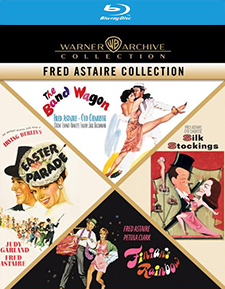
Director
Charles Walters/Vincente Minnelli/Rouben Mamoulian/Francis Ford CoppolaRelease Date(s)
1948-1968 (February 17, 2026)Studio(s)
Metro-Goldwyn-Mayer/Warner Bros.-Seven Arts (Warner Archive Collection)- Film/Program Grade: See Below
- Video Grade: See Below
- Audio Grade: See Below
- Extras Grade: B+
- Overall Grade: A-


Review
The great Fred Astaire (1899-1987) knew he was a great dancer, but after the mid-1940s—when this four-movie set commences—he almost chronically worried, needlessly, that he was getting too old in every department. Yet, even as late as That’s Entertainment, Part II (1976), dancing with Gene Kelly, Astaire, nearly 80, still had the Right Stuff. Yet Astaire was particularly dismissive of his considerable talent as a singer (more as an interpreter than his voice). MGM’s orchestrations were always very brassy and contemporary; classic songs from the ’10s and ’20s were always arranged to conform with the ’40s and ’50s, during the Arthur Freed years, but in 1953 Astaire recorded one of the all-time great albums (originally four LPs) called The Astaire Story, produced by Norman Granz for his Clef Records. Ingeniously if improbably Astaire teamed with Oscar Peterson on piano (other greats included Charlie Shavers, Flip Phillips, Ray Brown, and others) and his talent shined in those LPs in a way that most of his MGM work only hints at.
Astaire announced his retirement in 1946, during the production of Blue Skies, but was coaxed back into films to replace an injured Gene Kelly for Easter Parade (1948), which turned out to be one of his biggest hits ($6.8 million at the box-office against its $2.7 million cost), ultimately keeping him active in major movie musicals for another ten years. Though Judy Garland gets top-billing, Astaire dominates throughout.
It’s Broadway c.1912, and dancer Nadine Hale (Ann Miller) is sick of playing second fiddle to star dancer Don Hewes (Astaire). He thinks he’s love with her but she has eyes for Don’s best friend, Johnny (Peter Lawford). When Nadine announces she’s breaking her partnership contract, after insisting that he can replace her with anyone, Don decides to get even—and ultimately win Nadine back—by hiring saloon floor show dancer/waitress Hannah Brown (Judy Garland) to replace her. Hannah literally can’t tell her left foot from her right, and Don ludicrously tries to reshape her into the exotic “Juanita,” but once he realizes they’re better off with Hannah remaining Hannah, the partnership begins to click. Hannah, of course, falls madly in love with Don, but he treats her like a business expense, not realizing that he loves her, too—and not Nadine.
The plot is almost incidental to the Irving Berlin songs, many written by Berlin at the time the story is set, along with Garland’s singing and Astaire’s dancing. Particularly his dancing. Following an innocuous, very MGM-style number called Happy Easter, centering around models wearing exotic hats—one of them is Lola Albright, later of Peter Gunn; Joi Lansing is, reportedly another, though I didn’t spot her—immediately after is one of Astaire’s all-time great show-stoppers: Drum Crazy, set in a toy store where, to get a boy to part with a big stuffed rabbit Don wants to give to Nadine, he turns the boy onto drums by dancing and playing them simultaneously. His fluid, even uncanny timing is adept as a drummer as he is light on his feet, a wonder.
Another swell solo dance number is Steppin’ Out with My Baby, which incorporates a mesmerizing process shot of Astaire dancing, fluttering like a bird and defying gravity, in slow-motion while the dancers behind him dance at normal speed. That’s followed by the memorable duet with Garland, both dressed as bums, for A Couple of Swells, and Astaire dances with Miller for It Only Happens When I Dance with You. For her part, Miller does the outstanding Shakin’ the Blues Away, reportedly filmed in a back-brace after her then-husband threw her down a flight of stairs—you’d never know it.
The film cleverly circumvents Garland’s limitations as a dancer relative to Astaire by making her character’s dancing merely adequate. She’s funny and despite their age difference has good chemistry with Astaire, but curiously she has no big emblematic Garland-style solo number, unless one counts I Want to Go Back to Michigan. Her weight (and hair color) fluctuate noticeably; she’s clearly overweight in unflattering costumes in the early scenes but by the Easter Parade finale, she’s svelte like her Meet Me in St. Louis days.
The costumes and make-up don’t help the film. Both Garland and Miller wear makeup so thick and unnatural it could have been applied with a trowel. Combined with Garland’s mostly garish costumes, at times she looks like the studio-imagined “Vicki Lester” of A Star Is Born before James Mason lathered on the cold cream. More successful is the clever choreography that disguises the long and short of it, as it were—4’11” Garland wearing heals bringing her up to Astaire’s level, Miller losing the heels to avoid towering over him.
Warner Archive’s presentation of Easter Parade, first released in 2013, is mostly excellent, if a little erratic. Filmed in three-strip Technicolor, the bright primary colors have an almost unearthly “pop” at times, though the aforementioned heavy makeup of the female leads is a little distracting. Audio is DTS-HD Master Audio 1.0 mono, with optional English subtitles.
The repurposed extras, all from the DVD, include the following: an audio commentary by Ava Astaire McKenzie (Fred’s daughter) and John Fricke (Garland biographer); a 34-minute 2005 documentary, Easter Parade: On the Avenue; dailies and outtakes from Mr. Monotony, a number cut from the film; a four-minute radio promo and trailer; and a March 11, 1951 Screen Guild Radio Theater broadcast, featuring Astaire, Garland, and Lawford.
EASTER PARADE (FILM/VIDEO/AUDIO/EXTRAS): A-/A-/A/A-
A total delight from stem to stern, Vincente Minnelli’s The Band Wagon (1953) gets my vote as the best MGM musical of the (producer) Arthur Freed era. It kind of does for the Broadway stage what Singin’ in the Rain did for the silent-to-talkie picture transition, but The Band Wagon is less broad, more wittily adult, and its semi-biographical aspects lend it an authentically personal quality Singin’ in the Rain lacks.
Tony Hunter (Astaire), formerly a top (and top-hatted) star of movie musicals, worries that he may be washed-up, not having made a new film in three years, but his good friends Lester and Lily Marton (Oscar Levant and Nanette Fabray) have cooked up a Broadway show ideal for Tony’s comeback. Further, they’ve piqued the interest of the hottest name on the Great White Way, actor-director Jeffrey Cordova (Jack Buchanan), so hot he’s got three shows running simultaneously, one even starring himself.
Cordova, however, has an overpowering, almost maniacal exuberance, immediately declaring (while also misinterpreting) Lester and Lily’s light musical comedy a brilliant reinterpretation of the Faust legend. Tony is dubious about Cordova’s lofty ideas, but cedes to Lily’s enthusiasm, especially when Cordova manages to swing a deal with acclaimed ballerina Gabrielle “Gaby” Gerard (Cyd Charisse), whose boyfriend/choreographer Paul Byrd (James Mitchell), also joining the company, had refused all previous offers for Gaby to appear in a “mere” Broadway musical.
Though Tony soon falls in love with Gaby, the rehearsals are a disaster, the show soon unrecognizable from Lester and Lily’s original concept, and an out-of-town tryout is comparable to the Broadway premiere of Springtime for Hitler. Can their show be saved?
From Astaire’s wistful opening solo (By Myself) at Grand Central Station to its quick transition to the invigorating Shine on My Shoes, with Astaire teamed with Leroy Daniels, a real singing and dancing New York shoeshine man making his film debut, The Band Wagon is one great number after another, most of the songs from past Howard Dietz/Arthur Schwartz musicals, though That’s Entertainment! was written by them specifically for the film. In the later Silk Stockings, director Rouben Mamoulian attempted to express emotion more through dance than dialogue or narrative, but The Band Wagon’s Dancing in the Dark, with Astaire and Charisse, does this far better than anything in Mamoulian’s film. Other songs and dance numbers are almost as wonderful, including the charming I’ll Guess I’ll Have to Change My Plans with Astaire and Buchanan, Louisiana Hayride with Fabray, and all three in baby attire for Triplets.
The film’s secret weapon is Jack Buchanan, British stage star, singer-dancer, and occasional director. Loosely suggested by Jose Ferrer, Cordova might have been insufferably pretentious but Buchanan’s performance and the Betty Comden-Adolph Green screenplay turn him into a hilariously harmless force of nature. In one of the funniest scenes of any 1950s movie, Tony, Lester and Lily, and elsewhere Gaby and Paul, debate the wisdom of a musical Faust while Cordova pitches the project to a party of rich investors. One-by-one they open various doors to find the theatrical genius acting out the story to the would-be angels, whipping himself into a side-splitting state of near-hysteria.
The semi-autobiographical aspects add to the film’s charms: Tony’s professional self-doubts, believing he’s too old and out-of-touch as the musical form changes around him, just like Astaire; Levant and Fabray playing, essentially, Adolph Green and Betty Comden; former ballerina Charisse playing one here, etc. Further, the company’s struggles through rehearsals and tryouts, while funny, have an appealing authenticity somewhat more reminiscent of Warner Bros.’s backstage musicals of the pre-Code era, rather than the usual MGM backstage story.
Warner Archive’s Blu-ray, derived from the original Technicolor separation negatives, is a knockout; the riot of color throughout, especially in the Shine on My Shoes number, set in a color arcade, really pops off the screen. The DTS-HD Master Audio 5.1 mix is another major pleasant surprise. Many assume, wrongly I think, this was originally released monophonic; while I’m not aware of Warner Archive’s source for this stereo mix, throughout 1953, even before the unveiling of CinemaScope that autumn, many 3-D titles and big studio pictures offered stereo mixes in the bigger theaters, often using interlocked systems. Regardless, the mix here is a knock-out (and supported by optional English subtitles).
Extras, most if not all from earlier DVD incarnations, consist of an audio commentary track with Liza Minnelli and Michael Feinstein; Get Aboard! The Band Wagon, a 37-minute featurette featuring members of the cast and crew; The Men Who Made the Movies: Vincente Minnelli, a 58-minute PBS documentary from 1973 featuring the director; the one-reel short Jack Buchanan with the Glee Quartet; the cartoon The Three Little Pups, and a trailer. All of this material is sourced from standard-def.
THE BAND WAGON (FILM/VIDEO/AUDIO/EXTRAS): A/A/A/A-
Something is decidedly off about Silk Stockings (1957), produced by Arthur Freed for MGM, albeit independently this time, a film its makers strained to insist was not a remake of the classic Ernst Lubitsch romantic comedy Ninotchka (1939) with Greta Garbo. Rather, it’s a very loose adaptation of the 1955 Broadway musical of the same, Cole Porter’s last, itself adapted from Melchior Lengyel’s story. Yet, comparisons are inevitable.
In Paris, American film producer Steve Canfield (Astaire) wants classical Russian composer Peter Ilyich (Wim Sonneveld), on tour in the City of Lights, to compose the score for his latest film, an absurdly loose adaptation of War and Peace starring musical swimming star Peggy Dayton (Janis Page), obviously a spoof of Esther Williams. However, three Soviet commissars—Bibinski (Jules Munshin), Brankov (Peter Lorre), and Ivanov (Joseph Buloff)—have arrived to escort him back to Moscow.
Steve contests Ilyich’s Russian citizenship and wines and dines the Soviet trio with decadent capitalistic indulgences to stall for time, but back in Moscow the new Commissar of Art (George Tobias) dispatches no-nonsense Nina “Ninotchka” Yoschenko (Cyd Charisse), a dedicated communist, to bring the composer back. Faced with a much greater challenge, Steve conspires to charm her into submission.
Astaire’s previous film, Stanley Donen’s Funny Face, with Audrey Hepburn, was released just five months prior to Silk Stockings, earlier in 1957. Both films are set in Paris, but Funny Face was actually made there, energetically and in splendiferous VistaVision, with Fred singing and dancing all over picture-postcard Paris. Further influenced by the photography of Richard Avedon, visually-speaking that film is a total delight. By contrast, Silk Stockings is flat, notably stagey and at times virtually inert—it almost plays like an early talkie—with most of the story set in drab hotel suites. Funny Face is a riot of Parisian flavor, but Silk Stockings barely goes outside, and when it does it’s the usual MGM backlot streets and precious little of even that.
The Lubitsch Ninotchka of 1939 satirized political extremism, but by the 1950s the tone had shifted to a kind of smug superiority of western materialism, though Astaire’s appealingly flippant characterization mitigates this some. Nevertheless, the movie plays less like a remake of Ninotchka than a musical reworking of Jet Pilot, Howard Hughes’s notorious anticommunist film with Janet Leigh as the dedicated Soviet fighter pilot wooed by John Wayne tempting offers of Coca-Cola and Palm Springs resorts. Unlike Billy Wilder’s subsequent One, Two, Three (1961), the only attempt to contrast Soviet extremism with American philistinism is through Janis Page’s character, but while she’s delightful in a way, her character is gaudy and gauche instead of pointed and funny. It’s Only Fair Weather (1955) does something similar in its satire of American commercial television with Dolores Gray’s character, but where that set piece is quite hilarious, Page’s scenes make no impact at all.
In its troubled transition to the screen, Rouben Mamoulian, who hadn’t directed a film in a decade (though he was active on the Broadway stage during the interim), conceived the film more as a musical where emotion and even narrative would be expressed primarily through dance, though the finished film, at nearly two hours, is nonetheless extremely talky and excessively long. Indeed, the last act is excruciatingly protracted and the picture could’ve lost 30 minutes, easily.
Regardless, where the Broadway production starred non-dancer Hildegard Kneff, otherwise an intriguing casting choice, Mamoulian needed a dancer, and so opted for Cyd Charisse. Undeniably sexy and a great dancer, Charisse was excellent in her previous pairing with Astaire, The Band Wagon, and outstanding in It’s Always Fair Weather, her number Baby You Knock Me Out being a highlight. But in Silk Stockings the dramatic weight of the film rests on her shoulders, and while she’s not bad, neither is she really up to it. She lacks Garbo’s exoticism and her looks are emphatically American.
Of the dozen musical numbers, only All of You, maybe Cole Porter’s last great song, stands out, though Stereophonic Sound, in which every 1950s widescreen and color process gets a shout-out, is fun if overlong. (The Blu-ray recreates the effect used in the original 4-track magnetic stereo prints: During the phrase, “Glorious Technicolor, breathtaking CinemaScope, and stereophonic sound,” the words “stereophonic sound” are directed to the surround speakers.) Charisse’s Satin and Silk pushes the boundaries of the Production Code, while The Ritz Roll and Rock attempts to show younger audiences that Astaire was hip to new musical trends and, by golly, what might have been a horribly embarrassing number, Astaire somewhat successfully sells it through his dancing. (Then again, what’s a motion picture producer doing on stage in the end, starring in a musical show?)
In panned-and-scanned TV airings and early home video releases, Silk Stockings always looked terrible. Warner Archive’s Blu-ray of this color and CinemaScope production mostly fixes those issues, though the video transfer still lacks the clarity of other high-def transfers of CinemaScope titles from this same period. The color, though not helped by the art direction, are more vibrant, but the image is both a little softer and grainier than usual. Conversely, the DTS-HD Master Audio 5.1 remix impresses throughout. English subtitles are provided, and like the other discs this one is Region-Free.
Extras include the 10-minute featurette Cole Porter in Hollywood: Satin and Silk; Paree, Paree, a Vitaphone musical comedy short from 1934 with Bob Hope and Dorothy Stone; the 1955 short Poet and Peasant Overture featuring the MGM Symphony Orchestra; and the film’s trailer.
SILK STOCKINGS (FILM/VIDEO/AUDIO/EXTRAS): C+/A-/A/B
Finian’s Rainbow (1968) is one strange movie musical. At times genuinely magical, at other times inexplicably awkward, it adapts the then-progressive 1948 E.Y. “Yip” Harburg-Burton Lane-Fred Saidy Broadway show just as traditional movie musicals were bombing left and right, threatening the solvency of the studios that financed them. In downtown movie palaces, in theater-killing, months-long roadshow engagements, with few exceptions they played to empty houses. Further, the new wave of European-influenced filmmakers, on pictures like Bonnie and Clyde, The Graduate, In Cold Blood, Point Blank, 2001: A Space Odyssey, and Rosemary’s Baby (all released in the months prior to Finian’s Rainbow), made this gentle fantasy-musical, partly about racial intolerance, appear hopelessly quaint, if not outright ridiculous.
Attempts to update the 20-year-old show probably only made things worse. Bearded, often shirtless director Francis Ford Coppola was at 28 young enough to be the son or grandson of the disgruntled old-timers that made up most of his crew. Harburg changed one of the leads from a Woody Guthrie-type union organizer of sharecroppers to a kind of folk singer leader of what resembles a hippie commune, no matter that the racially-diverse community is trying to get rich perfecting mentholated tobacco, or that the actor playing Woody, Don Francks, seems to have been cast partly because he resembles a rougher, tougher Gene Kelly.
And yet Finian’s Rainbow has so many wonderful qualities—an excellent cast headlined by Fred Astaire, charming in his last musical; great songs, most staged with imagination, all beautifully sung; superb second unit work by Coppola’s UCLA classmate Carroll Ballard—that its charms outweigh the problems of adapting material probably impossible to adequately adapt no matter how one approached it. Warner Archive’s Blu-ray gives Finian’s Rainbow the best presentation possible, marginally better even than the 70mm blow-up this reviewer saw nearly 45 years ago. Good extras accompany the feature.
Roguish Irishman Finian McLonergan (Astaire) has stolen a pot of gold from a manic leprechaun named Og (Tommy Steele), absconding to the mythical State of Missitucky, where Finian plans to bury the crock near Fort Knox, in the belief that his stolen fortune will multiply. Accompanying him is his long-suffering daughter, Sharon (Petula Clark), and the two settle in Rainbow Valley, where Woody Mahoney (Francks) is spearheading the efforts of African-American botanist Howard (Al Freeman, Jr.) to develop mentholated tobacco so that everyone in the village can get rich. Meanwhile, racist Sen. Rawkins (Keenan Wynn), having learned about the buried gold, abuses his authority in attempt to steal away the land. Elsewhere, Woody and Sharon’s blossoming love is further complicated when Og falls for Sharon, too.
The 1947 Broadway musical had been a big hit, running 725 performances and winning several of were the very first batch of Tony Awards. MGM had wanted to film it, apparently with Mickey Rooney pegged for the role of Og, but Harburg, who wrote the lyrics and co-wrote the book, wanted too much money and creative control. John Hubley began an animated feature adaptation, supplementing the talents of the Broadway show’s stars with heavyweights including Frank Sinatra, Ella Fitzgerald, Oscar Peterson, and Louis Armstrong, but the pro-union, pro-civil rights themes of the story and Hubley’s blacklisting put a sudden end to financing, though recordings of the soundtrack survive. The project kicked around with various production companies until Warner Bros. snapped up the film rights, intending the modestly-budgeted ($4 million) Finian’s Rainbow to follow their big-budgeted Camelot ($13 million).
The resulting film is a peculiar blend of traditional and new Hollywood, with established actors like Astaire and longtime choreographer Hermes Pan at odds with Coppola. Astaire reportedly balked at being asked to dance in real grassy fields “with cow dung and rabbit holes” while Coppola found Pan’s choreography old-fashioned and eventually fired him. (Most of the dancing in the film looks like Pan’s work, however.)
Further, the odd, compromised look of the film alternates between utterly unreal soundstage “exteriors” and backlot sets, including some interiors lit comparatively naturally. The mix of all-out fantasy (such as all the magical business with Og) and broad social commentary (with Freeman’s botanist coached on how to talk and move like a stereotypical black servant) never coalesces. Would Finian’s Rainbow play better had the filmmakers committed to one extreme or the other, embracing the fantasy aspects completely or opting for a much harder-hitting, realistic approach? My guess is that neither would have worked, either.
Finian’s Rainbow might have been a colossal artistic failure if not for all the disparate wonderfulness in its favor. For starters, the Harburg-Lane songs are great, and cinematically staged by Coppola. Look to the Rainbow, How Are Things in Glocca Morra?, Old Devil Moon, and If This Isn’t Love are all standards, but even lesser numbers like The Begat and This Time of the Year are lively and memorable.
At the time of its release, reviewers were unduly harsh on Fred Astaire, who was 68 at the time and hadn’t made a musical since Silk Stockings a decade earlier. Truth is he’s marvelous, charming and droll as the wily Irishman, but also full of energy in every scene he’s in, even when surrounded by dozens of extras and nearly lost in the crowd. His dancing, cow dung notwithstanding, is as effortlessly graceful as it always was. In other words, contemporary critics were nuts.
Clark, Steele, and Francks were all new to the world of Hollywood musicals, but Clark and Steele had long been making smaller scale movies in Britain, and all three are fine singers, a welcome change from the ’60s trend to cast big stars who couldn’t and hire anonymous others to dub them. Some find Steele’s toothy, maniacal leprechaun hard to take (Mickey Rooney, just as energetic, would have been insufferable), but on a second viewing one begins to appreciate his finely tuned clowning. Astaire seems to have greatly admired all three, and it’s a shame the genre tanked when it did or they might have enjoyed big careers as Astaire’s generation had.
Also outstanding is the second unit work, particularly the magical opening titles sequence, shot all over the U.S. mostly using doubles of Clark of Astaire, directed primarily by Ballard, though incorporating footage of the principals shot by Coppola. (Including, briefly, their stroll near the schoolhouse from Hitchcock’s The Birds, in Northern California.)
Filmed in 35mm Panavision, often with shallow-focus compositions, Finian’s Rainbow was blown-up to 70mm for roadshow engagements, some reviewers inaccurately critical that the blow-ups cut off Astaire’s feet at the ankles (when, in fact, the optical conversion cut of the sides, not the top and bottom of the frame). The Blu-ray, running 2 hours and 25 minutes in all, includes the original (and quite short) overture, intermission, entr’acte, and exit music, using video culled from the DVD release. The image looks great with strong color throughout, and the 5.1 DTS-HD Master Audio remix from the original 6-track magnetic stereo original is generally excellent, though I found myself adjusting the volume throughout. The disc is Region-Free and optional English subtitles are included.
Supplements include Coppola’s on-camera introduction and audio commentary from the earlier DVD release, a trailer, and a 30-minute New York premiere special, featuring interviews with most of the cast.
FINIAN’S RAINBOW (FILM/VIDEO/AUDIO/EXTRAS): B+/A/A/B
As always with these four-in-one sets, if you have none or maybe one of these, the reduced price for the quartet makes release very appealing, and it takes up less shelf space besides. Highly Recommended.
- Stuart Galbraith IV