
Demonwarp (4K UHD Review)
- Review Date: Mar 25, 2026
- Format: 4K Ultra HD
-


Director
Emmett AlstonRelease Date(s)
1988 (March 31, 2026)Studio(s)
Design Projects Inc/Vidmark Entertainment (Vinegar Syndrome)- Film/Program Grade: C
- Video Grade: A-
- Audio Grade: B+
- Extras Grade: A-

Review
While the phrase “Bigfoot movie” may conjure up fairly narrow impressions in the minds of most people, the true cryptid aficionado knows that the sky’s the limit where the mythical shaggy beasts are concerned. Cryptid cinema in general and Bigfoot/yeti movies in particular can tell any kind of story in nearly any context: horror, comedy, drama, romance, found footage, full pseudo-documentary, Hitchcock pastiche, and even elegiacal meditations on aging (seriously, if you’ve never seen The Man Who Killed Hitler and Then the Bigfoot, stop whatever you’re doing right now and rectify that situation, stat). If it’s true that you can do anything in an animated cartoon, then it’s no less true with Bigfoot movies, cartoonish or not.
Yet there’s a subset of the Bigfoot subgenre that’s harder to classify, but in lieu of any kind of official designation, let’s call it “gonzo Bigfoot movies.” These are films that are so off the wall that they don’t just defy description, they beggar belief. James C. Wasson and Jim L. Ball’s indescribably weird 1980 effort Night of the Demon is probably the godfather of that sub-subgenre, although Michael Findlay’s equally bizarre Shriek of the Mutilated actually predated that film by six years. But since Findlay managed to make a gonzo Bigfoot movie without an actual Bigfoot in it, Night of the Demon probably still holds the crown as the spiritual antecedent for every gonzo Bigfoot movie that followed. And that brings us to Demonwarp.
Produced eight years after Night of the Demon for home video distributor Vidmark Entertainment, Demonwarp definitely follows in the Demon’s giant footprints (even if it falls short in at least one regard, but hold that thought for a moment). Harry and the Hendersons had been a modest hit the previous year, and that doubtless factored into Vidmark’s belief that there was money to be made in them thar cryptid hills, but Demonwarp is no family-friendly adventure. Instead, it’s loaded with all the requisite nudity and gore that were the hallmark of direct-to-video horror fare, taking full advantage of the laxer standards that tended to be applied to DTV titles (well, at least until Blockbuster Video became something of a de facto MPAA ratings board of its own, but that’s a story for another day).
Demonwarp was the brainchild of makeup effects guru John Carl Buechler, who wrote the first script and was originally slated to direct. But he ended up leaving the project after creating the Bigfoot costume and two other creatures (never fear, we’ll get to those in a moment, too). Jack Palance was hired to provide some aging star power as a supporting character, but he also left the production only to be replaced at the last minute by George Kennedy (who insisted that his daughter Shannon be hired as well). Ultimately, Jim Bertgesa and Bruce Akiyama were brought in to completely rewrite Buechler’s script in just two weeks, while Emmett Alston (New Year’s Evil) took over at the helm. According to Bertges, at least, Alston was just collecting a paycheck and he wasn’t really interested in the project, but his direction is certainly serviceable enough for a gonzo Bigfoot movie. (Alston would probably dispute Bertges’ assessment of his work, but there’s oral histories for you.)
Buechler’s script wasn’t particularly coherent in the first place, and while the rewrite from Bertges and Akiyama improved on many aspects, intelligibility wasn’t one of them. Yet the utter narrative incoherency of Demonwarp is one of its manifest charms. The story, such as it is, weaves together three different primary threads: one group of campers in the woods in and around Bronson Canyon (David Michael O’Neill, Pamela Gilbert, Billy Jayne, Hank Stratton, and Colleen McDermott); another pair of babes in the woods (Michelle Bauer and Shannon Kennedy); and, well, George Kennedy. (Oh, and there’s also a random fourth interloper played by Larry Grogan who was added during reshoots in order to pad out the running time, but never mind him.) The one thing that ties them all together is a particularly vicious Bigfoot with a penchant both for ripping people’s heads off and also for quality home electronics (just not necessarily in that order).
If all of that still seems like relatively straightforward Bigfoot fare, then just wait until the final act of the film when all four wheels come off the wagon and the rest of the story gleefully drives off a narrative cliff—and just like Thelma & Louise, it never lands again. Pardon the mixed metaphors, but they seem curiously apt for a mixed bag like Demonwarp. Those who know, know, but for those who don’t, let’s just say that Demonwarp isn’t a Bigfoot movie that tells any kind of story in nearly any context; instead, it tries to tell all stories in a single context. Bigfoot, werewolf-style bladder transformations, zombies, aliens, spaceships, religious cults, you name it, it’s all here. All that, plus a generous dose of a topless Michelle Bauer screaming her best Scream Queen lungs out. What more could a growing boy want?
Yet if there’s one flaw that keeps Demonwarp from being the gold standard of gonzo cryptid cinema, it’s that it takes far too long before it completely loses its mind. Night of the Demon didn’t even wait a half hour before offering its notorious dick-ripping sequence, so by the time that its daemonic Bigfoot rips out someone’s intestines and starts wielding them like a whip, audiences were already primed to expect the unexpected. Demonwarp, on the other hand, offers an abundance of gore throughout and plenty of female nudity to go along with it, but despite a few early hints that something even stranger might be going on, it still feels like relatively conventional Bigfoot exploitation fare right up until the moment that it doesn’t.
Oh, Demonwarp is still gonzo, alright, but for a film that features Bigfoot, transformation scenes, flesh-eating aliens, cultic priests, heart-ripping human sacrifices, zombies, meteorite spaceships, and George Kennedy, it’s simply not gonzo enough for the first two thirds of its running time. And yet... there’s still that deliriously demented final third of the film, which simply can’t be denied. No, Demonwarp isn’t the gold standard for gonzo bigfoot movies due to the fact that it takes too long to get to that point, but once it does, hoo boy. It’s the main reason why Demonwarp has maintained a modest cult following despite the fact that it hasn’t been particularly easy to track down for many, many years now. Fortunately, it’s now been resurrected in full 4K, giving future generations of cryptid cinema fans the opportunity to utter the immortal words that should always be elicited by any true gonzo Bigfoot movie:
“WTAF?!?”
Cinematographer R. Michael Stringer shot Demonwarp on 35mm film using Arriflex cameras with spherical lenses. (The effects unit used an Arriflex 2C, and presumably that was the same camera used on the main shoot, but I couldn’t verify that fact.) As a Vidmark production that was always intended primarily for the home video market, Stringer protected the full 35mm frame for open-matte 1.33:1 versions, but he also framed it so that it could be matted to 1.85:1 for theatrical release. (It’s not entirely clear if Demonwarp was ever screened domestically, but it was supposedly released theatrically overseas.) This version is based on a 4K scan of the original camera negative, digitally cleaned up and graded for High Dynamic Range in both Dolby Vision and HDR10. While most people experienced Demonwarp on VHS back in the day, it was no shot-on-video production, and this remastered 4K version serves as a great reminder that the budget of a film has little to do with its visual quality. 35mm is 35mm, and as long as the lenses, filters, or stocks don’t get in the way, it transfers to 4K beautifully.
Everything here is razor-sharp and crystal clear, with all of the fine textural details like the costuming, gravel, rocks, blades of grass, leaves, and even Bigfoot hairs being perfectly delineated. There are little to no signs of any remaining damage, at least not in motion, and no signs of any significant compression artifacts either. The contrast range, black levels, and densities are all excellent. If there’s one criticism, it’s that the flesh tones can be a little inconsistent, looking natural in most shots and just a bit too pinkish in others, but nothing ever veers into blatant oversaturation. Now, given that fact that Demonwarp has been largely MIA on home video since its original release and the only available versions since then have been VHS rips, this is automatically an improvement over anything and everything else that preceded it. But don’t let that low bar fool you; this is still an amazing remastering job. Demonwarp may not be a monumental film, but this is a monumental upgrade for it.
Audio is offered in English 2.0 mono DTS-HD Master Audio, with optional English SDH subtitles. It’s also generally clean and clear, with no noise or distortion, but there is a glitch in Don Slider’s music during the opening titles at 3:24. The same piece of music is used for the menus on the disc and it has the identical glitch in it, so it’s something that was baked into the elements. Similarly, there’s significant warbling in the score during the finale, but once again that’s probably something inherent to the mix that can’t be fixed.
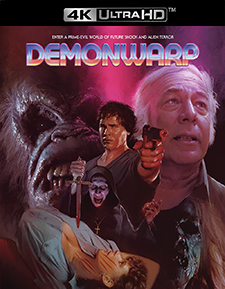
The Vinegar Syndrome 4K Ultra HD release of Demonwarp is a two-disc set that includes a Blu-ray with a 1080p copy of the film. The insert is reversible, featuring new artwork designed by Robert Sammelin on one side and the theatrical poster artwork on the other. Vinegar Syndrome is also offering a Limited Edition version featuring a spot gloss slipcover designed by Sammelin that’s available directly from their webstore and at a few select retailers, limited to 7,000 units. Either way, the following all-new extras are included, all of them in HD:
DISC ONE: UHD
- Commentary with Emmett Altson and Richard L. Albert
DISC TWO: BD
- Commentary with Emmett Altson and Richard L. Albert
- Beasts & Breasts (19:09)
- Some of It Was Stupid (25:08)
- Of Aesthetic Beauty & Bigfoot (36:45)
- Composing Demonwarp (27:07)
- Audio Interview with Hank Stratton (36:31)
- FX Gallery (10:07)
- Still Gallery (3:00)
The commentary with director Emmett Altson and producer Richard L. Albert is moderated by Jim Branscome from the Cinematic Void series at the American Cinematheque. They cover the prehistory of Demonwarp, its production, and its release (they confirm that it did play theatrically, at least overseas, but they’re still not clear about domestic screenings). They discuss the locations, the makeup and visual effects, the reshoots, and the experience of working with George Kennedy—and unsurprisingly, they have nothing but praise for Michelle Bauer, who was always game for anything. They also explain how the rights for the film were locked up when Lionsgate purchased the Vidmark catalogue, and since Lionsgate wasn’t interested in doing anything with it, that’s why it’s been MIA for so many years. But the rights finally reverted to the filmmakers, and that’s why we now have this glorious 4K version of Demonwarp.
Beasts & Breasts is an interview with the aforementioned Michelle Bauer, who discusses how her career as a scream queen developed (although she elides her early Pia Snow days, jumping straight from her modeling career to Fred Olen Ray’s The Tomb). She then shares her experiences on Demonwarp, including working with George Kennedy and the rest of the cast. She also describes the challenges of working with the makeup and the locations (she really did run barefoot through Bronson Canyon). The only other cast member appearing in this set is Hank Stratton, who joins via an audio-only interview by extras producer Ewan Cant. He gives an overview of his background and his experiences on Demonwarp, going all the way forward to his current position as the director the Johnny Carson School of Theatre and Film at the University of Nebraska.
Of Aesthetic Beauty & Bigfoot is with cinematographer R. Michael Stringer, who opens by recounting how he ended up backing his way into the film business and working his way up. He says that on low-budget shows, you have to be a jack of all trades, and that’s the best way of learning the trade. And on low-budget films, they’re shooting a schedule, not a script, so any aesthetic beauty is above and beyond keeping the schedule—you have to work quickly and do what you can in the time allotted. He admits to making some mistakes in lighting parts of Demonwarp, but he’s still pleased with it overall. This is a fantastic interview, with Stringer sharing decades of acquired wisdom in gentle, matter-of-fact fashion.
Some of It Was Stupid is with co-writer Jim Bertges, who traces the rewrite process for the script after he came on board the project. He admits that the structure of the story is weighted toward the final act—he quotes from a review of the film that said it was like a bowl of homemade soup: bland on top, with all the good stuff sunk to the bottom. Personally, Bertges feels that Demonwarp is as crappy as it ever was, but it’s still entertaining. (Hang on until the end for an appearance from a special guest star that’s spent decades boxed up in his garage.) Composing Demonwarp is with composer Dan Slider, who talks about his background in doing music rights clearances before making his scoring debut on Demonwarp. He was given free rein to do whatever he wanted to do, although like Stringer, he says that it was all about getting the work done on schedule. He also discusses the equipment that he used and his career since working on the film. (He’s been the main composer for America’s Funniest Home Videos for decades now.)
Finally, in addition to a regular Still Gallery, there’s an FX Gallery that’s narrated by visual effects producer Mark Wolf. He primarily focuses on the foreground miniature work for the crashed meteorite seen during the prologue, but he also covers the spaceship set and the monsters during the finale. All that, plus a story about how he never got his wristwatch back from George Kennedy.
Needless to say, there aren’t any missing extras here for the simple reason that there haven’t ever been any extras for Demonwarp. There haven’t been any legitimate releases of the film, full stop, ever since the VHS days. The only disc version that I could uncover was a 2020 double feature DVD that included The Church, but that was a Frolic Pictures release of questionable provenance (they’re not above releasing VHS rips on DVD, so their version of Demonwarp was probably also a rip). There wasn’t even a LaserDisc for it back in 1988. So, it goes without saying that Vinegar Syndrome’s 4K Ultra HD release of Demonwarp is a cause for celebration for cryptid cinema fans. For that reason alone, it’s one of the best releases of 2026 so far. The fact that it looks as good as it does and has a great slate of extras is only the icing on the cake. It’s highly recommended for anyone with a penchant for gonzo Bigfoot movies (you know who you are).
- Stephen Bjork
(You can follow Stephen on social media at these links: Twitter, Facebook, BlueSky, and Letterboxd).