
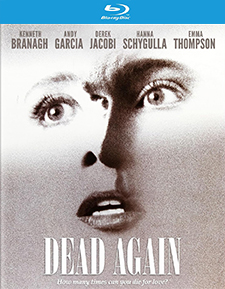
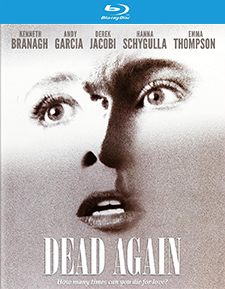
Dead Again (Blu-ray Review)
Director
Kenneth BranaghRelease Date(s)
1991 (March 17, 2026)Studio(s)
Paramount Pictures (Kino Lorber Studio Classics)- Film/Program Grade: B
- Video Grade: A
- Audio Grade: A
- Extras Grade: A

Review
Perhaps the best film about reincarnation is The Mummy, starring Boris Karloff. That film told of an ancient Egyptian mummy disentombed in the 1930s who comes back to life and finds the living re-incarnation of the woman he loved. In 1991’s Dead Again, a modern take on the effect of past lives on the living, a detective must discover the identity of an amnesiac terrified by nightmares of a murder that occurred more than forty years earlier.
Los Angeles private investigator Mike Church (Kenneth Branagh) agrees to help an amnesiac he calls Grace (Emma Thompson) uncover her true identity. The case leads to a decades-old murder involving wealthy composer Roman Strauss (Branagh again) and his wife Margaret (Thompson).
Church isn’t having much luck until an antique-dealing hypnotist (Derek Jacobi) turns up and transports Grace back into a past life, where she discovers she was Margaret and was stabbed to death in her bed. As they work to solve the mystery of her present identity, Grace and Church fall for each other. But with each successive hypnosis session, Grace becomes convinced that Church is the re-incarnation of Roman and is fated to kill her again.
Branagh and Thompson have a field day juggling four roles between them. With German and English accents in the past and American accents for the contemporary tale, they get a chance to show off their acting skills. Branagh’s Roman is more effective than his Church because he tends to overact in his attempt to capture the rough-talking gumshoe of classic noir. His Roman displays a range of emotion and is more believable as a troubled musical genius. A small mustache and beard distinguish his appearance as Roman.
As the amnesiac, Thompson is mute and perpetually terrified until the first hypnosis session. When she finally speaks, her words reflect a soul slowly trying to piece herself together. As Grace, Thompson speaks with an American accent. As Margaret, she has a British accent, further separating the two roles. Her hair, make-up, and clothing styles differentiate the periods. She effectively displays a range of emotion, equally comfortable as a woman gradually discovering her identity and an affluent wife of a musical genius.
The film is given added prestige by an excellent supporting cast. Andy Garcia plays journalist Gray Baker, the only character who lives through both time periods. Baker’s newspaper articles in the 1940s about the murder lead Church to Baker’s nursing home half a century later. Robin Williams plays an eccentric former psychiatrist whose home-away-from-home is a grocery store’s meat locker. Hanna Schygulla plays the Strauss’ housekeeper Inga, who was responsible for getting Roman out of Germany. Wayne Knight plays Church’s friend “Piccolo” Pete, who supplies welcome comic relief in addition to some crucial information. Campbell Scott has a brief role as Grace’s apparent fiancé.
Scott Frank’s screenplay is complex with many characters and two time periods. Scenes in black & white denote the 1940s and full color is used for the 1990s. This device helps clarify time periods but not the considerable complexities of the plot. The tone shifts between Gothic melodrama and near parody, which might keep the viewer from becoming fully invested in the story. Branagh may have undertaken too onerous a task, not only as the director, but also the lead actor in dual roles. The film winds up being more an exercise in technique and smart cinematic touches than an emotional exploration of a mystery from years past. It brandishes its cleverness, whereas more subtlety would have improved the tone.
Dead Again requires that viewers pay attention. The heavy dialogue, which some may find exhausting, drops clues throughout, along with red herrings and intentional distractions. Branagh succeeds in not telegraphing key revelations before they occur, adding to the story’s fascination. There’s a chase and a fight scene in the modern story that takes place outdoors, opening up the mostly interior sequences. The finale becomes pretty intense and violent, building suspense through deft editing, with the use of Patrick Doyle’s feverish score.
Dead Again was shot by director of photography Matthew F. Leonetti on 35mm film with Ultracam 35 cameras and Cooke lenses, processed photochemically by Technicolor, Hollywood, and presented in the aspect ratio of 1.85:1. The Blu-ray from Kino Lorber Studio Classics is sourced from a brand new HD master from a 4K scan of the original camera negative, approved by director Kenneth Branagh. The black & white sequences are reminiscent of classic film noir, with bold shadows and back lighting. These stand out in style from the more routine color footage. Clarity is sharp and details, such as hair, piano keys, closeups of scissors, costumes at a masked ball, fabric patterns, and architectural features are well delineated. In the color footage, complexions are rendered naturally. The camera pans in lengthy takes until it focuses the viewer on characters who are speaking key dialogue.
Audio options include English 5.1 and 2.0 DTS-HD Master Audio, with optional subtitles in English SDH. Dialogue is clear throughout. As Roman Strauss, Branagh speaks with a German accent, while Thompson’s Margaret Strauss speaks with a British accent. Sound effects include Church’s sports car zooming around town, bodies being pummeled in a fight, screams, thunder and lightning, and ambient party noise. Patrick Doyle’s score has a driving rhythm that enhances the narrative and creates an air of anticipation. His opera appropriately accompanies the movie’s melodramatic finale.
Bonus materials on the Blu-ray release from Kino Lorber Studio Classics include the following:
- Audio Commentary by Kenneth Branagh
- Audio Commentary by Lindsay Doran and Scott Frank
- Trailers:
- Dead Again (2:21)
- The Gingerbread Man (2:19)
- Internal Affairs (2:00)
- The Two Jakes (3:09)
- After Dark, My Sweet (2:17)
- Snake Eyes (2:23)
- The Underneath (2:07)
- Twilight (2:27)
- The Usual Suspects (2:28)
- The General’s Daughter (2:21)
Commentary #1 – Director Kenneth Branagh wanted to establish the film’s atmosphere immediately. The newspaper headlines title sequence presents clues and sets up the noirish Gothic story. It was designed to let the viewer know the film is “out there,” and took months to edit. The song Lush Life, heard in the opening, has an atonal feel to it. After directing Henry V, Branagh received many scripts, and he was intrigued by Dead Again because of its complexity. He felt black & white was necessary to separate the past events from the present. The combination of Hitchcock touches, music, and the Gothic mood leads to a “visceral ride.” Branagh speaks about Robin Williams and the unusual choices he made to present a sinister quality. Because many of the characters are made to look as if they have something to do with the mystery, Branagh emphasizes that the viewer must listen carefully to the dialogue. In long takes, camera movements were carefully choreographed so the camera would be on the right character as he or she spoke. Campbell Scott was co-operative in rehearsing his brief scene. He had to be immediately convincing. Branagh notes that it’s difficult to provide visual texture under bright California sunshine.
Commentary #2 – Producer Lindsay Doran and screenwriter Scott Frank offer their thoughts in this shared commentary. Dead Again was tested with the entire film in black & white and it “flowed better.” It was important to make both the front and back stories equally compelling, and intended to have wit and be over the top. Emma Thompson’s accent was always a concern. The child actor Gregor Hesse, who plays Frankie, the housekeeper’s pre-teen son, had to learn to stutter for the role. The commentators discuss decisions made for particular scenes, references to other films, and how audiences reacted to different scenes. Subjective and objective points of view had to be carefully observed in editing. Visual references to scissors in a character’s art work were so heavy-handedly numerous that audiences laughed, completely changing the mood of the film, so the set design had to be toned down. Various Los Angeles filming locations are identified. Securing footage of a scissors murder for the film Inga is watching on TV proved to be too costly, so a scene from Sorry, Wrong Number was used instead. The finale required great attention to repetition, alternate camera angles, and editing to make the revelation of the murder mystery clear. The final fight was choreographed precisely so actors wound up in the right place at the right moment. Patrick Doyle wrote the opera that’s heard on the soundtrack during the finale.
Dead Again is a challenge for mystery aficionados in that it’s hard to unravel and keeps you guessing. The re-incarnation theme is necessary to the film but seems gimmicky. Either story, fully developed, would have made a more satisfying picture. Casting himself and Thompson as the leads seems more like ego gratification and nepotism than traditional matching of role to actor, since Kenneth Branagh was married to Emma Thompson at the time. Branagh is shaky as Church, but more effective as Roman. Thompson’s deer-in-the-headlights stare gives way to a more nuanced performance as the amnesiac. Her Margaret is far more interesting. With plenty of theatricality, Dead Again is an intriguing excursion into murder, passion, and reincarnation... if you can keep track of its shuttling narrative.
- Dennis Seuling