
Breaking Glass (Blu-ray Review)
- Review Date: Jul 17, 2025
- Format: Blu-ray Disc
-


Director
Brian GibsonRelease Date(s)
1980 (June 24, 2025)Studio(s)
Allied Stars (Fun City Editions)- Film/Program Grade: B+
- Video Grade: A-
- Audio Grade: B+
- Extras Grade: B+

Review
When we first glimpse Kate (Hazel O’Connor) in writer/director Brian Gibson’s Breaking Glass, she’s riding one of the trains on the London Underground, surrounded by bored fellow passengers with their noses stuck in their newspapers. She’s a relatively unknown musician struggling to make a name for herself, sticking up flyers for her next gig on the walls of the compartment. As the opening credits roll, her song Writing on the Wall can be heard playing on the soundtrack—or is it really just non-diegetic background music? It does seem to start out that way, but she’s nodding her head in rhythm with the beat, and then a moment later, she suddenly turns to face the camera and sings the next part directly to the audience:
“Life, I’m told’s a compromise
Lethargy in disguise
Excuses by the faint of heart
Stuck in the mud before they start
I say sir, wouldn’t you rather be on top of the world
As opposed to always traveling underneath the ground?”
She’s telling us exactly how she feels, and yet at this point of the story, she doesn’t understand the price that she’ll have to pay in order to be on top of the world. By the end of the film, she’ll be back in the Tube, this time surrounded by her newfound adoring fans and some painful ghosts from her past, with reality and artifice blending together once again. Only this time, she’s the one who can’t tell the difference between the two, and she ends up suffering a complete mental breakdown. She couldn’t see the writing on the wall until it was too late.
Or at least, that’s how Breaking Glass concluded when it opened in the U.K. By the time that it made its way across the Pond, North American distributor Paramount Pictures had made some minor cuts throughout the film and one major cut to the ending. Gibson’s intentional parallelism between these two moments was gone, replaced by something else entirely—and yet, the ending of the North American version still works in its own way. But we’re getting ahead of ourselves; back to everything else that leads to that point.
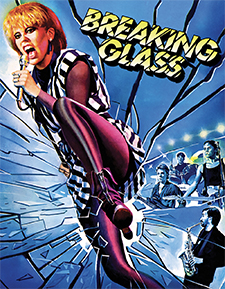
After Kate gets off the train at the beginning of the film, she has a fateful encounter with Danny (Phil Daniels), a lowly chart fixer who offers to be her manager. They put together a backing band named Breaking Glass, consisting of Ken (Jonathan Pryce) on saxophone, Tony (Mark Wingett) on guitar, Dave (Gary Tibbs) on bass, and Mick (Peter-Hugo Daly) on drums. Yet their real struggle begins once they start to navigate the music business. Kate is inspired by the social unrest around her, writing songs that reflect class differences, racial issues, increasing mechanization, and governmental oppression. Her music is catchy but a bit too edgy for the mainstream, yet she resists any attempts to blunt her message. Her career takes a turn when she starts working with legendary producer Bob Woods (John Finch), which drives a wedge between her and Danny. Will Kate stay true to herself, or sell out for the sake of success? Breaking Glass also stars Mark Wing-Davey, Derek Thompson, and Nigel Humphreys (watch for Richard Griffiths and an impossibly svelte Jim Broadbent in small cameos).
Brian Gibson may have written the script for Breaking Glass, but Hazel O’Connor wrote the songs, and as a result, she’s as much the author of the film as he is. Her lyrics, personality, and style inform the story to such a degree that it’s sometimes difficult to separate the actor from the character that she’s playing (and in a sad but completely unsurprising irony, a bad contract with her own record company resulted in her battling them for years over royalties for the Breaking Glass album). She contributed twelve songs that drive the film as much as anything else: Writing on the Wall, Monsters in Disguise, Come into the Air, Big Brother, Who Needs It, Will You?, Eighth Day, Top of the Wheel, Calls the Tune, Blackman, Give Me an Inch, and If Only. The social criticism in the film is a natural outgrowth of the social criticism in her music.
While If Only has arguably had the most legs over the decades since the film was released, it’s the spectacular staging of her U.K. chart-topping single Eighth Day that closes the film. At that point, Kate has turned her back on Danny and half of the band, polished the rough edges off of her lyrics, and become a pop icon. Her travails to achieve that kind of success have taken their toll, and she has to be drugged in order to perform. Eighth Day is a pastiche on the seven days of creation in Genesis, with Man having the hubris to create machines in his own image to make a better world for everyone. Yet on the Eighth Day, machine gets a mite upset at the way that it’s been treated, igniting a global apocalypse in order to purge mankind from the face of the earth:
“He said, ‘Behold what man has done
There’s not a world for anyone
Nobody laughs, nobody cries
World’s at an end, everyone has died
Forever amen, amen, amen!’”
It’s an appropriate way to end the film. Kate has stripped her own world of her friends and loved ones, selling out everyone and everything on her path to the top. It’s a triumphant moment musically and commercially, but that triumph is a hollow one. In the U.K. version, she comes to realize that fact too late, running off the stage and jumping back onto the Underground, which is where she has her complete mental and emotional breakdown. That’s followed by a bittersweet coda in which Danny visits her at the mental hospital, trying to make a connection with her, and perhaps more importantly, to connect her back to the music that she loves. As the closing credits roll, Kate is still unable to speak, but there’s at least a glimmer of hope that music might eventually bring her around again. It’s a rags to riches and back to rags again story, with just a tiny bit of light at the end of the tunnel.
Paramount cut all of that out of the North American version, ending the film with Kate still on stage as the crowd goes wild after her performance. Does that mean that this version of the film ends triumphantly? It might have, but intentionally or not, Paramount opted to roll to credits on a freeze frame of Kate’s face, and the moment that they chose says otherwise. There’s a pained expression on her face, almost a haunted one (it’s actually a repeated frame from an earlier moment in her performance). The effect is arguably worse—instead of realizing what she’s become and having a breakdown, she knows full well what she’s become but is willing to live with it. The North American version isn’t a rags to riches story, but rather a story about “what shall it profit a man, if he shall gain the whole world, and lose his own soul?”
So which version is better? There’s no simple answer to that question. Familiarity is always a factor, so watching the original U.K. cut can be a bit jarring after having seen only the North American version for more than four decades. Yet when trying to analyze them objectively, there’s still no simple answer. The reality is that both endings work; they just work in different ways. And they’re both a part of the history of Breaking Glass, so it’s great that they’ve both been preserved regardless of which version that you might prefer.
Cinematographer Stephen Goldblatt shot Breaking Glass on 35mm film using Panavision cameras with anamorphic lenses, framed at 2.39:1 for its theatrical release. This version is a new digital restoration and reconstruction of the original U.K. cut from the “best available film elements,” with all work performed by Paramount Archive. Details are scant, but Paramount appears to have created a new preservation master of the U.S. cut from its color reversal internegative, while the extended scenes for the U.K. cut were scanned from an archival print held by the British Film Institute. In any event, the added footage blends in pretty seamlessly. There’s still a fair amount of minor damage visible like light speckling and other small debris (at one point, what appear to be splice marks creep in at the bottom edge of the frame). Most of that damage is of the single-frame variety, so it’s not particularly noticeable unless you go looking for it.
The optically printed opening credits are naturally a bit soft, but once they’re over, fine details are better resolved than they were on the old Olive Films Blu-ray of the U.S. cut. The contrast range is improved as well, with less of a tendency toward crushed detail in the blacks. When Danny first meets Kate in the alley outside the club, details in his face and his clothing are more visible as he moves in and out of shadow—but nothing’s been unnaturally boosted, either, as the blacks stay deep and true. It’s just the benefits of better film elements. The colors all look accurate, too; the pink and purple lighting inside the club during the opening scene is vivid but never oversaturated. Even setting aside the invaluable reconstruction of the original U.K. cut, this is a major visual upgrade for Breaking Glass.
Audio is offered in English 2.0 DTS-HD Master Audio, with optional English subtitles. Breaking Glass was released theatrically in Dolby Stereo, and this sounds like the original matrix-encoded four channel mix (so be sure to engage your decoder). It’s still a naturally front-focused mix, with the surrounds limited to crowd noises and other ambient effects. Unfortunately, there’s not much deep bass in the music, but to be fair, the soundtrack album(s) have never exactly plumbed the depths, either. Regardless, you’ll want to nudge the volume up in order to get the full effect—Breaking Glass needs to be experienced LOUD.
Fun City Editions’ Limited Edition Blu-ray release of Breaking Glass includes a slipcover and a 12-page booklet with an essay by Margaret Barton-Fumo. It’s only available directly from FCE and DiabolikDVD. (The wide release version omits the slipcover, and note that either way, the booklet is limited to the first pressing and won’t be reprinted.) The packaging has been done with FCE’s usual flair, featuring different theatrical poster artworks on both sides of the insert and still another one on the slipcover. The booklet is designed to look like a music magazine from the era, with faux Breaking Glass tour dates on the back. The following extras are included, all of them in HD:
- Audio Commentary with Marc Edward Heuck
- A Movie People Will Be Talking About (18:33)
- The Experience Is Shattering (15:31)
- Image Gallery (18:26)
- Scenes from the North American Version:
- Text Introduction (:52)
- Overlord Record Party (:37)
- Music Machine Intro (:21)
- Music Machine Performance (:19)
- Mixing Booth (:20)
- Riot and Aftermath (:39)
- Calls the Tune (:35)
- Kate and Danny Argue (:09)
- “Danny Quits” Montage (1:55)
- Tormenting Ken (:25)
- U.S. Ending (6:37)
Mark Edward Heuck provides a new commentary for Breaking Glass, examining the complicated history of the film, including its prehistory and eventual release in different forms. He does break down the differences between the two version, although his comments on the scenes from the U.K. cut were recorded later and cut in (the disc may have been in production before Fun City Editions was able to secure the rights to the longer version). He provides some helpful cultural history about what was happening in the U.K. at the time, which had gone through a series of strikes during what came to be known as the Winter of Discontent between 1978 and 1979. Heuck identifies all of the actors in the film, including the cameos, and even identifies the various pieces of background music in the film like the De Wolfe Music library tracks. He also notes what personal details ended up working their way into the story, and traces the personal challenges that Hazel O’Connor underwent after the film was released. (For the record, Heuck agrees with me about the value of the North American ending.)
A Movie People Will Be Talking About is an interview with producer Davina Belling, who says that her career in theatre and film was a reaction against her safe, middle-class upbringing. She describes the path into becoming an independent producer during that era, and that she and her partner Clive Parsons wanted to make films that people would talk about. They did just that with Breaking Glass, and she explains how the project evolved as the creative team came together—especially once Hazel O’Connor’s songs became its centerpiece. She also details where she and Clive were hands on as producers and where they left that creative team alone.
The Experience Is Shattering is a visual essay by Chris O’Neill, focusing on the historical context that surrounded the making of Breaking Glass. The strikes during the Winter of Discontent had led to the rise of Margaret Thatcher, which only exacerbated some of the social unrest during that era. He also discusses the way that the film presents the music industry, and breaks down some of the differences between the two versions.
Finally, in addition to a comprehensive Image Gallery, there’s a collection of all the scenes that were altered for the North American version of the film, including the abbreviated ending. Most of them are shorn by mere seconds, so it might have been helpful to have had the option for a side-by-side comparison in order to see the differences. Naturally, the most overt changes were made to the concluding scene, so it’s nice to have the U.S. ending preserved here for those of us who may prefer it. (As a side note for those who own the Olive Films Blu-ray, this version of the ending has the correct audio with the sounds of the crowd fading into a reprise of Eighth Day as the credits roll. Olive’s disc inadvertently used the audio from the U.K. cut, which resulted in the background noises of the train playing over the credits instead.)
There’s also at least one Easter Egg on the disc: a trailer for another upcoming Fun City Editions title, hidden in an appropriate spot. Taken as a whole, that’s a pretty nice slate of extras for a film that’s barely ever had any. The only extra that has appeared elsewhere is an interview with Hazel O’Connor that was on the Region 2 DVD from Strike Force Entertainment in the U.K. While it’s not included here, the new extras more than make up for it. This is also the first time that the original U.K. cut of Breaking Glass has been available in HD, which is a pretty big deal. Still, it’s nice that Fun City Editions has preserved the alternate scenes from the North American version, especially the ending (for those of us who just won’t let go of it). This is a fantastic release, preaching to the choir for those of us who are already fans of Breaking Glass, and hopefully gaining a few new ones in the process. It’s highly recommended.
- Stephen Bjork
(You can follow Stephen on social media at these links: Twitter, Facebook, BlueSky, and Letterboxd).