
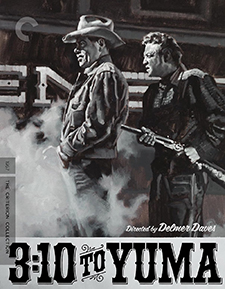
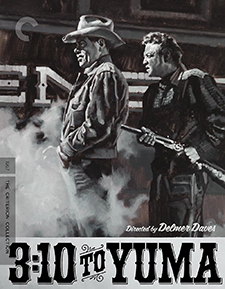
3:10 to Yuma (4K UHD Review)
Director
Delmar DavesRelease Date(s)
1957 (February 3, 2026)Studio(s)
Columbia Pictures (The Criterion Collection – Spine #657)- Film/Program Grade: A
- Video Grade: A
- Audio Grade: B+
- Extras Grade: D

Review
Delmar Daves’ 3:10 to Yuma wasn’t the first Elmore Leonard adaptation to reach the big screen—that honor went to Budd Boetticher’s Randolph Scott Western The Tall T, released just a few months earlier—but in many ways, it set the template for how to handle Leonard’s prose in cinematic fashion. That’s ironic, considering the fact that Leonard’s short story only covered the last half the film, with everything that preceded it being the invention of screenwriter Halstad Welles instead. But Welles drew more than just that slim narrative kernel from the short; he also absorbed Leonard’s dialogue and approach to characterization. As a result, 3:10 to Yuma feels like pure Elmore Leonard from the very first frame of the film, despite the fact that it takes 45 minutes from that point to reach anything that was actually written by the author.
Leonard’s short story Three-Ten to Yuma first appeared in Dime Western Magazine in 1953, which was one of the various pulp periodicals to which he had been selling his work at the princely sum of $.02 a word. Most of it is set in a hotel room in Contention, Arizona, where deputy marshal Paul Scallen is holed up with his prisoner, Jimmy Kidd. They’re waiting for the train to arrive later in the afternoon, which will end up taking Kidd the rest of the way to the jail in Yuma. They’re aided by Wells Fargo representative Mr. Timpey, but he’s only there to represent the bank’s interests, not to handle a gun. While waiting, they have to fend off the relative of one of Kidd’s victims and Kidd’s other gang members like Charlie Price, who are staking out the hotel from outside. When the train finally arrives, Scallen has to work alone while running the gauntlet between the hotel and the station.
In Welles’ adaptation, Paul Scallen has been changed to Dan Evans (Van Heflin), a struggling rancher who is roped into being deputized against his better judgment, but he needs the money in order to support his wife Alice (Leora Evans) and their two sons. Jimmy Kidd is now the notorious outlaw Ben Wade (Glenn Ford), although his second-in-command Charlie Price (Richard Jaeckel) got to retain the name that Leonard devised. Not so Mr. Timpey, who has been transformed into Mr. Butterfield (Robert Emhardt), the owner of the Butterfield Stage Line, which is held up at the beginning of the film by Wade’s gang. That holdup also sets the stage (no pun intended) for Evans’ interactions with Wade, since he witnesses the robbery while tending cattle with his sons. Leonard’s short story is further fleshed out with the addition of Emmy (Felica Farr), a bartender in Bisbee who draws Wade’s eye (and also provides an explanation for why he is captured), as well as other members of law enforcement like the drunken deputy Alex Potter (Henry Jones). But despite all of these additional details, all roads still lead to that hotel room in Contention City, where Evans has to sweat out the long wait for the 3:10 to Yuma.
The names and some of their backgrounds may have been changed, but the characters still feel like pure Elmore Leonard. Van Heflin was the perfect choice to play Evans, building on the type of internally conflicted roles that he had already mastered in films like Shane. Yet unlike Joe Starrett in that film, Dan Evans doesn’t feel like his masculinity is being threatened by this particular outsider. He doesn’t interfere with the stagecoach robbery at the beginning, not because he’s afraid, but rather because he’s smart enough to recognize that there’s nothing he can do—he’s outnumbered and has the safety of his boys to consider. While he may appear to be little more than a “lowly” rancher, he clearly has a professional skillset of his own, as he demonstrates (much to Wade’s surprise) later in the film.
No, the conflict that Evans struggles with comes from the fact that he knows that taking this job may end up leaving his family without a husband and a father. But he values his own integrity above all else, and once he takes on a job, he’s going to see it through until the end, however bitter that end may be. Evans gave his word, and he never goes back on that regardless of any temptations that may arise along the way due to the devious machinations of Wade. Yet ironically enough, it’s Wade who ends up saving the day. He has a warped sense of integrity all his own, and despite his attempts to save his own skin by leading Evans astray, he gains a grudging respect for the rancher’s unbreakable resolve. While waiting at the hotel, Evans saves Wade from being murdered by vengeance seeker Bob Moons (Sheridan Comerate), despite the fact that Wade’s death would have let Evans off the hook. In Wade’s personal ledger, that means he owes Evans, and he’ll eventually have the opportunity to pay that debt back even if it results in him making it to that jail cell in Yuma after all.
Still, however much 3:10 to Yuma owes to Elmore Leonard, the screenwriter who adapted him, and the actors who brought these characters to life, the real reason why the film would go on to become a Western classic is thanks in no small part to director Delmar Daves, who was one of the unsung heroes of Hollywood’s version of the old west. His name may not conjure up immediate Western associations in the same the way as those of John Ford, Budd Boetticher, and even Anthony Mann, but he still made indelible contributions to the genre. For 3:10 to Yuma, he relied on stark, high-contrast cinematography from the great Charles Lawton, Jr., and also on the deep focus that Lawton had utilized on Orson Welles’ The Lady from Shanghai. That allowed Daves to contrast the foregrounds from the backgrounds, the interiors from the exteriors, and to use windows and other barriers as framing devices to separate the characters.
It also allowed Daves to keep both Van Heflin and Ford in sharp focus regardless of the distance between them, which helps maintain a visual tension that supports the suspense inherent to their interpersonal conflict. Just like in Leonard’s original short story, there’s not much action in 3:10 to Yuma, but Daves maintains consistent tension throughout the film. Everything feels like a coiled spring that keeps winding tighter and tighter until Evans finally marches Wade to the station under the watchful eyes (and even more watchful guns) of Wade’s gang. 3:10 to Yuma is a deceptively simple film, based on a deceptively simple short story by Elmore Leonard, but thanks to Delmar Daves, it’s a masterclass in using the visual language of cinema to translate the written word. Leonard’s strength was in his terse prose and his unforgettable dialogue, while Daves’ strength was in finding a visual language that matched it. Together, they created one of the most memorable Westerns of the Fifties in 3:10 to Yuma. Simple story or not, it’s a complex film with many layers that take multiple viewings to untangle.
Cinematographer Charles Lawton, Jr. shot 3:10 to Yuma on 35mm film using spherical lenses, framed at 1.85:1 for its theatrical release. (Interestingly enough, a few posters and lobby cards from 1957 have a Magnascope logo on them, but I can’t find any evidence that 3:10 to Yuma was ever cropped for anamorphic projection.) This new 4K master was produced by Sony Pictures Home Entertainment under the supervision of the inimitable Grover Crisp. It’s based on 4K scans of the original camera negative, with digital remastering work done by Cineric in New York and Motion Picture Imaging in Burbank. Grading was handled by MPI, which also created new High Dynamic Range grades in both Dolby Vision and HDR10. With the usual caveat that the titles and any transitions were optical composites and thus were derived from dupe footage that was cut into the camera negative, the bulk of the film looks simply outstanding.
Fine details like the corduroy on Glenn Ford’s coat and even the pilling on Van Heflin’s shirt are razor sharp, and the subtle imperfections in Felicia Farr’s skin are perfectly resolved in closeups. The contrast range is noticeably improved compared to Blu-ray, with deeper blacks that still reveal more information than the older 2K master did. That’s not to say that it suffered from issues with black crush; it’s just that the HDR grades here are able to wring every last bit of subtle gradations out of the raw 4K scans. And contrast is everything in 3:10 to Yuma, with Lawton’s heavily red-filtered cinematography creating striking contrast between the landscapes and the skies, as well as between the interiors and the exteriors (often in the same shot, as the frequent framing devices demonstrate). His use of chiaroscuro was impeccable, and it enhances the deep focus nature of the cinematography.
If there’s a single criticism to be made here, it’s that the grain sometimes looks just a tiny bit harsh and noisy, mostly when seen against the bright skies and clouds of dust. It’s not clear if that’s due to an imperfect encode by NexSpec or else it’s just some residual scanner noise (something that HDR is more prone to revealing). Either way, it’s important to point out that this is being really, really nitpicky, and it probably won’t be noticeable on most displays at normal viewing distances. This is still an outstanding 4K upgrade for 3:10 to Yuma.
Audio is offered in English 1.0 mono LPCM and 5.1 DTS-HD Master Audio, with optional English SDH subtitles. The 5.1 version is processed “fake” stereo with some added reverb in the surround channels, and it doesn’t add much to the experience. The mono version is a much better choice. It was derived from the original 35mm optical tracks, a 35mm mag track, and the original vinyl studio recordings of the score, with digital restoration handled by John Polito at Audio Mechanics in Burbank. The dynamics are strong despite any limitations in the sources, with the sporadic gunfire providing some satisfying bangs. But 3:10 to Yuma isn’t really an action film, and the bulk of the experience is delivered via the dialogue and music. The former is always clear and comprehensible, while the latter (both the score by George Dunning and the title song sung by Frankie Laine) sounds smooth and pure. There’s minimal remaining noise and little or no distortion present.
The Criterion Collection 4K Ultra HD release of 3:10 to Yuma is a two-disc set that includes an umremastered Blu-ray with a 1080p copy of the film. It also includes a 20-page booklet featuring an essay by Kent Jones and restoration notes. The following extras are included (on the Blu-ray only):
- Elmore Leonard (HD – 13:01)
- Peter Ford (HD – 15:04)
The interviews with both participants were originally recorded in 2013. Elmore Leonard starts by discussing the experience of having his first stories published at two cents a word in pulp magazines. From there, he works his way up to selling his stories to Hollywood. He offers some thoughts about the film version of 3:10 to Yuma, including the cast and how he approved of some of Halstad Welles’ additions to his story. (Leonard is far less kind to the changes that were made in James Mangold’s 2007 remake.) Peter Ford, who wrote the biography Glenn Ford: A Life, gives a brief overview of his father’s career, with an emphasis on the Westerns that Glenn did with Delmar Daves. 3:10 to Yuma is Peter’s favorite of all his father’s Westerns, as it demonstrated how Glenn understood his own limitations as an actor and always played to his strengths. Peter also has nothing but praise for Daves.
As extras go, two brief interviews are unquestionably rather slim pickings. Yet in this case, they’re arguably more than enough. Some films stand well enough on their own, and 3:10 to Yuma is exactly that kind of film. It doesn’t need to be overanalyzed, just experienced for what it is—and Criterion’s 4K upgrade is unquestionably the best way to experience this Western classic. Highly recommended.
- Stephen Bjork
(You can follow Stephen on social media at these links: Twitter, Facebook, BlueSky, and Letterboxd).